Get Full Government Meeting Transcripts, Videos, & Alerts Forever!
Get email alerts on the Municipal Budget topic
No spam. Unsubscribe anytime.
Salisbury holds public hearings on FY26 budget; council cites PFAS treatment costs in 6% water and sewer rate increase
Summary
The Salisbury City Council on June 2 opened public hearings on three fiscal year 2026 budget ordinances — Nos. 2935, 2936 and 2937 — and heard residents' concerns about water and sewer increases and fee hikes.
The Salisbury City Council on June 2 opened public hearings on three fiscal year 2026 budget ordinances — Ordinance Nos. 2935, 2936 and 2937 — and heard a string of residents’ concerns about rising utility and fee costs.
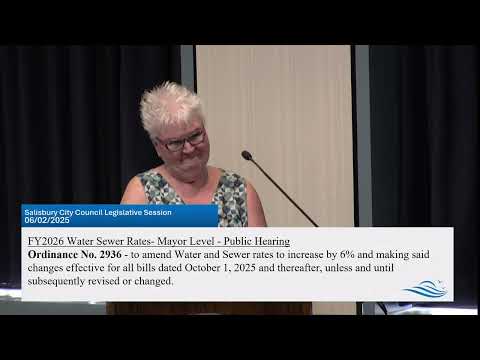
City staff presented Ordinance No. 2935 as the main budget appropriation ordinance for July 1, 2025–June 30, 2026; Ordinance No. 2936 would raise water and sewer rates by 6% effective for bills dated Oct. 1, 2025, and Ordinance No. 2937 would set miscellaneous city fees for FY26. "This is an ordinance appropriating the necessary funds for the operation of the government and administration of the city of Salisbury for the period of 07/01/2025 to 06/30/2026," the staff presenter said during the hearing on Ordinance No. 2935.
Why it matters: dozens of residents described the cumulative effect of utility, trash and stormwater increases on households, especially people on fixed incomes, and urged the council to consider alternatives before finalizing the budget. Council leaders repeatedly said the city faces unusually large capital and operating costs for water treatment tied to PFAS compliance and related debt service.
Most substantive public testimony focused on the water and sewer increase proposed in Ordinance No. 2936. Connie Lewis, who told the council she lives outside the city limits but is hooked to city sewer, traced the water charge increases over several years and said the steady rise is a hardship on a fixed income. "When you're on a fixed income that's — just that little bit is hard," Lewis said. Another resident estimated that, for an average household using 10,000 gallons, costs tied to city charges and related increases have added about $379 per year over the last five years.
Several witnesses urged the council to examine connection-fee waivers for new development, arguing those waivers shift infrastructure costs onto existing ratepayers. Michael Langford and another commenter said new commercial development outside the municipal limits is being connected to the city water system without paying city property taxes, which they said reduces the city’s revenue base and increases the burden on city ratepayers.
Council response: Council President Dowdy said the council and administration negotiated the proposed increase down from an earlier draft of 12% to the current 6%. "Unlike any time in the history of the water, you know, sewer plant, we are spending a tremendous amount of money on that for PFAS. We spent $12,000,000 last year, we're spending $8,000,000 this year," Dowdy said, and added that about $1.5 million of the increase is debt service. He said the city is seeking grants and reimbursement where possible but is trying to remain "ahead of the curve" rather than reactionary.
Other budget comments included a public complaint from Robert Taylor alleging questionable reimbursements on the ledger for items tied to Council President Dowdy (clothings, parade candy and event expenses) and asking the council to review any such reimbursements before adopting the budget. Taylor also urged scrutiny of a proposed additional council staff position. The council did not take a vote on any of the three ordinances at the June 2 hearing; the hearings were opened and then closed after testimony.
What’s next: The council opened and closed public hearings on Ordinance Nos. 2935–2937 during the June 2 session; no final votes on those ordinances were recorded in the transcript. Council members and staff said the budget will return for a formal vote at a later meeting after staff follow-up and additional review. Members encouraged the administration to prepare clearer public materials explaining the drivers of the water and sewer increase — including a breakdown of county versus city accounts connected to the city system — and to publish information about city programs that can help residents with bills.
Votes and formal actions recorded at the meeting: the legislative agenda for the session was adopted by voice vote at the start of the meeting; the three budget ordinances were the subject of public hearings only and were not adopted at the June 2 session.
Ending: City staff and council members said they will provide additional outreach and detail on the FY26 proposals, and the council indicated it expects to consider final adoption at an upcoming meeting after the public hearings concluded.