Get Full Government Meeting Transcripts, Videos, & Alerts Forever!
Get email alerts on the Stormwater Outreach topic
No spam. Unsubscribe anytime.
Eugene participants narrow flyer options for stormwater and climate-friendly yard handout
Summary
Two participants reviewed sample designs and agreed to pursue a simple handout highlighting 7–10 yard practices that support stormwater management and climate-friendly landscaping, with next steps to consult a graphics person and retrieve existing city handouts.
Two participants in an informal Eugene virtual meeting reviewed several sample handouts and sketched next steps for producing a stormwater- and climate-friendly yard flyer.
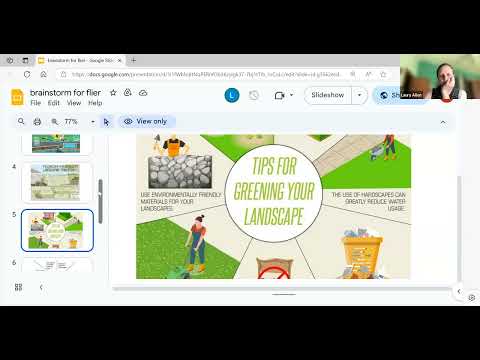
Participant 1, a meeting participant, opened the discussion by sharing a slideshow of sample designs and said the group was “not having an official meeting” but instead “just looking at a draft,” noting some people could not attend. Participant 2, a meeting participant, described the file displayed as a “brainstorm for flyer, and it's a slideshow.”
The group compared two main styles: a landscape “hub-and-spoke” layout showing a simple yard image with labeled climate-friendly actions, and a list-style layout with multiple discrete items (compare/contrast or a simple checklist). Participant 1 said they were “kind of leaning more towards not having the compare contrast” and preferred a single landscape image with callouts for specific actions. Participant 2 said a simpler list-style option would be “easier to create.”
Both participants agreed the front of a handout could be an illustrative image and the back could list resource links. Participant 1 noted existing materials to draw from, saying the city “does have some stormwater content” and that retired staff and organizations such as Friends of Trees and Beyond Toxics have resources that could be included. Participant 2 suggested contacting a graphics person to estimate how difficult either approach would be to produce and offered to email the group with that information.
Practical constraints discussed included keeping the handout uncluttered and limiting the number of recommended items. Participant 1 and Participant 2 suggested a target of roughly seven to ten items (one participant said “I think 10 at the most”) so the flyer would be readable and actionable. They also discussed including examples such as using electric yard equipment and pointing people to stormwater handouts available from the city.
Next steps recorded in the conversation: Participant 2 offered to contact a graphics person and report back by email on differences in effort between the two design styles; Participant 1 said they would try to locate retired stormwater staff files or handouts to mine for content; and the participants planned to reschedule a follow-up meeting with at least one week's notice to comply with the group's scheduling practices. Participant 2 said, “I’ll send an email to try to reschedule.”
No formal votes or official actions were taken during the session; the meeting was explicitly described as informal and a draft review.
The group identified external resources to consult (Friends of Trees, Beyond Toxics, and existing city stormwater materials) and agreed to keep the flyer concise and resource-focused on the back side.