Get Full Government Meeting Transcripts, Videos, & Alerts Forever!
Get email alerts on the School Food Ingredient Regulation topic
No spam. Unsubscribe anytime.
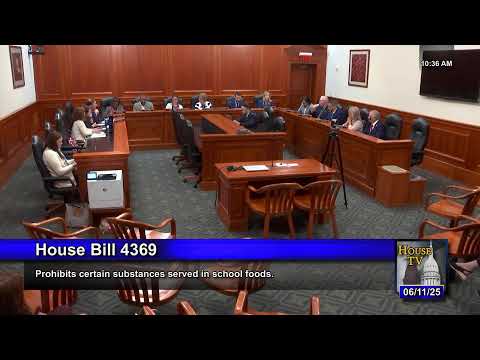
House committee adopts H-3 substitute for bill shifting school food-ingredient vetting to distributors, delays start to 2028
Summary
The House Education and Workforce Committee approved an H-3 substitute to House Bill 4369 that would move ingredient-vetting responsibility from schools to food distributors and food establishments, set an effective date of July 1, 2028, and remove titanium dioxide after expert input.
The House Education and Workforce Committee on an unspecified date adopted an H-3 substitute to House Bill 4369 and voted to report the bill with recommendation. Representative Paquette, the bill sponsor, said the substitute shifts responsibility for vetting ingredients “beyond distributors, food establishment distributors that are providing food to school” so that schools will no longer be solely responsible for ingredient vetting. He also said the substitute pushes the bill’s start date to July 1, 2028, to give affected parties time to prepare, and removes titanium dioxide from the bill after consulting an expert.
The substitute was offered by Representative Paquette and discussed briefly before roll calls. Paquette said he had “some feedback, which we want to make the legislation as strong as possible,” and itemized three changes: assigning the onus to distributors and food establishments, changing the start date to 07/01/2028, and removing titanium dioxide after consultation with Dr. Norbert Kaminski of Michigan State University’s Institute for Integrative Toxicology Center for Research on Ingredient Safety. Paquette said Kaminski “was very convincing in pointing out how titanium dioxide is quite the outlier among the other ingredients, and deemed relatively safe, especially with regard to this. So we removed that.”
Committee roll calls recorded two formal actions on the bill. The clerk’s first roll call on adoption of the H-3 substitute returned a tally the clerk announced as 11 ayes, 0 nays, 0 passes. The committee later voted to report House Bill 4369 as substituted (H-3) with recommendation; the clerk announced that vote as 8 yeas, 0 nays, 3 passes. No amendments or seconds were recorded in the transcript. The committee then adjourned.
The record in the transcript does not provide the bill’s full text, the specific regulatory standards that distributors or food establishments would be required to apply, or whether the change affects enforcement mechanisms. The transcript also does not record any public testimony at this meeting; the committee’s earlier hearing on the bill was mentioned but not repeated here. The committee’s action was limited to adopting the substitute and reporting the bill with recommendation.