Get Full Government Meeting Transcripts, Videos, & Alerts Forever!
Get email alerts on the Municipal Budget topic
No spam. Unsubscribe anytime.
National City council approves package of budget additions with targeted amendments
Summary
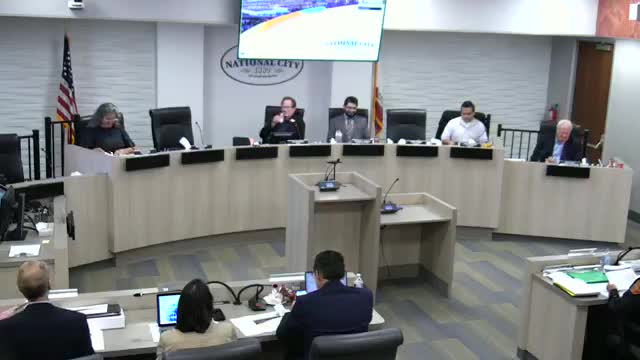
National City’s City Council voted to add a set of staffing and program items to the proposed 2025–26 budget on a motion that included several late amendments, the council said at a special meeting on issues raised at last week’s marathon budget workshop.
National City’s City Council voted to add a set of staffing and program items to the proposed 2025–26 budget on a motion that included several late amendments, the council said at a special meeting on issues raised at last week’s marathon budget workshop.
The council approved a package of mostly ongoing staffing requests and several one-time investments, but trimmed one custodian position from the original request and delayed purchases of some information-technology and radio equipment for later review. Council members also agreed to place a $1,000,000 “city revitalization” seed fund in the economic contingency reserve for future projects rather than charging it to the general fund.
Why it matters: The city presented a proposed general-fund budget with total revenues of about $72.8 million and projected expenditures near $81.0 million, producing a projected general-fund deficit of roughly $8.2 million for the coming fiscal year. The items the council approved are additions to that proposed budget; staff estimated the items discussed at the meeting would add roughly $1.7 million in new costs citywide and about $1.3 million initially to the general fund if all were included. Council members repeatedly emphasized the city’s multi-million-dollar projected shortfall and debated whether to use reserve balances to fund new positions and projects now or to defer until midyear.
Most important actions and details
- Council authorization: The council approved staff’s package of additional staffing and program items (as presented to the council) with the following amendments agreed on the dais: reduce the number of new custodial hires from four to three; reduce the number of community resource/community service officer (CSO) hires in the police department from two to one; keep the requested recreation-center supervisor hires but stagger implementation and revisit at midyear as needed; and move the proposed city revitalization seed fund out of the general fund and into the economic contingency reserve, increasing that seed amount to $1,000,000. The council also held off on funding or directed staff to delay certain operational purchases — specifically, procurement of some 800-MHz radios for neighborhood services and an automated development permit platform — pending further analysis or the midyear review. (Motion text, mover/second: not specified in the meeting transcript; outcome: approved.)
- Budget context and numbers presented by staff: City staff said the proposed budget presented last meeting included $72.8 million in general-fund revenues and roughly $81.0 million in expenditures, leaving a projected deficit of about $8.2 million. Staff said the set of additional items discussed at the special meeting would total roughly $2.9 million across all funds, of which about $1.7 million is a net increase over previously budgeted items; the initial estimated impact to the general fund was roughly $1.3 million. Those figures were cited repeatedly during questions and public comment.
- Staffing and revenue notes discussed in department presentations: Department directors described the operational case behind their requests. Examples discussed during debate: - Public Works asked for additional custodial and maintenance positions; staff explained that custodial positions are funded through an internal facility-maintenance fund and chargebacks to operating funds create an indirect general-fund impact of about 80% of those internal costs. - Fire Department requested a 40-hour fire division chief position to support succession and administrative workload; the chief said it was intended to be largely funded by holding two firefighter positions vacant and by new cost-recovery programs, including a reinstated false-alarm billing program that generated roughly $175,000 in a prior pilot year (2020). Staff reported 297 potentially billable false alarms year‑to‑date and a low-end near-term revenue estimate of about $110,000 from addressing currently unbilled false alarms, if the program is staffed and billed. - Police Department requested two community service/resource officers to handle low‑priority calls and desk work; council members discussed scaling that to one position for immediate funding and revisiting headcount later. - Community Development described revenue-offset strategies (for example a tobacco retail license program) and reported that moving certain homelessness/outreach costs into the housing enterprise fund will relieve general-fund pressure. - Library asked for funding to continue police coverage as a security pilot (20 hours/week) and to replace a two‑decade‑old integrated library system (ILS); the librarian said the ILS would be implemented over 8–10 months and can be paid over two years, and staff will continue to pursue grant funding.
Quotes and attributions (selected)
“Total revenues in the general fund are 72,800,000.0. Projected expenditures are lower 81,000,000. We’re projecting a deficit for next fiscal year of 8,200,000.0,” said Bruce (staff member), summarizing the figures in the budget book presented to council.
“The intent of the fire division chief is that there are department for the departure of my position within this fiscal year… it was a budget neutral position,” Fire Chief Sergio Morrow said, noting the position’s succession-planning purpose and expected cost recovery from other programs.
“We had roughly about a $175,000 as a result of us charging for those false alarms [in 2020],” Morrow said, and later added staff had identified 297 potentially billable false alarms in the current year.
Public comment and community priorities
Speakers in the public-comment period urged the council to consider expanded services for migrants, legal and mental-health clinics, stronger after‑school programming, and protection for tenants who might be affected by federal housing-policy changes. Dion Civello and Ren Sano, both representing immigrant and student advocacy groups, urged that reserves and budget choices account for vulnerable families and programs such as after‑school activities and Section 8 housing supports. Edward Neto urged deeper structural examination of revenues and expenses and cautioned against assuming reserve balances are “healthy” without recognizing committed or restricted portions of those balances.
What the council directed staff to do
Council members asked staff to: (a) bring back midyear updates with actuals and potential savings from current vacancies; (b) continue pursuing fee and cost‑recovery programs (for example false‑alarm billing and updated inspection fee schedules); (c) develop an implementation plan and criteria for the city revitalization fund that will return to council for approval before any expenditure; and (d) provide more detail on hiring timelines for the positions included in the approved package.
Background and next steps
Staff said many budgeted positions remain vacant and that filling vacancies will be staggered; HR described typical recruitment timelines and said some of the approved positions can be filled faster because eligibility lists already exist. Council members asked that staff return with midyear financial results and recommended quarterly updates on progress toward cost recovery and any reserve draws. The city manager said consultants are preparing additional analysis around service‑fee structures and development-project playbooks and that staff will return with more detail in August.
Ending
The council’s vote authorizes staff to add the approved items to the proposed budget subject to the amendments and directions recorded on the dais. Staff will return with implementation details and midyear financial updates. Several council members emphasized their continued interest in short‑term revenue generation and in revisiting longer‑term structural issues at the next scheduled budget and policy update meetings.