Get Full Government Meeting Transcripts, Videos, & Alerts Forever!
Get email alerts on the Zoning Variance Hvac topic
No spam. Unsubscribe anytime.
Board approves variance for HVAC contractor at 2454 North Illinois Street over staff objections
Summary
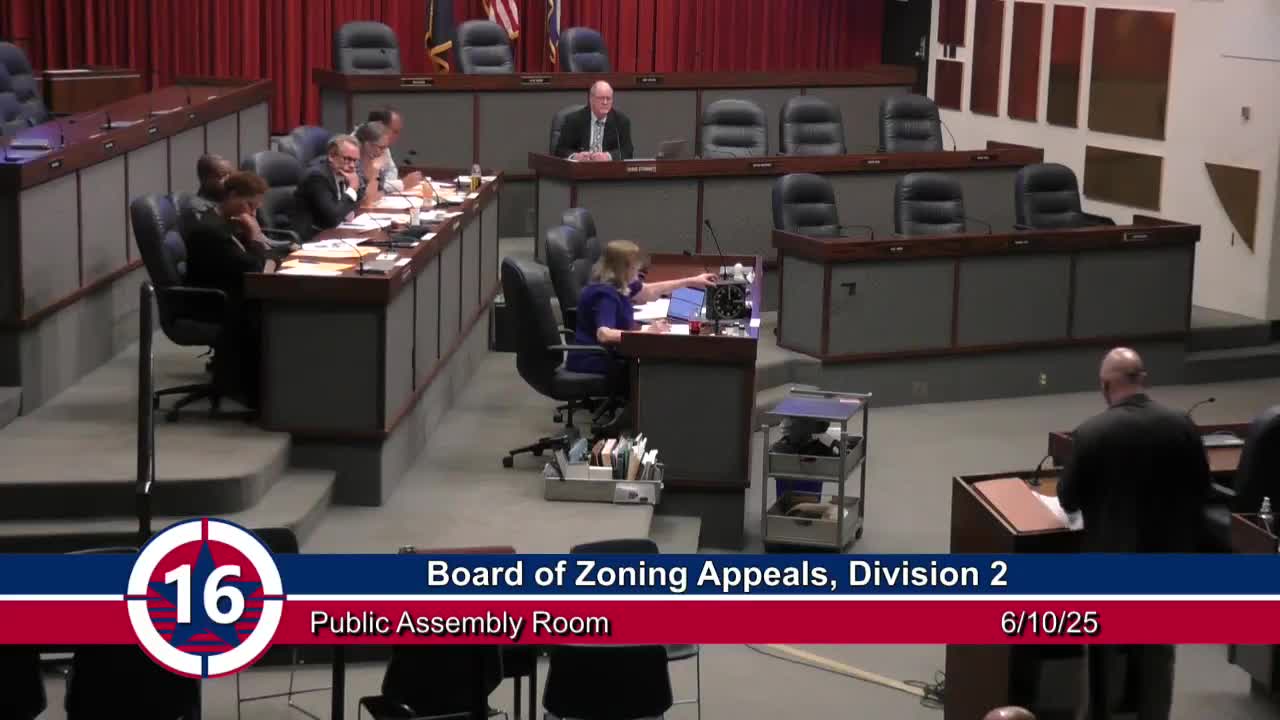
The Indianapolis Board of Zoning Appeals Division 2 voted 3-2 to allow Smart HVAC to operate from 2454 North Illinois Street after debate over compatibility with the Transit-Oriented Development overlay and a staff recommendation to deny.
The Indianapolis Metropolitan Board of Zoning Appeals Division 2 voted 3-2 to approve a variance allowing Smart HVAC, owned by Sharif Nesem, to operate from 2454 North Illinois Street, granting several deviations from development standards and permitting contractor-type activity at a site inside the Transit-Oriented Development (TOD) overlay.
The board’s decision followed testimony from the petitioner, neighborhood supporters and city staff that highlighted competing views about the site’s history, current use and suitability inside a TOD and regional-center overlay.
Justin King, attorney for the petitioner, described the property’s commercial history and told the board the business operates primarily as an office at the site. King said the petitioner has committed to moving a fence back from the front yard, adding landscaping and limiting on-site operations. "We see this as an office use. We see Sharif's business as an asset to the community, not a hindrance," King said.
Supporters included Shameka Anderson, president of the Near North Development Corporation, who said the neighborhood and the Near North CDC view the business as economic development. Anderson said Meridian Highland Neighborhood Association members met and "were in agreement" with the proposed commitments.
Opponents included Ryan Hunt, manager of service planning for Indianapolis Public Transportation Corporation (IndyGo), who urged denial. Hunt said the site sits within a TOD overlay that is intended to encourage walkability and mixed use around high-capacity transit investment. "This request... is not appropriate inside the TOD overlay," Hunt said, arguing the contractor classification is a higher-intensity commercial or industrial use that can include outdoor storage and frequent commercial-vehicle activity.
City staff recommended denial. Eddie O'Nan, current planning administrator for the division, told the board staff’s recommendation was based on the site’s predominantly residential context, the TOD and regional-center overlays and an enforcement history at the property. "Staff is recommending denial of this petition for a contractor use as located within a predominantly residential context, as well as within the TOD and regional center secondary overlays," O'Nan said. Staff cited an open violation case tied to outdoor storage, commercial vehicles and other development-standard deficiencies.
Petitioner materials submitted to the board included a plan of operation, interior photos and a site plan showing revised landscaping and a relocated fence. King said the petitioner performs most work off-site and that employees leave from home to job sites; the petitioner confirmed small parts deliveries sometimes arrive at the business. King also said the owner has provided free HVAC assistance to nearby residents through a local center.
Board members asked whether the use should instead be pursued as a rezoning and whether a C1 office designation would be more appropriate. Staff said a rezoning to a commercial district would be the clearer path to authorize recurring commercial uses because a variance does not change the zoning designation on the map.
The board’s roll-call announcement recorded five ballots cast. The board stated three members voted yes and named them: Patrice Duckett Brown, James Duke and Beth Brandon. Two no votes were recorded but not individually named on the public roll call. The board therefore approved the variance 3-2.
After the vote staff and several board members discussed the value of adding neighborhood contextual information to the packet for future hearings, including maps showing surrounding zoning.
The board moved on to other docket items and then adjourned.