Get Full Government Meeting Transcripts, Videos, & Alerts Forever!
Get email alerts on the Transitional Kindergarten topic
No spam. Unsubscribe anytime.
Senators press departments on readiness for universal TK, staffing and expanded-learning rollout
Summary
Committee members pressed the administration and CDE on whether districts have the workforce and facilities to implement universal transitional kindergarten and related expanded learning proposals, and CDE said about 91% of LEAs reported having enough fully qualified TK teachers.
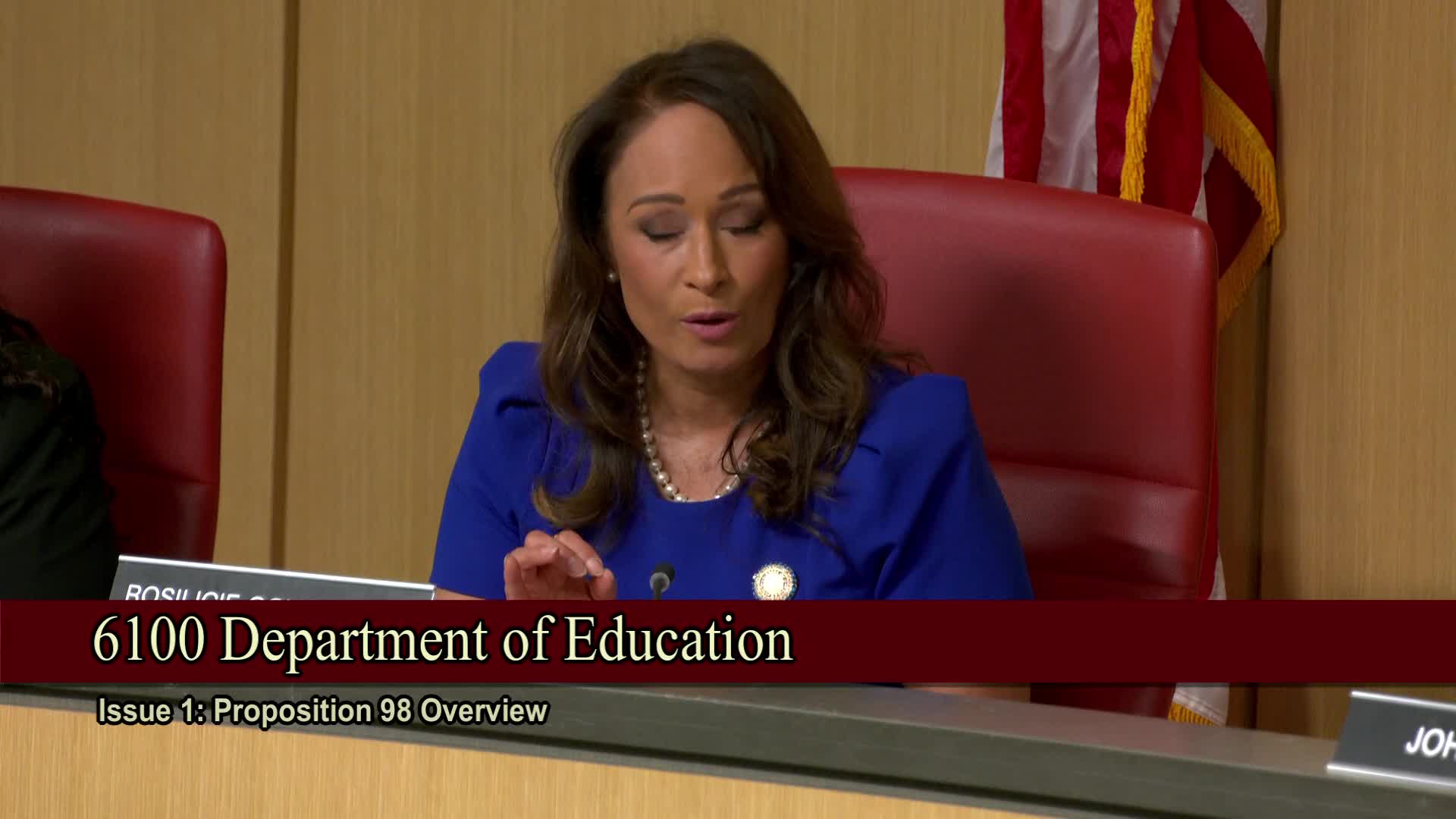
Senators at the Budget Subcommittee No. 1 hearing probed whether the state is ready to implement universal transitional kindergarten (TK) at the scale assumed in the May Revision, focusing on teacher supply, facilities and the expanded learning opportunities program.
"My concern is whether the state is ready to move this forward," said Senator Ochoa Bogue as she described conversations with local school boards about classroom space and staffing in rural and mountain communities.
Department of Finance and CDE witnesses described the fiscal and operational assumptions supporting TK expansion. The administration said the rebenching of the Proposition 98 guarantee reflects the increased TK enrollment that triggers additional funding. Finance emphasized that the administration views the costs as being generated by TK average daily attendance and therefore allocated to the TK/K–12 side of Prop. 98.
Kimberly Rosenberg of the California Department of Education told the subcommittee that, in CDE reporting to the agency, about 91% of local education agencies (LEAs) said they had enough fully qualified TK teaching staff and that 89% of districts and 93% of charter schools reported adequate TK staffing. "We are able to move forward with TK," she said, and asked the committee to accept CDE's data for planning purposes.
Senators raised several practical concerns: whether districts have the classroom infrastructure to accommodate full-day TK, especially in rural areas; whether available teacher-preparation and training slots are sufficient to meet demand; and the pipeline problem created by a wave of retirements in some regions. Senators also discussed potential penalties tied to staffing ratios and whether those consequences should be delayed if districts cannot meet statutory ratios.
The LAO and Department of Finance recommended options to reduce fiscal risk: delaying requirements that would force districts to immediately lower TK class-size ratios from 12:1 to 10:1; increasing the discretionary block grant to give districts flexibility to preserve core services; or rejecting some new ongoing proposals and using one‑time resources for short‑term needs.
The subcommittee did not take votes but asked the agencies to continue coordination with districts and to provide more data on staffing and facilities readiness during negotiations.