Get Full Government Meeting Transcripts, Videos, & Alerts Forever!
Get email alerts on the Solid Waste topic
No spam. Unsubscribe anytime.
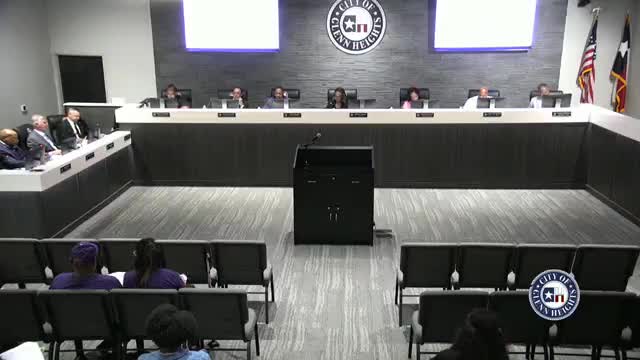
Glenn Heights council hears Community Waste Disposal explain rate increase and respond to service complaints
Summary
Community Waste Disposal officials outlined the calculation behind a June 1 contract cost adjustment and defended a five-day collection schedule while council members and the mayor pressed the company for clearer follow-up on missed pickups, liquidated-damages reconciliation and more frequent updates to the city and residents.
Community Waste Disposal officials told the Glenn Heights City Council on May 20 that a contract cost adjustment set to take effect June 1 reflects rising disposal, fuel and consumer-price indexes and would raise the company’s internal residential charge from $15.13 to $16.22.
The matter drew extensive council scrutiny because many residents have complained about missed pickups, brush piles and apparent inconsistencies in how crews apply the contract’s collection rules. Mayor Sonya A. Brown and council members pressed CWD executives for evidence of how the company tracks missed service, whether liquidated-damages owed to the city have been collected and whether CWD will return for quarterly public briefings.
CWD President Jason Ramer and CEO/founder Greg Ramer described how the company calculates its annual adjustment and defended the current five-day collection model. “The short answer is we cannot,” Ramer said when asked whether the company could shift the city to a single weekly pickup day, explaining CWD does not keep sufficiently many idle rear-load trucks to run the entire city on one day. The company said it uses three public indices in its contract adjustment calculation: the Dallas–Fort Worth CPI-U (with the energy component removed), the Henry Hub natural‑gas index for fuel, and disposal changes at the McCommas Bluff Landfill, which the company identified as the disposal site for Glenn Heights.
The company presented grievance metrics it said show improvement: a rolling measure of grievances per 1,000 service opportunities fell from 0.9 (in 2023) to 0.57 (2024) and was about 0.5 for January–April 2025, a figure CWD said matches its company average. Greg Ramer also described CWD’s daily noncompliance and monthly municipal reports, which are delivered to city staff and include address-level detail and missed-pickup logs.
Council members and the mayor questioned whether grievance counts understate resident dissatisfaction because some residents stop calling CWD and instead post complaints on social media or contact elected officials. Councilman Garrett summarized the sentiment of several residents: “I’m disappointed,” he said, describing repeated examples of brush and bulky items left at curbs for weeks. Councilwoman Hale asked specifically about contract penalties and whether the city has received liquidated‑damages payments: “I have not heard anything about those fees coming back to the city,” she said. CWD executives said they would review the contract and the records and that, to their knowledge, liquidated damages had not been applied to CWD since service began in June 2022.
CWD told the council it can and has produced an annual calendar, digital reminders and an address-search tool on its website to help residents keep track of alternating recycling weeks, seasonal bulk‑brush rules and other service details. The company also said it can reorganize service days along major thoroughfares so the same street isn’t split across multiple collection days, but that change would require city staff and communications support to notify roughly 50–60 homes affected by any rescheduling.
No vote or formal direction on rates or contract terms was taken at the meeting. Mayor Brown asked CWD to share address-level grievance detail monthly with staff and invited CWD to attend a council meeting or a public town-hall so residents can raise questions directly. Council members asked staff to (1) confirm any liquidated-damages owed to the city and report back and (2) consider whether CWD should provide quarterly service updates to council and the public.
CWD’s presentation also included the company’s worked example showing how the three indices were weighted across components of the per-household charge: approximately 60.66% of the charge is indexed to CPI-U (energy removed), 4% to compressed natural gas fuel, and 30% to disposal changes. Using those inputs, CWD said the calculated average adjustment across charge categories equates to a 7.5% change in the cost of doing business for the prior 12 months.
Mayor Brown noted a different pass-through figure for customers later in the meeting: she said the resident bill would move from $16.64 to $17.89, a $1.25 monthly increase. The council did not adopt any ordinance or formally change resident billing at the meeting; CWD described the calculations it uses under the existing contract and the mayor clarified the effect on the current customer bill as presented to the city.
Council members asked CWD to (a) provide a reconciliation of any contractual liquidated-damage amounts owed to Glenn Heights since service began in June 2022, (b) commit to clearer, more frequent address-level reporting to staff, and (c) consider attending future council meetings or town halls to field resident questions.
Mayor Brown closed the discussion by stressing the central role of daily municipal services in local quality of life and by urging both the city and CWD to repair the partnership where it has frayed. “Residents reach out to you … the level of grievances may have gone down, but for us, they have remained fairly steady if not gone up,” she said, urging better transparency and follow‑up.