Get Full Government Meeting Transcripts, Videos, & Alerts Forever!
Get email alerts on the Code Enforcement Technology topic
No spam. Unsubscribe anytime.
Cathedral City tests CityDetect AI to speed code-enforcement work; legal, privacy and data-ownership questions remain
Summary
Code enforcement staff showed a CityDetect pilot that uses vehicle-mounted cameras and computer vision to flag blight, graffiti, shopping carts and other right-of-way issues; the vendor and staff said a human verification step would be used and the city attorney will review data-retention and access policies before contracting.
Cathedral City’s code enforcement manager told the council on May 28 that the city ran a CityDetect pilot that used vehicle-mounted cameras and computer-vision models to identify likely violations such as overgrown yards, boarded windows, litter, graffiti and abandoned shopping carts. CityDetect’s CEO described how imagery is collected from roving vehicles, analyzed in the cloud and presented in a web portal where staff can verify findings and create targeted abatement tasks.
Justin Gardner, Cathedral City’s code enforcement manager, said the system can run multiple detection models simultaneously and that the pilot included sampling routes in three districts. He and the vendor said the platform is intended as a force multiplier to automate the repetitive work of photographing and mapping potential violations; staff would continue to review and verify items before issuing notices or taking enforcement action.
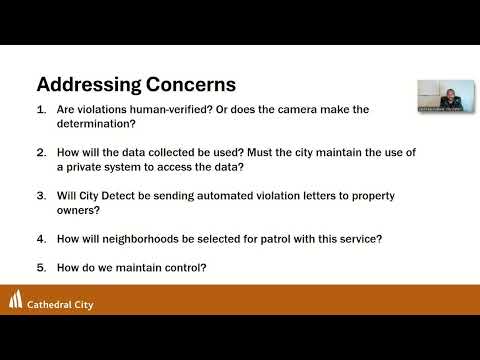
Gavin Von Blake, CityDetect’s CEO, described the company’s approach: cameras mounted on municipal vehicles collect images while the vehicle moves, the platform runs detection models for specified issue types, and a human-in-the-loop review verifies and converts those detections into case-management tasks. The vendor said imagery associated with reports is retained and that analytical training data remains part of the company’s model-development assets; the vendor said regular reports and case images are available to the city and that image-retention defaults are three years with older data moved to longer-term “glacial” storage after 12 months.
City staff flagged legal and privacy questions that remain to be negotiated: the city attorney said the draft agreement requires more work on ownership, access and retention rules, and staff said they will develop internal policies (including access logging and blurring tools) before any contract is finalized. Staff also said they are working on an integration with the city’s case-management system (GoGov) so that verified detections could populate case records and, if desired, generate mailings targeted to verified problems rather than citywide mass mailers.
Council members and staff generally endorsed the idea of automated detection to expand code-enforcement reach, but asked for follow-up on who owns raw imagery, how personnel access will be audited, how minors and private activities would be protected, and what a deployment schedule would look like. Staff said CityDetect can be mounted on code vehicles or other city vehicles and that routes can be chosen to ensure even coverage across neighborhoods.