Get Full Government Meeting Transcripts, Videos, & Alerts Forever!
Get email alerts on the Legislation topic
No spam. Unsubscribe anytime.
California Senate advances wide package of bills; partisan fight over Law Day resolution
Summary
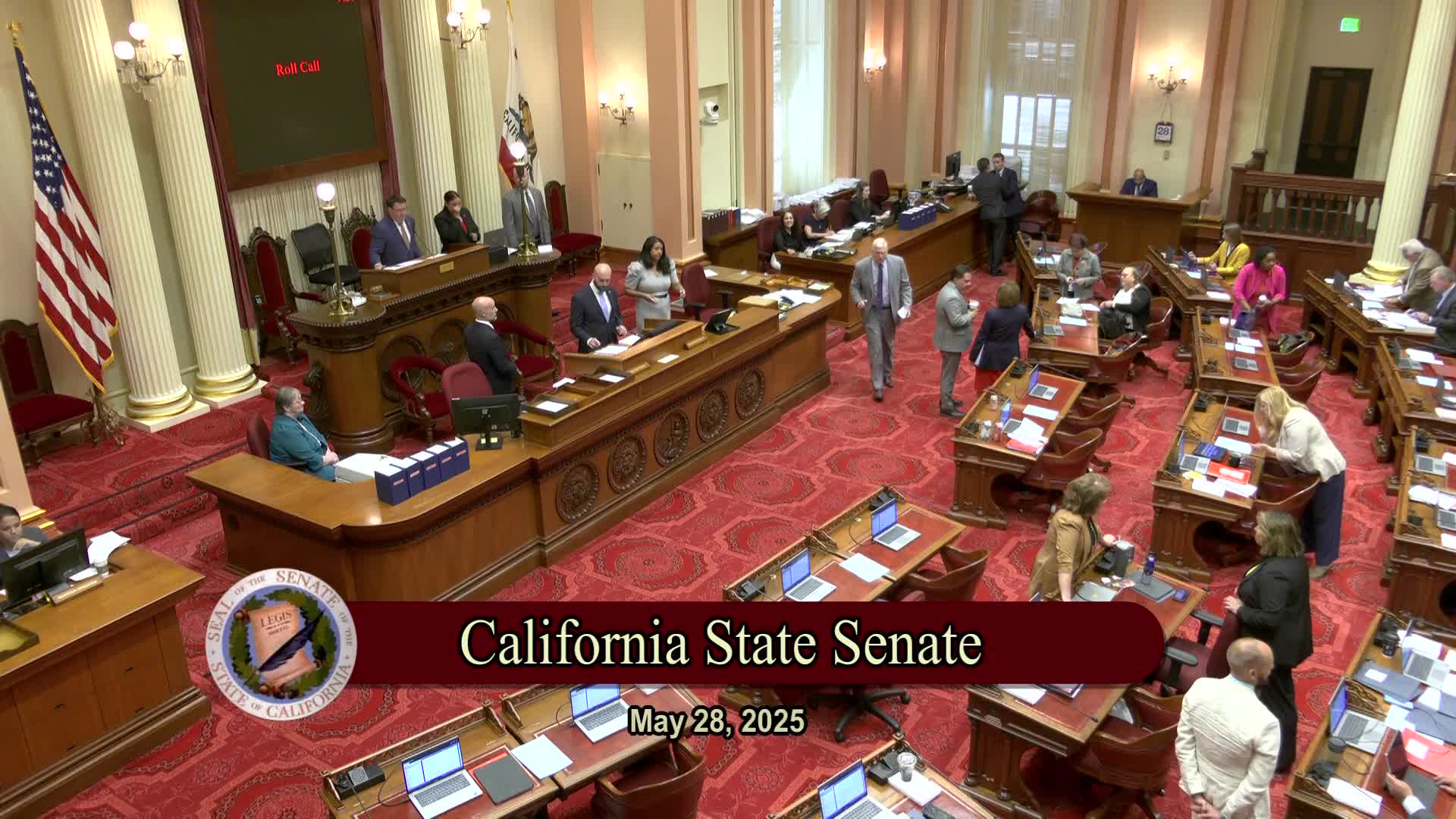
The California State Senate approved a broad package of bills on the floor and confirmed governor appointments, while a contentious debate over Senate Concurrent Resolution 66 (Law Day) occupied much of the chamber’s attention.
The California State Senate completed a lengthy floor session that produced dozens of approvals on a wide range of measures — from consumer protection and health coverage to housing and infrastructure — and confirmed multiple governor appointments. Lawmakers also engaged in a heated, floor-long debate over Senate Concurrent Resolution 66, a Law Day measure that drew sharp partisan disagreement about whether the measure singled out a particular president for attack or legitimately defended the rule of law.
Why it matters: The session advanced items that affect everyday Californians — including bills addressing online pricing practices, data-breach notification timelines, pharmacy benefit manager oversight, school-meal access and emergency permitting for transportation and housing projects — while exposing deep partisan fault lines on symbolic but politically charged matters such as SCR 66.
What the Senate did and how members debated - Votes at a glance (selected items from the daily file): • SCR 66 (Law Day, Sen. Umberg) — Adopted (roll-call: Ayes 27, Nos 8). The resolution drew extended debate from members across the aisle who argued both that the measure defends rule-of-law principles and that it was partisan in tone (see body below for details). • SB 259 (Wahab) — Fair Online Pricing Act (limits operators from using certain device data to set consumer prices): passed (vote tally not specified on the floor transcript excerpt). • SB 445 (Wiener) — Amendments to streamline third-party permitting timelines for sustainable transportation projects; sponsor said the measure was temporarily narrowed and will be rebuilt in the Assembly: passed (vote tally not specified on the floor transcript excerpt). • SB 446 (Hurtado) — Consumer Data Protection and Notification Reform Act (shorter deadlines for breach notice to consumers and the Attorney General): passed (vote tally not specified on the floor transcript excerpt). • SB 41 (Wiener) — Pharmacy benefit manager (PBM) reform: author described practices that raise drug prices and urged regulation; passed (vote tally not specified on the floor transcript excerpt). • SB 40 (Wiener) — Insulin affordability (cap on monthly out-of-pocket costs): passed (vote tally not specified on the floor transcript excerpt). • SB 363 / SB 3 63 (Wiener) — Denials reporting and accountability for insurer denials (requires plans to report denials and imposes penalties where IMR overturn rates are high): passed (vote tally not specified on the floor transcript excerpt). • SB 411 (Perez) — Stop Child Hunger Act (streamlines school meal/Sun Bucks access and codifies privacy protections for applicants): passed (vote tally not specified on the floor transcript excerpt). • SB 283 (Laird) — Energy/battery-storage safety measures (building-code and permitting changes intended to reduce fire risk at industrial battery storage facilities): passed (vote tally not specified on the floor transcript excerpt). • Multiple other bills on housing, water, and wildfire response passed or were adopted without objection during the day. Many measures were eligible for unanimous roll call and recorded as passed on the floor.
Appointments confirmed - The Senate confirmed several governor nominations on the floor (items noted on the daily file). The transcript records two appointment items taken up and approved by roll call earlier in the session.
The Law Day fight: what was said Senate Concurrent Resolution 66, introduced as a recognition of Law Day and the rule of law, became the session’s most contested single item. Senator Umberg (the resolution sponsor) framed the measure as a defense of the rule of law and said it was intended to recognize lawyers and law firms that "stood up" in the face of what he described as executive efforts to intimidate the judiciary and legal advocates. He said, in part, that "the rule of law underpins what we do as a democracy" and urged senators to support the resolution.
Opponents argued the measure improperly singled out one administration and turned a bipartisan commemorative resolution into a partisan statement. Several Republican senators and others urged a no vote, saying the resolution ignored alleged abuses by prior administrations and thereby politicized a bipartisan observance. Senator Nilo (floor) called the resolution "imbalanced" and said it omitted other instances he characterized as violations of the rule of law; Senator Strickland used blunt language to call for consistency across administrations.
Supporters pushed back, arguing the current attacks on law firms and the judiciary are of a different order and that recognizing firms and judges who defend the rule of law is appropriate. Senator Padilla read an extended excerpt invoking the constitutional principle that "observance of the law is the eternal safeguard of liberty," and other supporters recounted instances they said illustrated current threats to judicial independence.
The chamber recorded a roll-call vote on the resolution: Ayes 27, Nos 8. Transcript excerpts show repeated, lengthy floor exchanges — including references to specific law firms and to judicial criticism of executive statements — that drove the debate.
What the votes do not show - Floor debate and votes record positions and outcomes, but do not themselves create new policy beyond the measures the Senate passed. Several bills were described from the floor as having technical amendments to work through in the other house or with stakeholders; those changes may still alter final text in the Assembly or in conference.
What to watch next - Several measures the Senate passed will move to the Assembly for consideration; some authors said they expect further amendments. Measures involving deadlines, funding mechanisms, or constitutional changes (for example, any bill tied to state credit or new financing authorities) may require additional steps before implementation.
Ending note The floor day included dozens of measures, many of them adopted without recorded opposition, and showcased both routine floor business (appointments, unanimous-roll-call measures) and intense partisan disagreement over symbolic matters. The public transcript records the roll-call tallies where the Senate recorded them; for bills not explicitly tallied in the excerpted file, the final Assembly action and enrolled bill text should be consulted to confirm final outcomes.