Get Full Government Meeting Transcripts, Videos, & Alerts Forever!
Get email alerts on the Budget And Taxes topic
No spam. Unsubscribe anytime.
Royce City council debates up to double‑digit property tax increase to shore up wages, staffing
Summary
City leaders weighed raising the property tax rate to cover a $450,000 shortfall in the tentative budget, address a long‑running wage gap with neighboring cities and stem heavy turnover in fire and public works, and set a June 17 deadline to set a maximum rate for public notice.
Royce City Mayor (Mayor) and city budget staff told the council in a June special work session that the tentative budget submitted in May faces a roughly $450,000 gap and that council members must set a maximum property tax rate for public notice at their June 17 meeting.
The meeting centered on three linked problems: an immediate shortfall in the tentative budget, long‑term wage compression that leaves Royce City about 14% behind neighboring jurisdictions, and heavy staff turnover in critical departments. City Manager Matt (Matt) framed the discussion as a guided conversation and noted the city had identified $300,000 in previously unaccounted wage savings that reduce a projected 15% tax increase to roughly 9% if used to close the gap. “This is meant to be a guided discussion and not a lecture,” Matt said.
Why this matters
Council members stressed that decisions now will affect public safety and day‑to‑day services. Chief Williams (Fire Chief) told the council his department has experienced “70% turnover” over several years, and that many firefighters are within their first three years on the job — a level that, he said, risks response capability and increases overtime costs. “My goal is to keep us competitive,” Chief Williams said, describing an offer to hold two positions vacant to reallocate salary funding within his department.
What council discussed and options on the table
- Tax-rate scenarios: Staff said a 9% property tax increase would fill the current budget gap and fund the cost‑of‑living adjustments (COLAs) and merit increases included in the tentative budget. A previously advertised 15% rate would provide additional funds to address wage compression more aggressively but would rely in part on one‑time proceeds. Council members also discussed hypothetical higher ceilings (approaching 20%) and the political and economic consequences of each option.
- One‑time funds versus ongoing costs: The city expects about $540,000 from a pending land sale; staff and several council members cautioned that using one‑time proceeds for permanent salary increases creates a structural shortfall for the next year. Council member Sophie said, “You can't use that money for human capital. You're just gonna get yourself deeper and deeper next year.”
- Targeted relief and departmental tradeoffs: Chief Williams offered to freeze (not eliminate) two positions and use the salary savings to raise pay within his department. Public Works Director Brandon (Brandon) said his operations are paid largely from enterprise funds and that enterprise budgeting limits how much he can redirect to general fund pay: “I'm heavily enterprise funds, so, yes, that would help me a ton.” Discussion included the idea of a one‑time, pro rata payment from onetime proceeds to all employees versus permanent increases; several council members and staff warned a one‑time bonus would not stop turnover and could prompt a clawback requirement if used to retain staff.
Data and constraints cited by staff
- Sales and population effects: The mayor and staff reviewed Utah Tax Commission data showing Royce City’s gross taxable sales were high in late 2024 (staff cited roughly $145 million in one quarter and about $534 million in gross sales for the city in 2024) but noted distribution rules split sales‑use tax allocation roughly 50/50 between where a sale occurs and population. Because Utah's 2024 population gains flowed heavily to Utah County, Royce City’s per‑capita share did not rise and the city’s population estimate in state data even showed a small decline — reducing the city’s share of the distribution.
- Magnitude of wage gap and fiscal needs: Staff and council discussed a citywide wage lag of about 14% compared with neighboring jurisdictions. That gap was described as roughly a $1.2 million annual cost to bring base pay to market; a broader estimate that includes COLAs and other adjustments was discussed as higher (staff referenced a $2.1 million figure when combining multiple adjustments).
- Turnover and staffing: Fire and public works were identified as most affected. The fire chief reported about 70% turnover across the department over the referenced multi‑year period; Brandon said the street crew has shrunk from 11 positions in 2009 to eight.
Next steps and deadlines
Council members directed staff to prepare additional tenure and turnover data (breakouts by department and by years of service) before the June 17 meeting. Matt and finance staff indicated the council must set a maximum tax rate at the June 17 meeting for advertising under the truth‑in‑taxation process; the council may later adopt a final rate in August. Matt noted multiple public hearings are scheduled as part of that process. “We would have to have that maximum tax rate voted on on the seventeenth,” Matt said.
No final tax ceiling was set at the work session. The council took one formal vote at the end of the meeting to adjourn; the tax decision will come at the scheduled public hearings.
Ending note
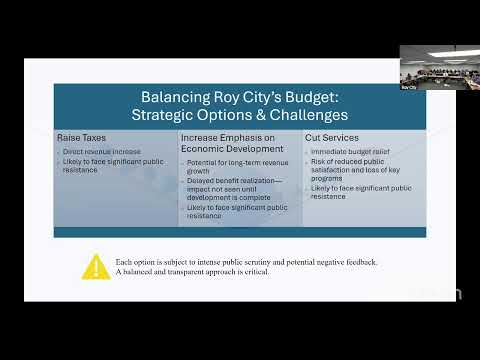
Council members repeatedly framed the issue as a tradeoff among raising taxes, pursuing longer‑term economic development to expand the tax base, and cutting services. Several council members urged the public to weigh the consequences for emergency response and routine services against the cost of higher property taxes; others pressed for options that would protect residents on fixed incomes. The city will return to the topic at its June 17 public meeting, when it must set a maximum tax rate for the public notice required by the truth‑in‑taxation process.