Get Full Government Meeting Transcripts, Videos, & Alerts Forever!
Get email alerts on the Child Welfare Funding topic
No spam. Unsubscribe anytime.
Michigan child-welfare providers urge legislators to close funding gaps, build COLA into contracts
Summary
Representatives of statewide nonprofit child-welfare providers told the Michigan House Subcommittee on Human Services that state contract rates lag actual costs. They asked the subcommittee to support adoption-rate adjustments, independent-living funding, a cost-of-living adjustment in contracts and closing a foster-care funding gap.
Representatives of Michigan’s community-based child-welfare providers told the Michigan House Subcommittee on Human Services on May 20, 2025, that state contract rates lag the cost of delivering services and asked lawmakers to back several budget fixes, including adoption supports, independent-living investments and a cost-of-living adjustment for provider contracts.
Katie Prowt, chief strategy officer at the Michigan Federation for Children and Families, told the committee the Federation represents “more than 60 nonprofit community based organizations that contract with the Michigan Department of Health and Human Services to provide a full continuum of child welfare and behavioral health services across all 83 counties.” She said these local providers are “the backbone of Michigan’s families” and that “every budget decision that you all and your colleagues are making echoes through the lives of Michigan’s children.”
The Federation and agency leaders asked the subcommittee to support several line items in the governor’s executive budget and other requests. Prowt identified a $4,900,000 request to expand adoption support services and a $1,900,000 request to invest in independent living plus programming for older youth. She said members also want a recurring cost-of-living adjustment built into all provider contracts to help close persistent funding gaps.
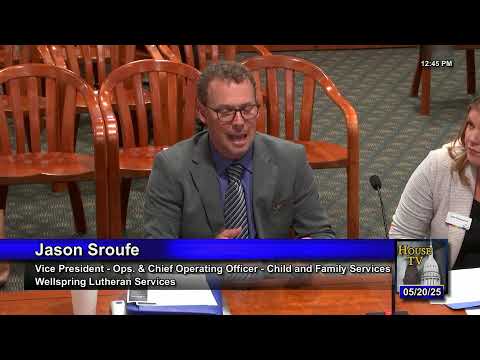
Jason Schroff, chief operating officer at Wellspring Lutheran Services, described the role of family preservation (Families First) and other home-based services in preventing children from entering foster care. “Over 90% of the families we work with at the end, the kids are still at home,” Schroff said, adding that keeping children at home reduces trauma and costs associated with foster care. Schroff cited a PCG cost analysis he said showed community-based services are funded at roughly 45% of the needed level and asked the committee to consider closing an estimated $11.5 million funding gap for family preservation services.
Schroff also reported that, as of Friday, May 16, there were 9,977 children in foster care in Michigan. He said last year providers recommended a $70-per-day foster-care per diem; the state moved the per diem from about $55.20 to $60.20 last year but providers say that remains below needed levels.
Julie Thomasma, chief executive officer of Child and Family Charities, said her organization provides about half of private-agency foster care and runs residential and independent-living programs. She asked for a one-time $2,000,000 allocation to cover adoption cases opened before new contracts took effect Oct. 1, noting that the department changed the method of payment and rates for adoption services starting Oct. 1 and that children who entered care earlier remain on prior terms. Thomasma also described underfunding of residential and independent-living beds, citing a current daily rate of $210 for a mother–baby independent-plus program (Angel House) and saying that PCG’s analysis indicates those services are two to three times underfunded when compared with service needs.
Providers also raised behavioral-health staffing and service concerns. Committee members and providers described growing acuity of behavioral-health needs among children and families, limited clinician availability in rural areas, and the need for loan-repayment or retention strategies that include nonprofit providers. Prowt said several member organizations provide behavioral-health services in all 83 counties and that Certified Community Behavioral Health Clinics (CCBHCs) have expanded access but that the state’s redesign and rebid of PIHP contracts could affect local delivery.
Committee members asked clarifying questions about how the new adoption-rate structure works, the sequence of contract payments, and a recent lawsuit over payment sequencing. Providers said the department has paid the $60.20 rate since the lawsuit was finalized but that agencies have not yet received all amended agreements. Members also discussed how family preservation referrals and utilization have fallen following prior CPS “front-end” redesigns and that fewer investigations and substantiations have reduced referrals to preservation services.
No new legislative action or votes on funding were taken during the presentation; providers were invited to continue conversations with committee staff.