Get Full Government Meeting Transcripts, Videos, & Alerts Forever!
Get email alerts on the Mobile Food Vending topic
No spam. Unsubscribe anytime.
Commissioners narrow options on revised mobile food-vending rules; staff to craft clearer definitions and exceptions
Summary
The board spent extensive time refining a proposed mobile food-vending ordinance: members discussed annual vs. temporary permits, restroom-access rules for employees, distance-from-street limits, overnight parking, and how rules apply in residential neighborhoods; staff will revise language and return for further deliberation.
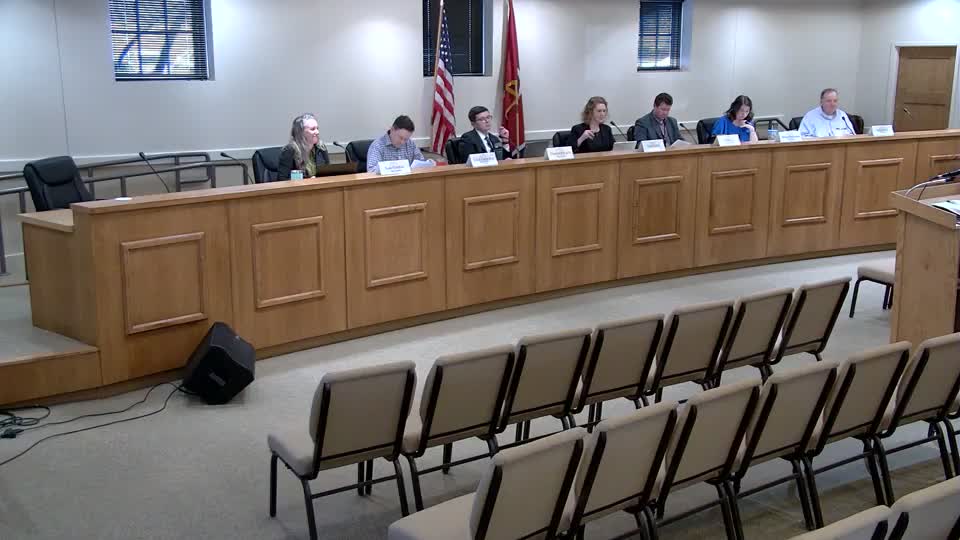
Nolensville commissioners spent a substantive portion of the March 24 work session reviewing a comprehensive draft municipal-code and zoning-text package to regulate mobile food vending, including two draft ordinances (municipal code provisions and zoning text amendments).
Staff and the assistant town manager reviewed earlier public input and a planning commission referral. The key policy choices discussed were: whether to offer both a short-term (three-day) and an annual permit; how to treat mobile vendors on private property versus public right-of-way; whether vendors must be set back from a public street (the draft used 150 feet in a proposed revision, with prior drafts referencing 100 feet); restroom-access requirements for employees (the draft proposed permanent restrooms within a specified distance; commissioners discussed reducing the distance to 150 feet to match other sections); whether to prohibit overnight parking in view of public streets and how to word “direct view” to avoid ambiguous enforcement; and whether special-event permits should be exempt from certain rules.
Commissioner Carpenter said the 100–150 foot rule was aimed at preventing semi-permanent roadside truck setups that clutter the town’s main corridors, but commissioners acknowledged that a strict linear distance rule could unintentionally restrict neighborhood events and some legitimate commercial lots where buildings are near the front lot line. Staff suggested alternatives such as limiting the rule to front property placement (require trucks to be located mid/rear lot) or tying the distance requirement to the annual-permit (not short-term special-event permits).
On restrooms, commissioners and staff discussed using a written authorization approach: vendors who operate long-duration (annual) events should have written permission to use a permanent restroom on-site (for employee needs); short-term (three-day) pop-ups or special-event vendors might be treated differently. Commissioners also noted enforcement challenges for an overnight-parking ban but left the provision in the draft pending clearer, less ambiguous language on visibility and practical enforcement.
The board agreed not to finalize the ordinance at the work session. Staff will reword ambiguous phrases (for example, “direct view from a public street”), align distance requirements between sections (suggestion to reduce to 150 feet for restroom access or clarify exceptions), and prepare amendments reflecting the board’s direction for the April meetings and the planned public hearing.