
Committee hears two St. Paul arena and ballpark funding proposals; public, labor and team leaders testify
Get AI-powered insights, summaries, and transcripts
Sign Up Free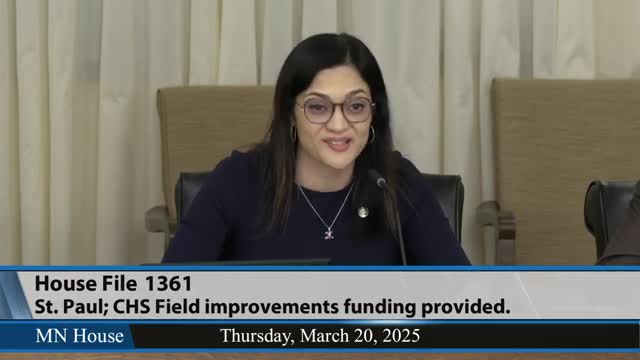
Summary
Two St. Paul projects — an $8 million CHS Field request and a proposed roughly $394 million renovation of the Xcel Energy Center complex — drew testimony March 20 about player health standards, economic impact and financing options.
Two high‑profile Saint Paul projects drew extended testimony during the committee’s March 20 hearing: an $8,000,000 request tied to CHS Field improvements and a larger renovation proposal for the Xcel Energy Center complex that proponents described as an appropriation‑bond package totaling roughly $394,000,000.
Representative Frank Perez Vega introduced House File 13‑61 to authorize an $8,000,000 appropriation for CHS Field in Lowertown Saint Paul. Tom Whaley, executive vice president of the St. Paul Saints, said Major League Baseball’s 2021 restructuring and subsequent facility standards for affiliated clubs created new requirements “dealing with players’ health, safety, and welfare.” Whaley told the committee the Saints and city have invested in the ballpark and that the Saints have added about $4,000,000 of improvements; he described the remaining needs as visiting‑team locker rooms, training and commissary space, improved weight and stretching areas and facilities for female coaches.
Whaley later said the Saints had spent money to meet immediate standards in 2021 and that “the players now make more money than they ever have before,” which in his view increased facility standards. He asked the committee to consider the $8,000,000 request, which he characterized as modest compared to recent nationwide facility investments.
More contested testimony covered the Xcel Energy Center, Roy Wilkins Auditorium and Saint Paul River Center. Mayor Melvin Carter and Minnesota Wild owner Craig Leopold described the complex as an economic engine — the mayor cited an annual impact figure proponents provided (roughly $383,000,000) and Leopold said the city’s arena is nearing “the end of its intended lifespan.” Leopold said the Wild invested time and resources in feasibility work and that similar investments elsewhere have anchored downtown revitalization.
Proponents framed the Xcel complex work as appropriation bonds rather than general‑obligation bonds; House fiscal staff explained the difference in committee and noted appropriation bonds do not pledge the state’s full faith and credit, have different debt‑management treatment, and can carry higher interest rates. Mayor Carter and proponents said appropriation bonds were one pathway but did not present a final financing plan; committee members repeatedly pressed for details on proposed revenue sources and long‑term debt service.
Speakers from the St. Paul Area Chamber, local student athletes and the Minnesota Building and Construction Trades Council provided supplemental testimony. A high‑school hockey player said the Xcel was “the pinnacle of our sport” for Minnesota youth tournaments; the construction trades council emphasized a project labor agreement and said it would supply trained union workers and long‑term maintenance jobs for the complex.
Committee members questioned whether Major League Baseball or other external partners would contribute to ongoing upgrades; Whaley said MLB does not provide capital for facility standard changes and that teams and facility operators bear the cost. Members also pressed whether renovation‑driven price increases for concessions or tickets were planned (Leopold said the project would create more viewing and lower‑priced community spaces and that ticket and concession pricing would be managed by the operator).
Several members voiced concern about scale, timing and statewide priorities: Representative Lee asked for clarity on the appropriation bond mechanics and warned that appropriation bonds add to state debt‑service obligations and compete with other capital requests. Proponents requested follow‑up conversations on financing and local partnership details. No bill votes occurred; proponents said they would continue working with the delegation and committee staff to refine a financing plan.