Get Full Government Meeting Transcripts, Videos, & Alerts Forever!
Get email alerts on the Water Infrastructure topic
No spam. Unsubscribe anytime.
Minn. capital committee hears PFAS, small-town water infrastructure requests
Summary
Representatives and city officials described PFAS contamination and aging water systems in several Greater Minnesota towns and asked the House Capital Investment Committee for state capital funding to replace wells, install municipal mains, and repair storage tanks.
Members of the House Capital Investment Committee heard detailed funding requests March 20 from municipal officials about contaminated or aging drinking-water systems in several Greater Minnesota communities.
The requests centered on two related problems: private and municipal wells with PFAS detections and decades‑old public water systems that officials say cannot be repaired without state help. City administrators and mayors described ongoing reliance on temporary fixes, public‑safety exposures and the inability of small tax bases to absorb major capital projects.
Ross Olsen, city administrator for Sauk Rapids, told the committee a 2021 Minnesota Department of Health notification showed “test results for Wells 2 and 3 exceeded their recommendations for PFAS levels,” and said the city had shut those wells. Olsen said the city is “far below capacity” after taking the wells offline and is requesting $3,600,000 in state support toward drilling and engineering for new well capacity and interconnections to restore reliable supply.
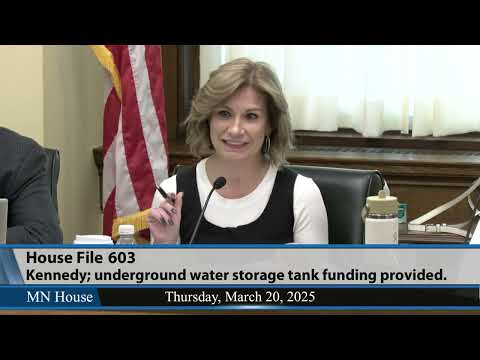
Melissa Wojnarowicz, city clerk for Kennedy, described a 2017 water‑tower failure that left the town on a temporary direct feed system for eight years. She urged support for House File 603, calling the town’s plan to install a booster station and repair underground storage tanks “a public‑safety issue,” noting firefighters’ limited on‑hand water and that Kennedy’s roughly 103 households could not shoulder replacement costs without outside aid. Wojnarowicz said the total estimated cost is $2,696,000 and that the city had secured some grants but still faces a funding gap.
Representatives and local officials also pressed for funding tied to PFAS responses. Mayor Jamie Barthel of Andover urged support for House File 2,080, a request for $8,000,000 in bond‑proceeds to connect roughly 96 properties in the Red Oaks area to municipal water after private‑well testing showed PFAS above Minnesota Department of Health guidance. Sarah Cotton, Andover city administrator, told the committee that about $6,000,000 of the appropriation would be bond‑eligible for public mains and $2,000,000 would be nonbondable costs for individual service connections and well sealing.
Small towns with failing systems also testified. Gary Cook, mayor of Biscay, said the town’s 80‑year‑old system had multiple leaks and orange‑colored water; he estimated a per‑household replacement cost “approximately $70,000,” and asked staff and lawmakers to consider the project’s scale relative to local tax capacity. Tim Corby, the town engineer, said Biscay’s need illustrated a broader wave of aging water and sewer infrastructure across many Minnesota communities.
Committee members asked questions about grant timing, whether planning costs could be phased, and whether any additional funds were expected from multiyear settlements or the attorney general’s office for PFAS. Committee chairs and members repeatedly noted the committee was taking informational testimony and was not voting on the bills that day.
Officials emphasized distinctions between discussion, direction and formal action: the hearing gathered testimony and fiscal requests (discussion), members asked staff to follow up with the attorney general’s office on PFAS settlement information (direction), and no motions or votes were taken on the funding requests (decision).