Get Full Government Meeting Transcripts, Videos, & Alerts Forever!
Get email alerts on the Education Funding topic
No spam. Unsubscribe anytime.
Senate committee hears broad support for $1,000 BSA increase in House Bill 69
Summary
At a March 19 Senate Education Committee hearing in Juneau, school officials, teachers, parents and education advocates urged lawmakers to approve House Bill 69, which would raise the Base Student Allocation (BSA) by $1,000; the Department of Education outlined fiscal notes and the committee requested additional district-level distribution data.
Juneau — At a March 19 hearing of the Alaska Senate Education Committee, school board members, superintendents, teachers and parents urged lawmakers to pass House Bill 69 to raise the Base Student Allocation (BSA) by $1,000, arguing the increase is needed to avert school closures, staff cuts and larger class sizes statewide.
Melissa Burnett, president of the Fairbanks North Star Borough School Board, told the committee that her district has closed seven schools since 2019 and is closing three more this year after losing about 650 students; she said the district faces a roughly $16 million shortfall if funding remains at current levels. "Our district print shop has been shut down. We've reduced administrative staff by 20% and are currently considering a budget that includes another $500,000 to a million in administrative cuts," Burnett said.
The committee also heard fiscal detail from Heather Heineken, director of finance and support services for the Department of Education and Early Development. Heineken said the department's analysis shows HB 69's proposed $1,000 increase would cost about $253,201,200 in fiscal year 2026 and the same amount in each out year through FY 2031; the bill's effective date in the fiscal note is July 1, 2025. Heineken reviewed related fiscal notes that would affect Mount Edgecumbe High School (about $706,500 in receipts in FY 2026) and a new charter school coordinator position (roughly $158,200 in FY 2026 and about $153,200 annually thereafter). She also said the bill creates a reading proficiency incentive grant of $450 per K–6 student who meets proficiency or shows progress; using current data, the department estimated 48,847 eligible students, producing an annual grant cost of about $21,981,200 and a one‑time legal cost of $6,000 for regulation development. Heineken identified a one‑time $6,000 legal cost for drafting required mobile communication device policies and said the student and school achievement allocation component would total about $22,151,400 in FY 2026.
Supporters who spoke during public testimony described classrooms stretched beyond capacity. Andrea Gardner, a certified reading specialist and kindergarten teacher from Anchorage, said she had a kindergarten/first-grade combined class of 35 students and called overcrowding a barrier to reading gains: "An education system starved of funding doesn't just struggle. It wears down its teachers, limits students' potential, and makes meaningful learning harder every single day." Andy Holliman, president of the Anchorage School Board, warned that without a significant increase to the BSA districts will continue to return each year seeking additional funding to cover inflation and operational costs.
Several witnesses urged fixes beyond the funding increase. Burnett recommended policy changes including permissive open enrollment with local-student priority, increasing the foundation formula weight for correspondence students (testimony suggested raising the weight currently described as 0.9 toward parity with brick-and-mortar funding), and a stronger career and technical education focus. Eric Waltonbaugh, principal of West Homer Elementary School, and other testifiers raised concerns about accountability for students educated through correspondence or homeschool programs; Waltonbaugh said many correspondence students do not take state tests and suggested tying full funding to testing or other accountability measures.
Mike Bronson of NAACP Anchorage framed the BSA increase as a step toward meeting the state constitutional obligation to provide an opportunity for every child to meet state academic standards. "You can think of the increase as a down payment for the long overdue debt to students," Bronson said.
Not all testimony was uniformly supportive of the bill's form: journalist David Ignell said HB 69's legislative path — he described it moving from a single-page monetary bill to a nine-page rules committee substitute with policy changes — limited opportunities for public comment and amendment. Some speakers also urged the legislature to pair increased funding with an adequacy study or an ongoing inflation adjustment rather than one-time fixes.
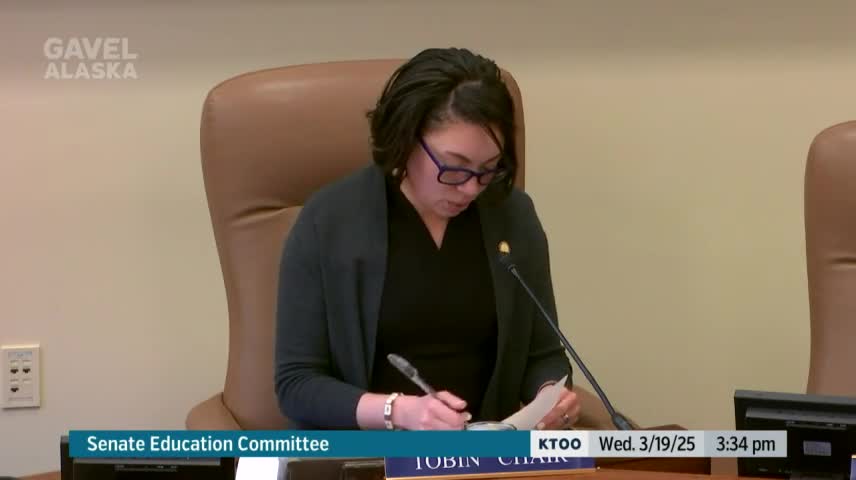
Chair Senator Tobin and committee members asked the department for additional data. Senator Kiel asked the department to clarify whether the reading incentive grants are expected to increase the number of students meeting grade-level reading standards and requested a district-by-district breakdown of the 48,847 students used in the reading grant calculation; Heineken agreed to provide follow-up information. The committee also asked that Fairbanks provide the number of out-of-district students currently attending Fairbanks schools.
The committee did not take formal action on HB 69 at this hearing. Chair Tobin kept public testimony open and scheduled continuation of HB 69 for Friday at 3:30 p.m.; she asked potential amendment sponsors to work with her office and the bill sponsor’s office on a committee substitute. The committee indicated it would circulate requested data before further consideration.
Contacts and next steps: The Senate Education Committee will resume consideration of House Bill 69 on Friday; the committee requested additional district-level allocations, testing/participation projections for correspondence programs, and other clarifying analyses from the Department of Education and Early Development.