Get Full Government Meeting Transcripts, Videos, & Alerts Forever!
Get email alerts on the Artificial Intelligence topic
No spam. Unsubscribe anytime.
Professor outlines AI opportunities and risks, urges Indianapolis to build data governance and a ‘city brain’
Summary
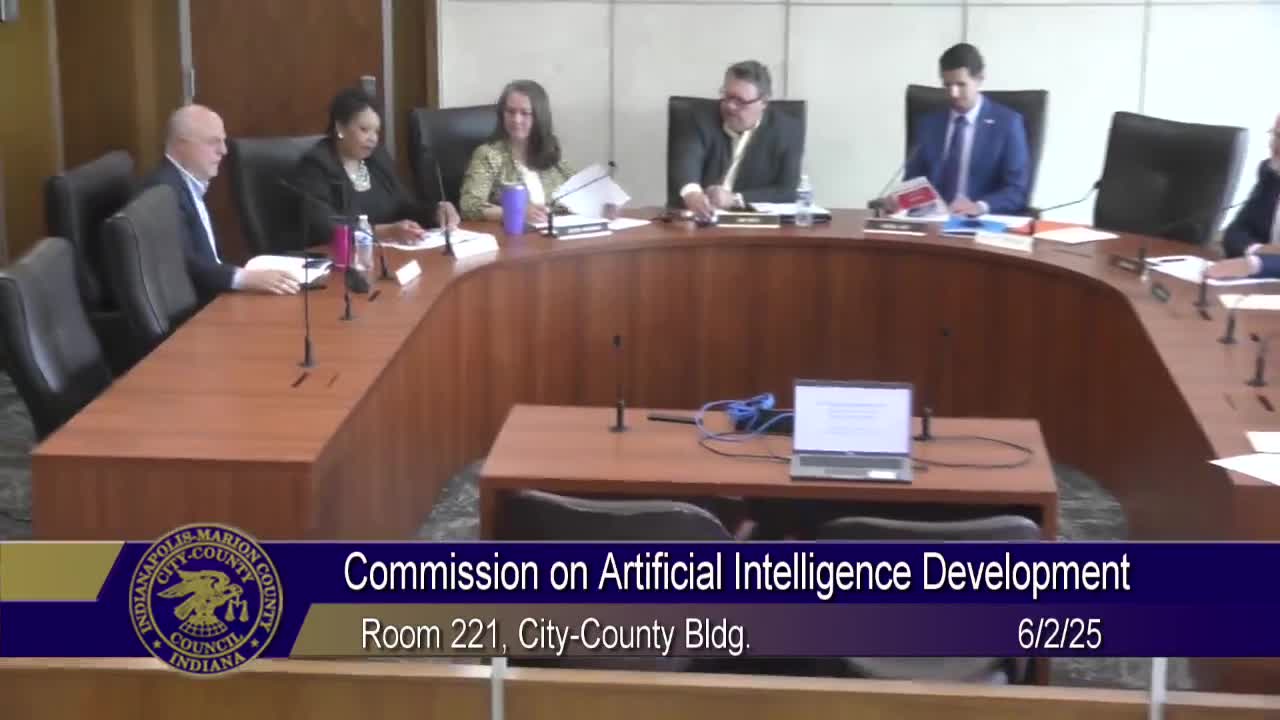
At a June 2 meeting of the Indianapolis City-County Council Artificial Intelligence Commission, Indiana University law professor Frank Emmett outlined AI use cases, risks and governance recommendations, urging the city to invest in data, training and a centralized ‘city brain.’
Professor Frank Emmett, of the Indiana University Robert H. McKinney School of Law, told the Artificial Intelligence Commission of the Indianapolis City-County Council on June 2 that cities must prepare now for fast-moving advances in artificial intelligence and invest in data, skills and governance to capture benefits while limiting harms.
Emmett said federal action on AI appears unlikely in the near term and warned that proposed federal preemption language in a pending budget bill could bar state or local regulation; he pointed to the European Union—s recently adopted AI Act and its General Data Protection Regulation as contrasting approaches. "AI is data hungry," Emmett said, arguing that local governments must collect and link more real-time data to support services ranging from traffic management to emergency response.
The professor told commissioners that most current systems are narrow, task-specific tools but that capabilities are improving rapidly across machine learning, natural language processing and computer vision. He recommended that Indianapolis consider a layered, citywide architecture and a centralized, highly secured computing resource -- what he called a "city brain" or digital twin -- that could run simulations, coordinate traffic flows, support public safety responses and help allocate social-services resources more precisely.
Emmett emphasized workforce training and human oversight. He said municipal staff should become "power users" who can vet AI outputs rather than relying on systems without supervision. He noted risks including bias in training data, cybersecurity vulnerabilities, vendor lock-in and the possibility that private providers will abandon specialized systems or change pricing. He urged coalition purchasing and intergovernmental cooperation to increase leverage with large vendors.
The presentation covered sector-specific uses including grid and energy optimization, emergency dispatch optimization, predictive maintenance for infrastructure and automated assistance for permitting and constituent services. Emmett also discussed longer-term social questions such as job displacement, suggesting cities should plan for workforce transitions and consider incentives to retrain affected workers.
Commission members followed with questions about state and federal limits, equipment and energy needs for large-scale local computing, and public acceptance of surveillance and video analytics. Several commissioners said local legal limits on camera-based enforcement and traffic-video uses (noted by one commissioner as a restriction under Indiana law) will affect what the city can do without state action.
Emmett concluded by urging a pragmatic, coordinated plan: evaluate current systems, break down data silos, develop clear data governance and privacy rules, pilot high-impact projects such as traffic and citizen-contact automations, and invest in cybersecurity and workforce training. He recommended partnerships with other cities and universities to share knowledge and purchasing power.
Commission Chair Dan Boots and Vice Chair Michael Paul Hart, among others, thanked Emmett for the overview and noted the commission will hear staff updates on implementation steps in the same meeting.
Emmett's presentation framed both near-term operational steps and longer-term strategic choices for Indianapolis as AI capabilities expand.