Get Full Government Meeting Transcripts, Videos, & Alerts Forever!
Lexington affordable-housing manager details fund allocations, outcomes and challenges
Summary
Rick McQuady, Lexington’s affordable housing manager, told the planning commission the city’s Affordable Housing Fund has committed roughly $52.9 million to support 3,661 affordable units, described funding sources and warned rising interest rates and management costs are increasing subsidy needs.
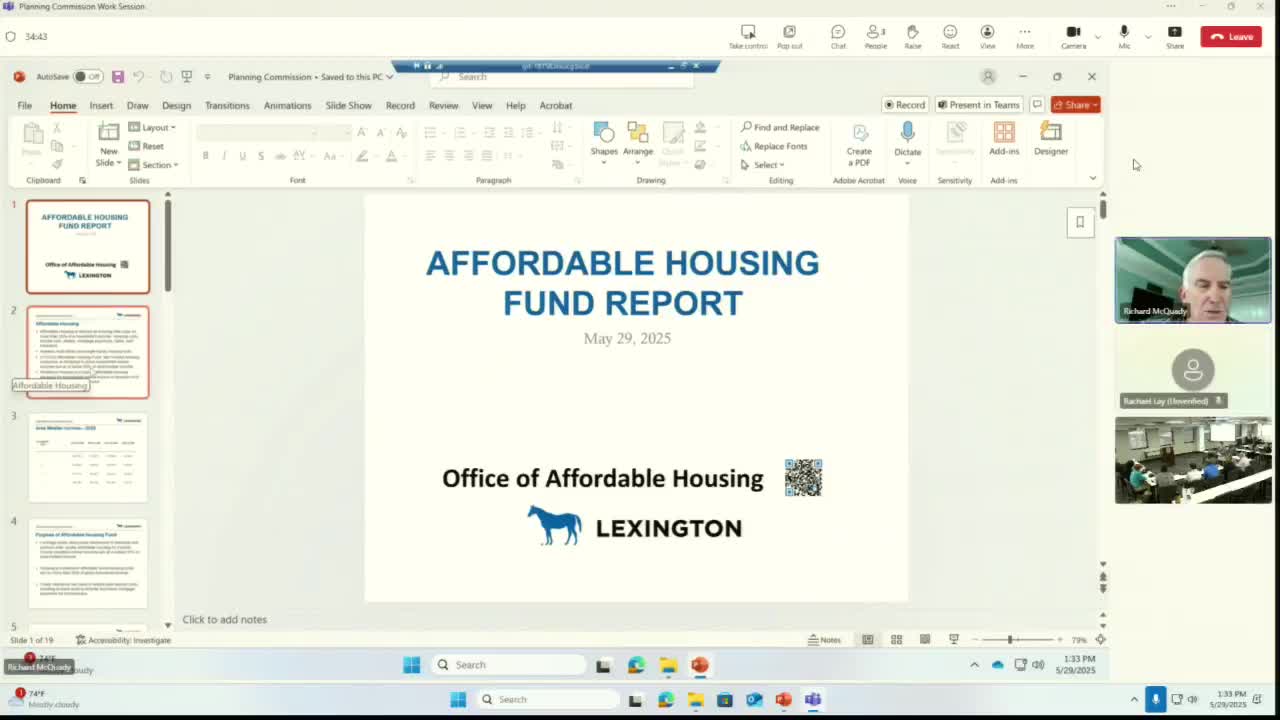
Rick McQuady, Affordable Housing Manager for the City of Lexington, told the planning commission at its May 29, 2025 work session that the city’s Affordable Housing Fund has been used to preserve and produce affordable housing across Fayette County and that maintaining quality in those developments is a program priority.
McQuady said the fund’s purpose, established when the city council created the program in February 2014, is “to leverage public and private investment to preserve and produce safe quality affordable housing units in Fayette County for those at 80% and below” of area median income. He used the federal definition of affordability in his explanation: “Affordable housing is defined as housing that costs no more than 30% of a household's income,” including utilities, taxes and insurance.
The fund has combined city general-fund allocations and federal COVID-relief (ARPA) dollars with other public and private resources. From fiscal year 2015 through 2025 the city allocated about $31,000,000 in general funds and approximately $17,000,000 in ARPA money, McQuady said, for a total near $48,300,000. He said the fund has committed roughly $52,900,000 in total financing to support 3,661 units, at an average of approximately $14,466 per unit; the program has leveraged roughly $474,000,000 in outside investment, he added.
Why it matters: McQuady said preservation is as important as new construction because existing affordable units age and require rehab. He said the fund places deed restrictions on units to preserve affordability — 15 years for multifamily units and five to 15 years for…
Already have an account? Log in
Subscribe to keep reading
Unlock the rest of this article — and every article on Citizen Portal.
- Unlimited articles
- AI-powered breakdowns of topics, speakers, decisions, and budgets
- Instant alerts when your location has a new meeting
- Follow topics and more locations
- 1,000 AI Insights / month, plus AI Chat