Get Full Government Meeting Transcripts, Videos, & Alerts Forever!
Get email alerts on the Affordable Housing topic
No spam. Unsubscribe anytime.
Lexington affordable-housing manager details fund allocations, outcomes and challenges
Summary
Rick McQuady, Lexington’s affordable housing manager, told the planning commission the city’s Affordable Housing Fund has committed roughly $52.9 million to support 3,661 affordable units, described funding sources and warned rising interest rates and management costs are increasing subsidy needs.
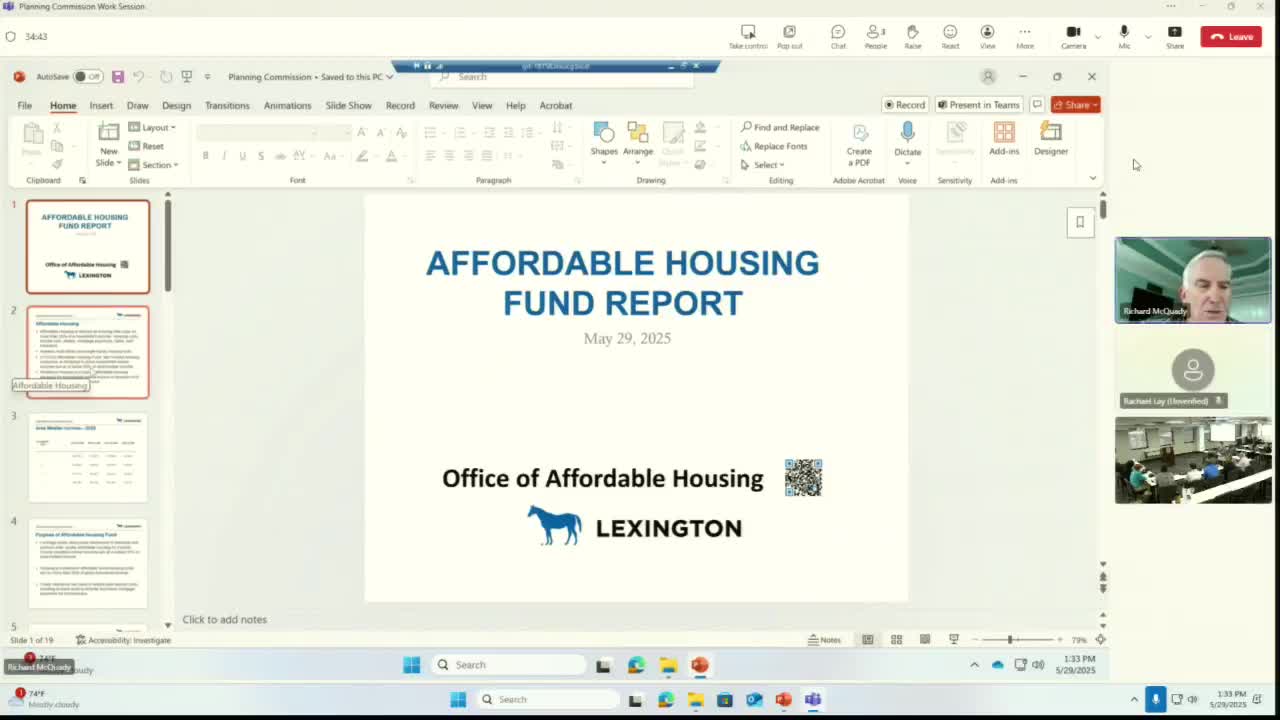
Rick McQuady, Affordable Housing Manager for the City of Lexington, told the planning commission at its May 29, 2025 work session that the city’s Affordable Housing Fund has been used to preserve and produce affordable housing across Fayette County and that maintaining quality in those developments is a program priority.
McQuady said the fund’s purpose, established when the city council created the program in February 2014, is “to leverage public and private investment to preserve and produce safe quality affordable housing units in Fayette County for those at 80% and below” of area median income. He used the federal definition of affordability in his explanation: “Affordable housing is defined as housing that costs no more than 30% of a household's income,” including utilities, taxes and insurance.
The fund has combined city general-fund allocations and federal COVID-relief (ARPA) dollars with other public and private resources. From fiscal year 2015 through 2025 the city allocated about $31,000,000 in general funds and approximately $17,000,000 in ARPA money, McQuady said, for a total near $48,300,000. He said the fund has committed roughly $52,900,000 in total financing to support 3,661 units, at an average of approximately $14,466 per unit; the program has leveraged roughly $474,000,000 in outside investment, he added.
Why it matters: McQuady said preservation is as important as new construction because existing affordable units age and require rehab. He said the fund places deed restrictions on units to preserve affordability — 15 years for multifamily units and five to 15 years for single-family units, depending on the board’s terms — and that most funding (about 80%–86%) targets households at or below 60% of area median income.
Key funding sources and program mechanics
McQuady described the low-income housing tax credit (LIHTC), governed by Internal Revenue Code §42 and allocated in Kentucky by the Kentucky Housing Corporation (KHC), as the primary subsidy that brings equity into large multifamily developments. He said LIHTC projects typically need to be roughly 20 units or larger to be financially feasible. Other resources he named include HUD programs (for example, HOME), grants and low-interest or forgivable loans from the Affordable Housing Fund, the Federal Home Loan Bank of Cincinnati programs, private bank debt and developer equity.
McQuady said loan repayments on previously funded projects have returned about $6,100,000 to the fund over the last 11 years; he also said the fund’s administration cost over that period has been about $1,500,000.
Who the fund serves and what has been built
McQuady gave income and occupancy details: he said area median income for a household of four in Fayette County is $102,400 and that the average household income served by funded units was about $22,575 (figures he described as based on 2024 compliance reviews). He said ARPA-funded projects emphasized lower incomes and permanent-supportive and accessible senior units: the ARPA-funded pipeline included 45 accessible senior units and 34 permanent supportive-housing units. McQuady said the fund has financed about 21 homeownership units to date and that most activity has been rental development.
He described a few developer partners by name — AU Associates, Winterwood, the Lexington Housing Authority, the Lexington Urban League and Habitat for Humanity — and said developers frequently create separate LLCs for projects. McQuady said Lexington has preserved many tax-credit and other affordable units and that one large recent development, Kearney Ridge on Georgetown Road, included roughly 252 units.
Challenges and constraints discussed
McQuady identified several constraints: rising interest rates and higher construction costs have increased project debt service and have required larger subsidy per unit; property-management labor shortages and wage pressures are increasing operating costs; and acquiring viable, affordably priced land in Fayette County is difficult. He said these trends have pushed average per-unit public subsidy up from under $10,000 pre-COVID to just under $14,500 in recent years.
Exchange with commission members
Commission members asked how local land-use and planning decisions can help developers access LIHTC and other competitive funding. McQuady said KHC’s scoring and qualified allocation plan determine LIHTC scoring and that those rules change periodically; he said the state sometimes uses geographic boosts for qualified census tracts but that he does not control the scoring rules. He also said the city’s planning department has changed rules that help affordable development, including reducing or eliminating parking requirements.
On vouchers and tenant selection McQuady said acceptance of Housing Choice vouchers (Section 8) is a requirement for any development receiving Affordable Housing Fund dollars: “One of the requirements is you cannot turn down a tenant simply because they have a voucher,” he said. He told the commission most tenants in nonelderly-disabled developments are employed and appealed to members to emphasize who lives in affordable housing when engaging with neighborhoods.
On ARPA timing: McQuady told the commission ARPA funds had to be committed by Dec. 31, 2024, and spent by Dec. 31, 2026; he said the city expects to have the allocated ARPA-funded projects completed and expenditures made well before the federal spending deadline.
Next steps noted by commissioners
Members asked staff to assemble additional information for the commission, including a district-by-district mapping of funded projects and invitations to housing providers and financial partners to appear before the commission to discuss barriers and financing. Commissioners suggested exploring Community Reinvestment Act (CRA) mechanisms and other bank products to align bank investments with affordable housing projects.
No formal vote or city-council action occurred during the discussion. McQuady said all fund disbursements require Affordable Housing Fund Board approval and that he brings applications and underwriting recommendations to that board for funding decisions.
Ending
Commissioners said they want to convene developers, service providers and lenders in a future session to identify specific zoning, financing and procedural changes that could accelerate projects. Several members said staff should return with a list of recommended invitees and a summary of policy ideas the commission could pursue.