Lifetime Citizen Portal Access — AI Briefings, Alerts & Unlimited Follows
Debate over Melrose protected bike lanes turns to safety, emergency access and cost
Loading...
Summary
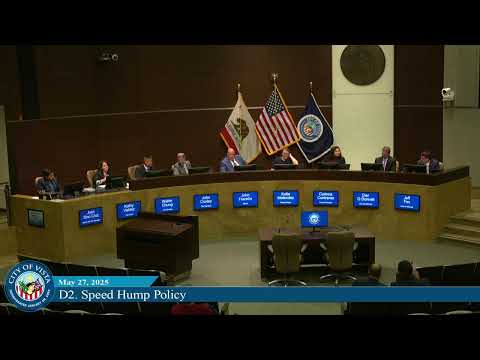
After hours of public testimony and expert presentations, councilmembers split over newly installed asphalt berms on Melrose Drive. A motion to remove berms in a section of District 4 failed; council directed staff to continue some installations while pursuing public education and further review of problem sites.
A heated, hours-long discussion of Vista's new protected bike lane project centered on safety, emergency access and whether the city should remove recently installed asphalt berms that separate bicyclists from traffic on stretches of Melrose Drive.
Councilmember Joe O'Donnell moved to remove all berms and delineators from Shadow Ridge to Dawson on both the north and south sides of South Melrose and to remove berms from Dawson to Faraday; he said the change would reflect resident opposition in his district and save money. "Remove all berms and delineators from Shadow Ridge to Dawson on both the north and south sides of the Street," O'Donnell said in presenting the motion.
That substitute motion failed in a roll-call vote recorded in the minutes: two in favor, two against and one abstention (the record shows Councilmember O'Donnell abstained on that vote). The council then considered alternate language and additional requests for targeted changes.
Deputy Mayor Melendez, who supported continuing the protected-bikeway work citywide, urged a data-driven approach and stepped-up public education. "I stand by my decision to support the protected bikeways," Melendez said, arguing that vertical separation and physical buffers can reduce vehicle-bicycle conflicts when properly designed and maintained.
Public testimony filled more than two hours. Residents and advocacy groups were sharply divided. Dozens of speakers backed the berms as lifesaving protection for cyclists and pedestrians, especially children who ride to nearby schools. "These asphalt barriers are vital for safety," said Shannon Goen, noting previous fatal collisions on South Melrose. Other speakers — including some cyclists and nearby homeowners — said the low-profile berms and short, white flex posts are a hazard: riders can be thrown from their bikes if they strike a berm, they said, and the barriers collect debris and complicate emergency response.
Fire Chief Gerard Washington told the council the department had not yet collected a full set of incident data specific to the new berms and asked that the city track and report any emergency-response impacts. "Safety is our top priority," he said, adding that staff would work with the council to gather operational data.
An invited expert, Dr. Ron Medak — who reviewed Encinitas data after that city's similar cycle-track installations — told the council a before-and-after analysis showed more reported bicycle collisions on the Encinitas segment he studied. In his presentation Medak said the Encinitas segment had 18 collisions before the cycle track and 27 after installation, and he documented additional incidents not captured in official datasets. He concluded the cycle track there had “a significant negative effect” in the sample he examined.
Councilmembers stressed trade-offs. Several noted the city has budgeted federal and local funds for a connected bikeway network and cited research from federal and regional agencies showing protected facilities can reduce vehicle-bicycle collisions overall. Others emphasized local rollout and design problems — in particular the initial placement of black asphalt berms without high-visibility striping and the need to clear debris more frequently.
Council gave staff direction to prioritize public outreach, coordinate with fire and law enforcement on operational concerns, and compile a post-installation safety report. The transcript shows the council debated targeted removals for a short stretch in District 4 but did not adopt a blanket citywide removal.
The council also discussed enforcement and maintenance steps such as increased street sweeping of bike lanes and clarifying where parking and trash pickup will operate adjacent to protected lanes. Staff said a portion of project funds remain and committed to return with implementation details and any site-specific engineering changes.
The council's split underscores how cities confront design, safety and operational trade-offs when converting car-oriented streets to multimodal corridors. Vista officials left the meeting with two clear tasks: collect and publish incident and response data for the newly altered corridors, and expand community education and enforcement to reduce conflicts while staff reviews targeted design adjustments.