Get Full Government Meeting Transcripts, Videos, & Alerts Forever!
Get email alerts on the Land Use Zoning topic
No spam. Unsubscribe anytime.
McMinnville aldermen reject rezoning request for Pace Street property after residents oppose change to R-6
Summary
The McMinnville Board of Mayor and Aldermen voted down Ordinance 2025-01, a proposal to change the zoning of a property commonly identified in the agenda as “TBD Pastry” (Tax ID 058002.0) from R-1 (low-density residential) to R-6 (smart-growth single-family).
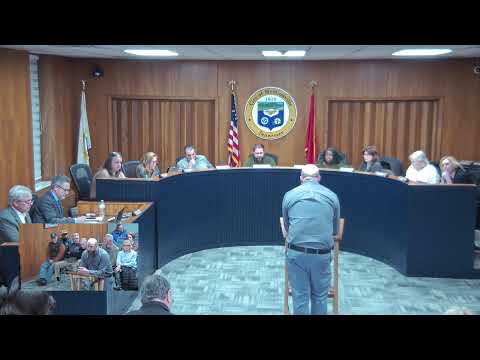
The McMinnville Board of Mayor and Aldermen voted down Ordinance 2025-01, a proposal to change the zoning of a property commonly identified in the agenda as “TBD Pastry” (Tax ID 058002.0) from R-1 (low-density residential) to R-6 (smart-growth single-family). The vote followed an extended public comment period during which several nearby homeowners urged the board to keep the parcel zoned R-1.
Residents who live adjacent to the parcel told the board they bought homes expecting R-1 density and said converting the land to R-6 would bring smaller lots, more traffic, and stormwater problems that could reduce property values. Carol Rutledge, who said she lives at 302 Pace Street, told the board she and her neighbors want to “insure” that property values are not decreased and asked aldermen to preserve the historic character of the Bel Air subdivision.
Other residents raised similar concerns. Darlene Woodard, who said she lives at 102 Bickers Drive, pointed to a lack of sidewalks and steep hills on Pace Street and asked the board to keep the area at R-1 so families would retain yards and safe outdoor space for children and pets. Michael Adamson, who lives at 308 Pastry, said he invested in his home because it is in an R-1 neighborhood and opposed the R-6 change. Roger Yates, a longtime resident of Delano Street, and Larry Judkins, who has lived on Page Street for 50 years, asked the board to review drainage and infrastructure before altering zoning.
Planning commission staff told the board the commission had recommended approval of the rezoning (not unanimously). City planning staff explained that the request complies with the master plan and noted technical distinctions between R-1 and R-6: lot-coverage rules, right-of-way widths, and fire-code requirements for developments of 30 or more single-family homes, which would require two points of ingress and egress. Staff cautioned that smaller lots do not automatically translate into smaller houses because of lot-coverage limits and that roadways, drainage, and required infrastructure reduce the theoretical number of lots that could fit on the parcel.
Staff also described subdivision and permitting safeguards: a preliminary and then a final plat process, the option to require bonds to ensure infrastructure installation, and state and local stormwater regulations that must be met before final plat approval or building permits are issued.
At the same time, one board member noted a legal risk: staff said the rezoning application “checks all the boxes” required by state and local rules, and denying it solely on general objections could expose the city to a legal challenge that a court might uphold. That point, raised during the board discussion, was presented as a legal possibility by staff rather than a prediction of litigation.
The board then voted on Ordinance 2025-01. The roll-call vote recorded the following responses: Sally Brock — No; Dietra/Dietrich Dunlap — No; Steve Harvey — No; Rachel Kirby/Coby — No; Carrie Morton — No; Kara/Carrie Youngblood — No; Mayor Mary Chastain — No. The ordinance failed.
What happens next: with the ordinance defeated, the property remains R-1. If the applicant seeks to move forward in the future, any new application would again be subject to the planning commission review and the city’s subdivision and stormwater permitting requirements.
Provenance: The public-comment excerpts are from the public-hearing segment that began when the board announced two concurrent public hearings, one concerning the Pace Street rezoning; residents’ remarks and the planning-staff presentation appear in the public-comment and agenda discussion segments. The vote and roll call are recorded in the ordinance item discussion and vote segment of the full board meeting.