Get Full Government Meeting Transcripts, Videos, & Alerts Forever!
Get email alerts on the Downtown Government Campus topic
No spam. Unsubscribe anytime.
Boca Raton council previews interim agreement, space study for downtown government campus; staff says recreation facilities will be replaced
Summary
City staff said an interim agreement with developer Terra Frisbie and CBRE will set roles, responsibilities and timelines as the city moves toward a master partnership agreement for the downtown government campus.
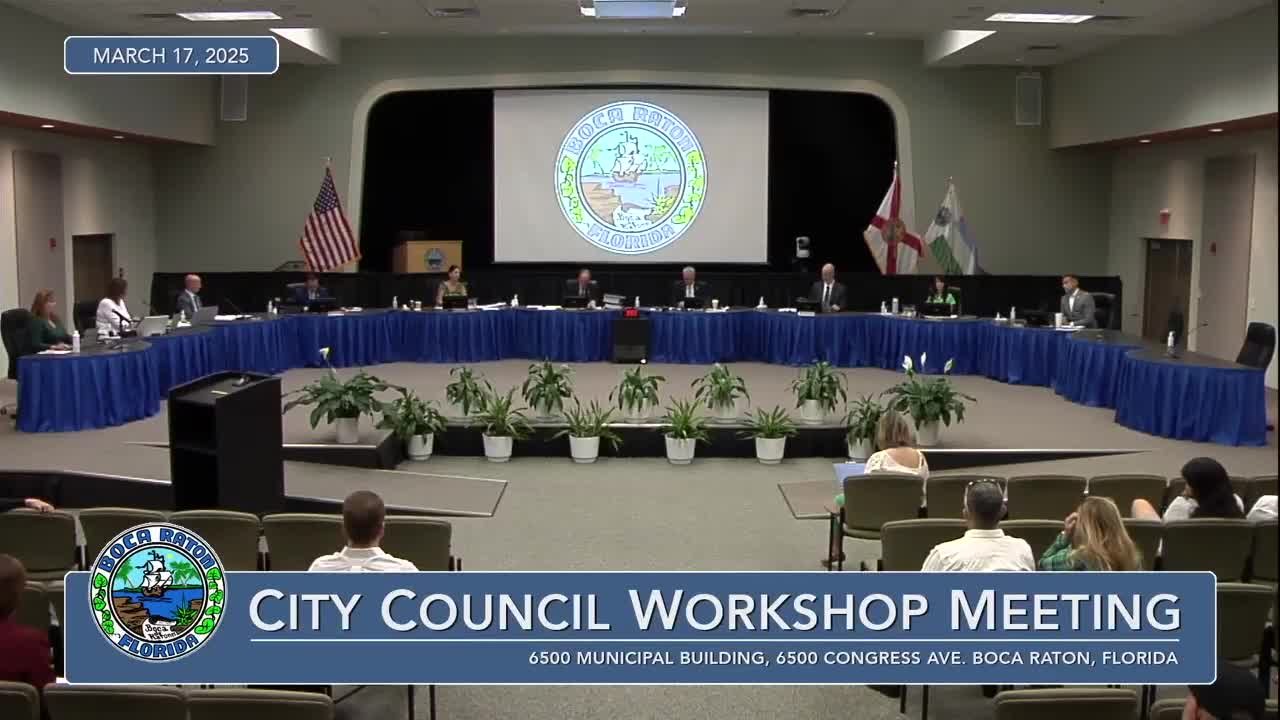
City staff told the Boca Raton City Council on March 17 that an interim agreement with the project's private partner will define roles, responsibilities and timelines as the city moves toward a master partnership agreement for the proposed downtown government campus.
The update came from a city staff member, Mr. Lukasick, who said staff is meeting weekly with CBRE and the partner and is “working on developing our action plans, planning next steps, giving updates” as the team prepares an interim agreement to be considered the following day. Lukasick said the interim contract will set the path toward a revised conceptual plan — an “interim master plan” — and will include a schedule for public engagement before the developer returns with changes to the concept.
The matter matters because the interim agreement will frame the process for designing the campus, selecting which city functions will be located there, and how the city will involve residents in planning. Council members and staff spent much of the meeting clarifying whether the campus would be a short-term temporary location for municipal offices, a permanent relocation of many services, or some combination of both.
Councilmember Wicker urged the council not to treat the move as purely temporary and asked for a cost–benefit analysis that would include long-term options if construction estimates make keeping more services downtown expensive. “We’re still evaluating what’s actually going to happen there,” Wicker said, asking staff and CBRE to include long-term leasing or relocation alternatives in the feasibility work. A separate speaker — identified in the record as Mr. Thompson — said he would “keep an open mind” but agreed feasibility numbers should drive decisions.
Mayor Scott Singer and other council members described a shared, conceptual baseline: core public-facing functions — such as council chambers, public meeting spaces, some clerk functions and other services tied directly to in-person meetings — should remain part of the downtown campus. Staff said it has been planning for a reduced core footprint compared with earlier estimates: initial discussions referenced about 162,000 square feet, which staff later refined to roughly 80,000–85,000 square feet for core downtown functions. Lukasick said staff will also try to use sensors and operational studies while occupying temporary space to better understand actual space needs before finalizing the master plan.
CBRE is participating in the evaluation and outreach. Councilmembers encouraged leveraging private-sector partners and potential landlords to provide conceptual space plans and help identify temporary or permanent office locations. “CBRE is a partner with us in that as well,” Lukasick said.
Public speakers during the council meeting pressed the city to plan for recreation replacements tied to the redevelopment. Mayor’s staff and Mr. Brown, a city staff member who addressed recreation matters, told the council the city intends to replace softball fields removed from the current Memorial Park location at Sugar Sand Park and to replace downtown tennis courts and the skate park. Brown said the softball replacement at Sugar Sand Park could include three or perhaps four fields “with a clubhouse.” He also said the skate park would be modernized and that staff is exploring a North Park location on the west side of Second Avenue in coordination with the Beach and Park District; he acknowledged there may be a period when a temporary skate facility is not available during construction.
Resident Judy Morrow urged the council to preserve the Boca Raton Tennis Center at 271 Northwest Boca Raton Boulevard and said she brought more than 250 signed petitions asking the city to keep the facility in place. Mr. Brown replied that the city’s plan is to “replace what we have” and that tennis replacement could be partially downtown. Skate park advocates said any permanent removal of the Tim Huxold skate park should be followed by construction of a modern, free, publicly accessible facility.
Councilmembers repeatedly urged staff to proceed with detailed feasibility analysis, to be transparent about which services are assumed to remain downtown, and to keep public outreach active as the interim agreement and revised concept plan are developed. Lukasick said the interim agreement before the council will establish roles and timelines and allow formation of work groups to address components of the master partnership agreement.
For now, the council left the project open to further analysis and refinement. Staff will present the interim agreement for formal consideration at the next meeting, and public engagement will continue before a revised conceptual plan is returned by the partner.