Get Full Government Meeting Transcripts, Videos, & Alerts Forever!
Get email alerts on the Child Welfare Burden Of Proof topic
No spam. Unsubscribe anytime.
Committee debates raising burden of proof in termination-of-parental-rights cases to 'beyond a reasonable doubt'
Summary
Senate Bill 156 would change child-welfare evidentiary standards, requiring proof "beyond a reasonable doubt" to terminate parental rights; the sponsor called the change a safeguard for constitutional rights, while child-welfare officials warned it could harm children by reducing court oversight and access to services.
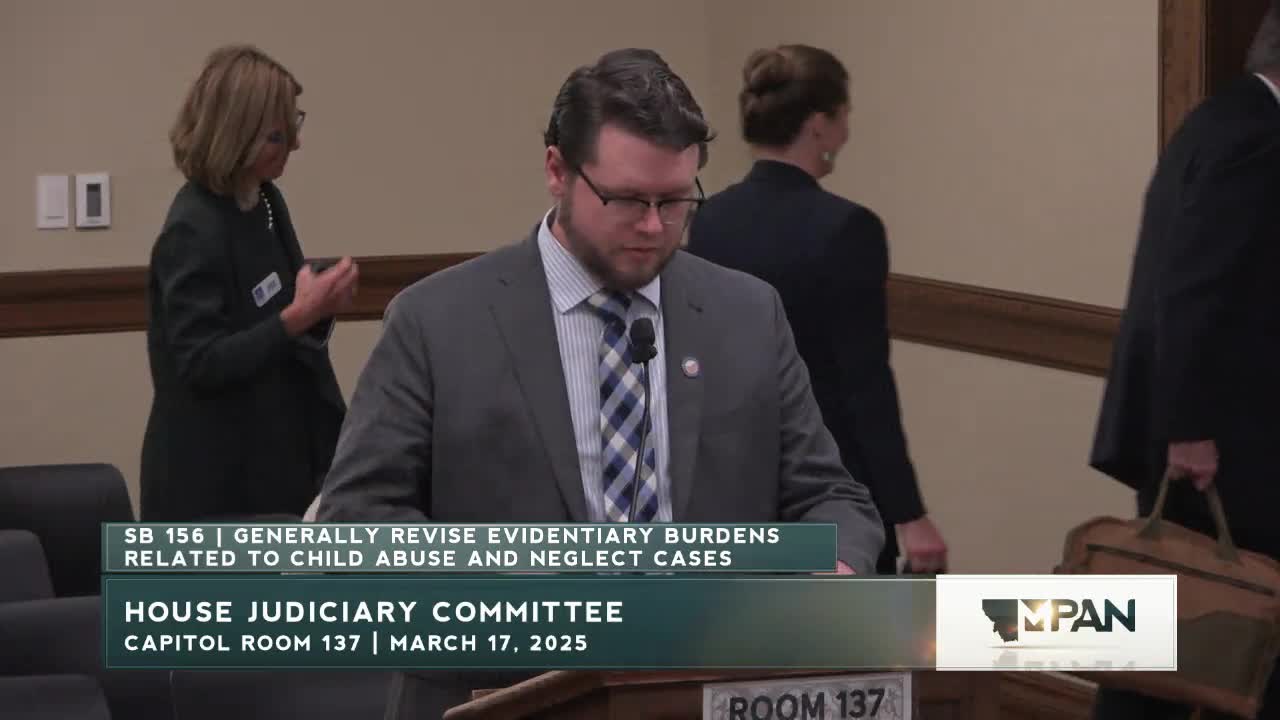
Senate Bill 156, sponsored in committee by Senator Daniel Emmerich, would raise evidentiary standards in Montana child-welfare law: it would require proof "beyond a reasonable doubt" for termination of parental rights rather than the current lower standard. The sponsor said the measure mirrors language in the federal Indian Child Welfare Act (ICWA) and the Montana Indian Child Welfare Act (MCWA) and is intended to ensure courts have sufficient evidence before terminating constitutionally protected parental rights.
Emmerich told the House Judiciary Committee the current preponderance standard can lead to mistakes and that the higher standard would require Child and Family Services (CPS) to present stronger proof in termination cases. "When we're removing a constitutionally guaranteed right, we want to make very sure that we're not doing it by mistake," he said.
Informational and opposing testimony highlighted operational consequences. A speaker from Child and Family Services (CFS) warned the change could result in more case dismissals and leave children in unsafe homes or create repeated removal cycles. The agency cited data showing a higher-than-national-average reentry rate — 6.7 percent in Montana versus 5.6 percent nationally — and said raising the burden for adjudication and termination could reduce court oversight that helps families access treatment and services. CFS described typical case timing: emergency protective services and removal followed by an adjudication hearing within 90 days; termination proceedings may occur after many months of services and oversight.
Defense of the proposal focused on the gravity of permanently ending parental rights. Emmerich and supporters argued that termination commonly occurs up to 18–24 months into a case and that courts and the department should be able to prove the case to the higher standard after years of involvement. Committee members asked for examples and data; several informational witnesses (including Heather Webster, deputy chief county attorney in Yellowstone County) and county attorneys discussed how timelines and service access can affect outcomes.
Testimony was sharply divided on effects for children and families. Supporters framed the bill as protecting parental liberty rights and requiring better-prepared cases; opponents and child-welfare professionals said the change risks returning children to harm, increasing reentry to foster care, and reducing parents' access to court-ordered services. The committee held the hearing and took extensive testimony; no committee vote was recorded during the session.