Get Full Government Meeting Transcripts, Videos, & Alerts Forever!
Get email alerts on the Long Range Capital Program topic
No spam. Unsubscribe anytime.
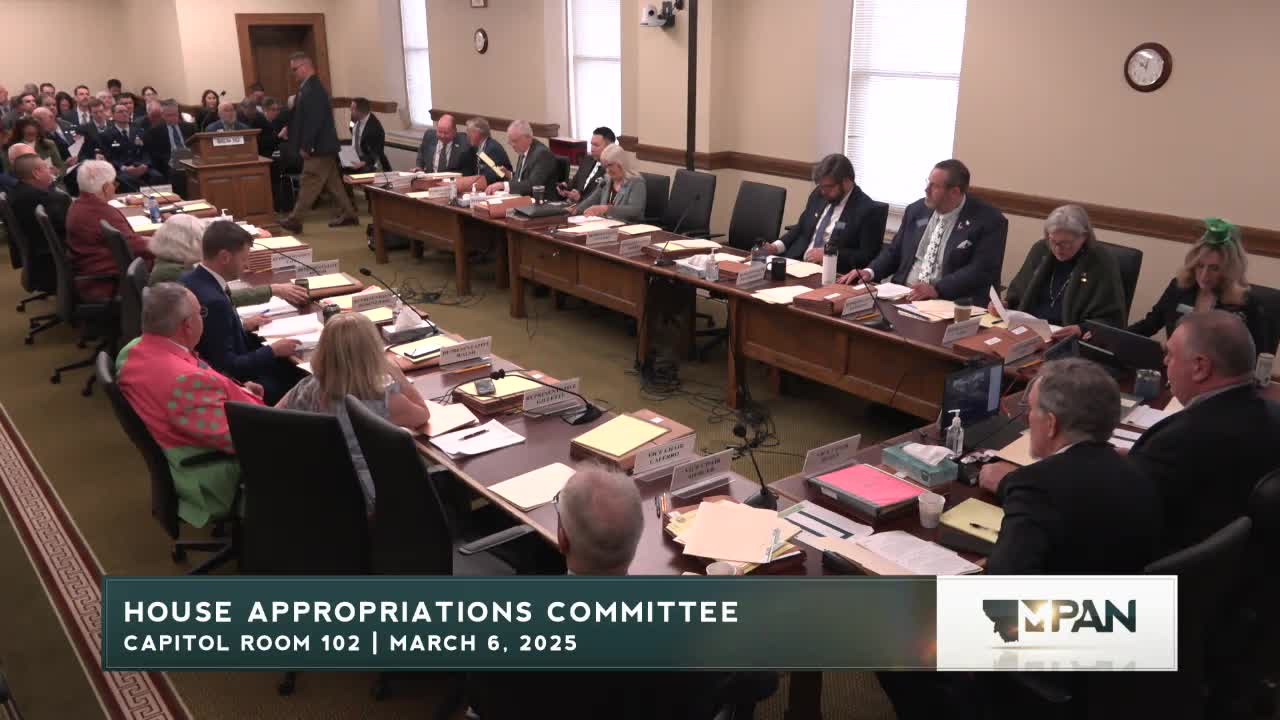
House panel hears House Bill 5 long-range building plan with cuts, new priorities and questions on funding sources
Summary
The Montana House Appropriations Committee on Wednesday heard House Bill 5, the long-range capital and maintenance package, with lawmakers pressing agency witnesses about funding sources, project prioritization and procurement changes while the bill sponsor said committee edits trimmed apparent overpricing on several projects.
HELENA — The Montana House Appropriations Committee on Wednesday heard House Bill 5, the long-range state capital, facility building and maintenance program, receiving detailed questions from legislators about project costs, funding sources and how the Department of Administration will prioritize work on the Montana State Hospital and Department of Corrections projects.
Representative John Fitzpatrick, the bill sponsor, told the committee House Bill 5 packages three components: major repair projects, capital development projects and operating-and-maintenance (O&M) funding tied to new or substantially renovated facilities. Fitzpatrick said the major repair section lists 56 projects totaling about $43.3 million; the bill overall aggregates projects funded from state capital development dollars, state special revenue accounts and federal special revenue, and the entire long-range package represents a multihundred-million-dollar ask compared with prior sessions.
The bill sponsor and witnesses described committee edits that trimmed some costs and directed the Architecture and Engineering (A&E) Division to standardize designs and bundle similar projects to reduce design and construction costs. Russell (Russ) Catherman of the A&E Division testified he supports House Bill 5 and said staff are available to answer project-specific questions.
Committee members pressed agency witnesses on funding sources and project details. Lena Havron of Montana Fish, Wildlife & Parks (FWP) explained that the $12 million land-acquisition line is drawn from multiple state special revenue accounts, including the Wildlife Management Account and the Habitat Montana fund, with a portion coming from general license and State Hunting Improvement Program auction funds. Havron said an additional $18 million labeled as an "enhanced" Habitat Montana appropriation is funded by marijuana tax revenue (commonly referred to in testimony as 701 funds) and is stacked on top of existing Habitat Montana funding.
Erica Thomas of the Legislative Fiscal Division and other committee members requested historical context on long-range spending; Thomas said budget documents show fund-balance tables that can be used to report prior-year unspent appropriations and that she could supply additional historical figures on request.
Several lawmakers focused on specific projects. Representative Gillette sought historical spending context and asked whether the committee had scrutinized the purpose of enhanced 701 funding; Fitzpatrick said the committee did not evaluate the 701-funded project purposes "in any great detail." Representative Nave asked whether a $1.3 million figure is the operating-and-maintenance (O&M) amount for a new Department of Corrections low-side housing expansion; Fitzpatrick confirmed the O&M amount shown in the bill is $1,300,000.
Questions about ranges and remediation drew attention. The statewide indoor firing-range remediation line-item carries a $2,450,000 price tag; Fitzpatrick described the remediation as primarily ventilation upgrades and lighting modernization. Major General Hronek, the adjutant general and director of the Department of Military Affairs, clarified acronyms and locations for military projects (for example, Fort Harrison and Missoula), and said MEP in the bill denotes mechanical, electrical and plumbing repairs.
Committee members also asked about procurement and bundling. The bill directs A&E to prioritize project management and to bundle similar projects (for example, multiple roof replacements) to lower costs. Witnesses acknowledged bundling can increase contract size and bonding requirements, which may discourage smaller contractors, but argued bundling will generally secure more competitive pricing for similar scopes of work.
Members asked the sponsor and agencies to formalize reporting. Vice Chair Mercer requested quarterly reports on progress for prioritized projects — particularly for Montana State Hospital and corrections facilities — and Fitzpatrick said he would discuss a reporting requirement with Mercer and the budget office and consider drafting an amendment before executive action.
On capital-reserve authority, committee members asked why the Department of Military Affairs has a $31.5 million capital reserve in the bill. Fitzpatrick and witnesses said the line is intended to preserve federal special revenue authority; the committee cut some original DMA project requests and created a reserve to hold federal funds if they become available while allowing the department flexibility to respond to emergent needs. Fitzpatrick said some trimming was made because several DMA projects appeared overpriced.
Higher education spending authority and contingency funds also drew scrutiny. The bill includes $20 million in authority for the university system for use of nonstate funds and a $10 million reserve for the Department of Administration to address market, supply-chain and inflationary increases on projects; Fitzpatrick and the university commissioner said that authority is intended for smaller interim projects and that major projects would come back to the legislature if they exceeded statutory thresholds.
Several agencies agreed to provide follow-up materials. Havron (FWP) agreed to provide the committee a history of Habitat Montana funding sources and projected uses of the $12 million land-acquisition appropriation and the enhanced 701 funds. Erica Thomas (Legislative Fiscal Division) said fund-balance tables and prior-year appropriation data are available for committee review.
No formal motions or votes were taken at the hearing; committee staff said executive action on the bill will be scheduled later. Fitzpatrick said he would introduce technical adjustments in advance of executive action.