Get Full Government Meeting Transcripts, Videos, & Alerts Forever!
Get email alerts on the International Relations topic
No spam. Unsubscribe anytime.
Chair of Ireland's Senate addresses Private Acts Committee, praises U.S. role in Northern Ireland peace and highlights trade, education ties
Summary
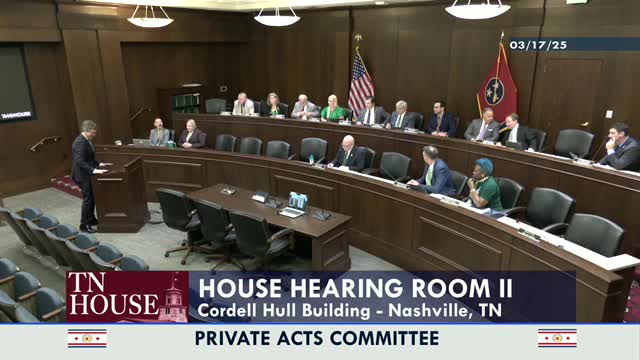
Senator Mark Gailey, chair of Ireland's Senate, spoke to the Private Acts Committee on March 17 about historical U.S.-Ireland ties, the Good Friday Agreement implementation, paramilitary risks in Northern Ireland and the work of the Tennessee-Ireland Trade Commission.
Senator Mark Gailey, who identified himself as chair of Ireland's Senate, addressed the Private Acts Committee on March 17 during a visit timed for St. Patrick's Day and spoke about historical and contemporary ties between Ireland and the United States.
Gailey credited U.S. support for the 1998 peace process in Northern Ireland and said implementation was the difficult work after the accords. "Peace isn't a moment in history. It's when you implement it," he said, describing the years of work after the Good Friday Agreement to decommission weapons, reform policing and manage prisoner releases.
Gailey warned that paramilitary structures still exist in Northern Ireland and described an estimated 10,000 people associated with paramilitary groups, though only a few hundred are active. He said those groups are involved in "racketeering" and other criminal activity that can be destabilizing if reactivated.
The senator also promoted economic and educational ties. He welcomed the Tennessee-Ireland Trade Commission, described by Gailey as an effort "not just [as] a trade commission, it's also an education commission bringing the universities together to collaborate," including student exchanges and research partnerships. He highlighted Ireland's role as an English-speaking gateway to the European Union and said companies based there can offer U.S. firms broader access to EU markets.
Gailey discussed Brexit-related trade issues, noting that Northern Ireland retained certain arrangements that avoided a hard land border on the island and that U.S. political support was significant in preserving an open border. He argued that an open cross-border arrangement helps prevent a return to the violence of the Troubles.
Committee members asked about Ireland's population, citizenship by descent and the country's international investments. In response to a question about citizenship through ancestry, Gailey summarized what is commonly called the "grandparent rule," saying, "If your grandmother or grandfather were born in Ireland, then you're entitled to [citizenship]." Vice Chairman Sparks and other members discussed the new direct flight from Nashville to Dublin and the value of stronger tourism and trade links.
Gailey invited committee members to Ireland for annual events that around an August college football game and said the gatherings bring state legislators and potential investors together. He credited U.S. figures including Sen. George Mitchell for mediation work during the peace process and recounted how diplomacy sometimes meant "shuttle" negotiations because opposing parties would not meet in the same room.
The visit concluded when the committee paused for the senator's remarks and then returned to business.
Why it matters. The senator's remarks underscored the continuing political and economic relationship between U.S. states and Ireland, and highlighted the committee-level interest in trade, education exchanges and tourism links between Tennessee and Irish institutions.