Get Full Government Meeting Transcripts, Videos, & Alerts Forever!
Get email alerts on the Parole Board Discretion topic
No spam. Unsubscribe anytime.
District attorneys back widening parole board discretion; some senators warn it may undercut incentives for rehabilitation
Summary
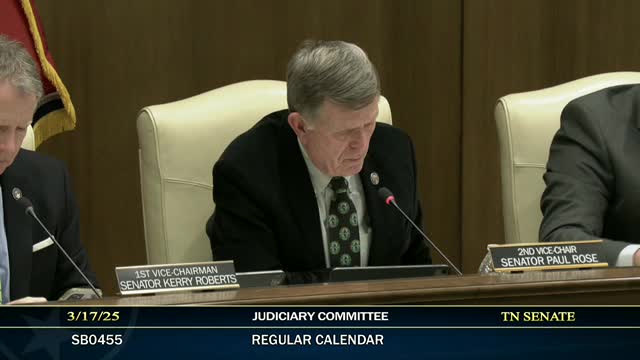
The Senate Judiciary Committee approved Senate Bill 455, restoring the parole board's ability to deny parole when release would diminish the seriousness of an offense or promote disrespect for the law.
Senate Bill 455, sponsored by Sen. Rose on behalf of the District Attorneys' Conference, cleared the Senate Judiciary Committee and will go to the calendar after committee members voted to approve the bill and an amendment.
The bill removes statutory language that limited parole denials solely to a fixed list of offenses and restores (per sponsors) the parole board's discretion to deny parole when releasing an inmate would "depreciate the seriousness of the offense" or "promote disrespect for the law." Supporters from the Tennessee District Attorneys General Conference argued the change simply restores decision-making authority to the parole board and allows the board to account for serious harms not listed in the current statute.
Stephen Crump, executive director of the Tennessee District Attorneys General Conference, and Mike Donovan, deputy executive director for legal services and policy, testified in favor. Donovan provided an extended list of offenses prosecutors want the board to be able to consider when denying parole, including aggravated assault resulting in death, fentanyl delivery resulting in death or overdose, carjacking, aggravated robbery, aggravated kidnapping, aggravated burglary (home invasion), certain class A/B property and drug trafficking offenses, crimes involving a deadly weapon or serious bodily injury, money laundering, exploitation of a vulnerable adult, terrorism offenses, and bribery of a public servant.
Several senators said they were sympathetic to victims and the desire to ensure public confidence in sentencing, but some — including Sen. Roberts — warned that parole was intended as part of sentence incentives. Roberts said the state's sentencing scheme was designed to provide carrots for rehabilitation: behavior, programming and education inside facilities that could make an inmate eligible for parole. He asked why the Legislature should widen parole board discretion instead of addressing sentencing ranges if the legislature believed sentences were too lenient.
Prosecutors responded that the bill does not remove parole board authority to grant release; rather, it restores discretion to deny parole in cases where the seriousness of the offense and the victim's harm weigh against release. Proponents framed the bill as honoring victims and the sentences imposed in court.
After debate, the committee approved the bill and sent it to the Senate calendar. The roll call recorded six ayes, two noes and one present not voting.