Get Full Government Meeting Transcripts, Videos, & Alerts Forever!
Get email alerts on the Parental Accountability topic
No spam. Unsubscribe anytime.
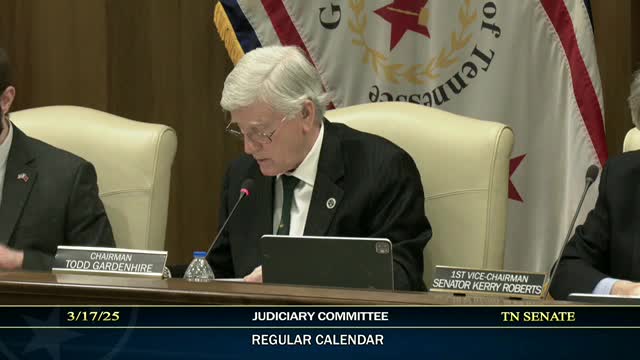
Senate Judiciary panel rejects mandatory parental restitution for third juvenile offenses
Summary
Senate Bill 219, which would have required judges to order parents, guardians or custodians to pay restitution after a juvenile's third offense, remained in committee after a divided vote.
Senate Bill 219, which would have made restitution mandatory for parents, guardians or legal custodians after a juvenile's third or subsequent offense, remained in committee after a divided vote.
The bill's sponsor, Sen. Trevor Taylor, told the committee the measure would change the Parental Accountability Act passed the prior year by converting the current judge's discretion for third and subsequent juvenile acts into a mandatory requirement. Under the statute described during testimony, a judge may currently order restitution for a second or subsequent act; the proposal would require restitution on a third offense with amounts set in statute: $250 minimum for misdemeanor acts, $500 minimum for felonies, and a $1,000 maximum.
The measure drew testimony from a Vanderbilt Law School clinical professor and a victim's advocate. Cara Souval, a clinical law professor who directs Vanderbilt's Youth Opportunity Clinic, urged the committee to keep the current discretionary standard. She warned mandatory restitution could harm families, reduce access to guardianship or kinship placements, and confuse the purpose of restitution by routing money to law enforcement rather than to victims. "Restitution is supposed to be financial compensation to victims," Souval said, arguing the bill could divert resources from victims and impose debt burdens on families.
Raffia Muhammad McCormick, a victim's advocate with Mothers Over Murder, told senators that financial penalties on parents often increase household stress and can make it harder for families to obtain therapeutic services that helped her daughter after multiple juvenile hearings. McCormick described court-ordered therapy and psychiatric evaluations as what ultimately changed her child's path and urged the committee to vote no and invest instead in supports for children and families.
Several senators pressed the sponsor on scope and consequences. Senators asked whether the statute would attach liability to a person who gained custody later (for example, a relative who becomes legal guardian after two prior offenses). Taylor and witnesses acknowledged the bill, as drafted, would reach a legal guardian or custodian at the time of the third offense even if that person had not been responsible for earlier incidents, and that could discourage relatives or foster caregivers from taking custody.
Other senators described philosophical objections to penalizing parents for their children's conduct and raised concerns about the financial burden on low-income households. Multiple senators said the committee had adopted the discretionary approach the prior year and preferred keeping judicial flexibility.
After debate, the panel voted and the bill remained in committee. The sponsor asked for a positive vote; senators opposed and praised the intent but said they would not support converting discretion into a mandatory sanction.
Votes and outcome: the committee left SB 219 in committee following a roll call; the sponsor's motion did not carry.
The debate combined policy concerns about juvenile rehabilitation and practical questions about placement and kinship care, and committee members repeatedly returned to whether mandatory restitution would produce behavioral change or simply impose financial hardships that could undermine rehabilitation.
What's next: The bill remains in the Judiciary Committee pending further action or amendment.