Get Full Government Meeting Transcripts, Videos, & Alerts Forever!
Get email alerts on the Elections And Constitutional Amendments topic
No spam. Unsubscribe anytime.
Committee hears bills to raise voter approval threshold for constitutional amendments
Summary
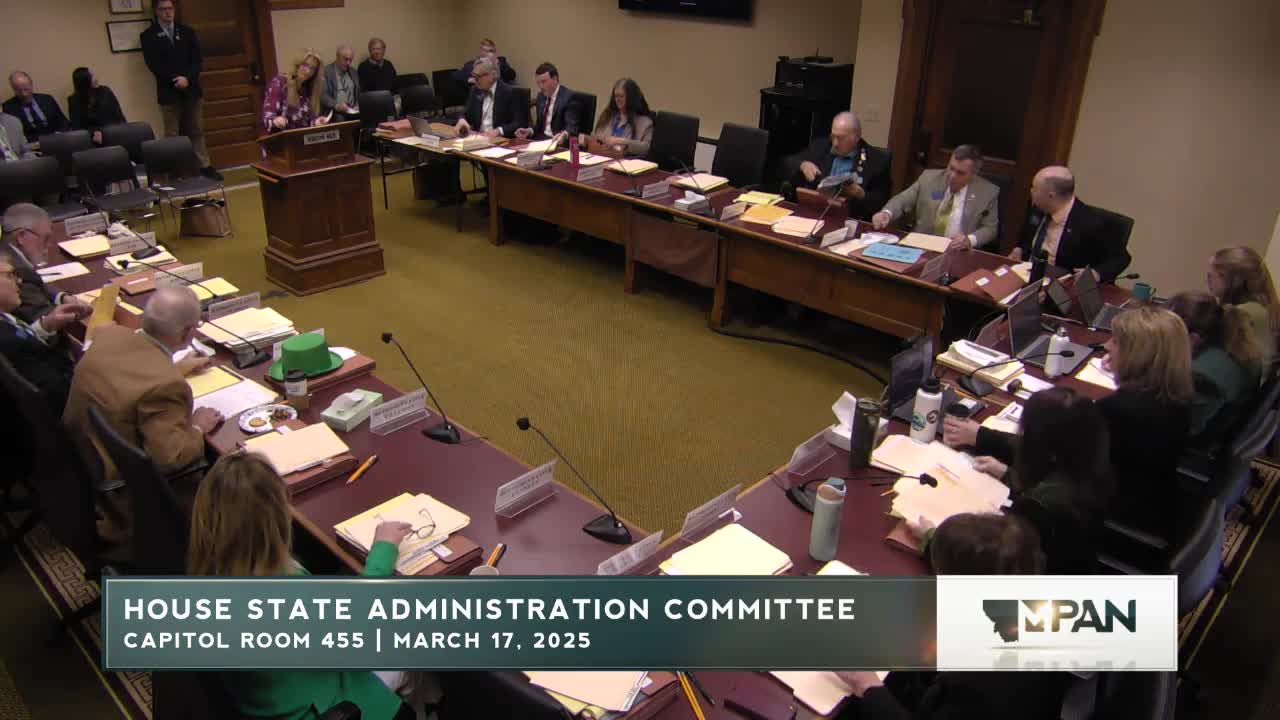
HELENA — The House State Administration Committee heard testimony March 17 on House Bills 821 and 822, measures from Representative Jodie Etchart that would raise the voter approval threshold for constitutional amendments from a simple majority to 60 percent.
HELENA — The House State Administration Committee heard testimony March 17 on House Bills 821 and 822, measures from Representative Jodie Etchart that would raise the voter approval threshold for constitutional amendments from a simple majority to 60 percent.
Etchart, a Republican from Billings, told the committee she filed the measures at the request of a constituent who argued the legislature must achieve a two-thirds vote to refer constitutional amendments and that voters should face a higher threshold as well. “So do we want to make that threshold for changing our constitution 50 percent, or do we want to make it at 3/5s?” Etchart said during her opening remarks.
Supporters of the current 50%-plus-one rule and opponents of the bills said the proposals would make it substantially harder for voters to change the constitution and could freeze policies that later fall out of public favor. Jonathan Motl, a licensed Montana attorney and longtime ballot-issue advocate, said the signature requirements for placing a constitutional initiative on the ballot are already more demanding than for statutory initiatives, and he urged the committee to reject the bills. “The actual vote that takes place at the ballot … that is 50 percent, one more than 50 percent, and that is the requirement,” Motl said.
Mark MacKin, who testified in opposition, noted existing review processes and court scrutiny for initiatives, and said increasing the approval threshold risks blocking changes that previously have won voter support. “I think you’re setting too high a standard at 60 percent,” MacKin said.
Hunter Losing of the Montana Federation of Public Employees warned that public opinion changes over time and that raising the threshold would make it more difficult to reverse initiatives that voters later oppose. C.B. Pearson, speaking for himself, emphasized the distribution and signature-count requirements that groups must meet to place a constitutional amendment on the ballot, and urged committee members to vote no on the bills.
Committee members asked clarifying questions about who the proposed change would affect. Representative Strand pressed the sponsor on the policy trade-offs, asking whether the measure would make it more difficult for citizens to keep the constitution up to date; Etchart responded that the bills would not change the process for getting measures onto the ballot but would raise the approval bar required to amend the constitution.
No committee vote was recorded during the hearing. The sponsor closed by reiterating the policy question before members: whether constitutional changes should continue to require a simple majority or be raised to a three-fifths threshold.
The hearing record contains testimony both defending the status quo of majority approval for amendments and arguing for a higher standard to protect constitutional stability. The committee closed the House Bill 821 hearing and opened a separate hearing on House Bill 822 at the same session; testimony and opposition points were largely identical for both bills.