Get Full Government Meeting Transcripts, Videos, & Alerts Forever!
Get email alerts on the Agriculture topic
No spam. Unsubscribe anytime.
Minn. agriculture omnibus bill laid over after committee debate over disease funding, broadband rules
Summary
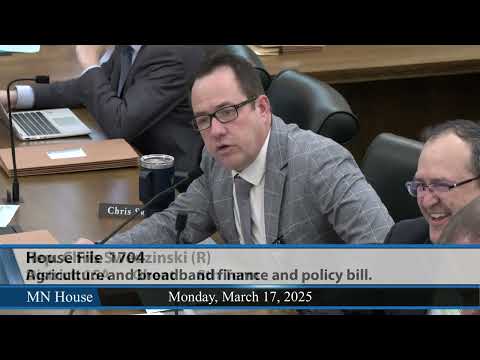
The House Ways and Means Committee on March 17 laid over House File 1704 after extended debate over funding for the Board of Animal Health, an ag emergency fund, broadband installation rules and reductions to some nutrition and farmer-support programs.
ST. PAUL, Minn. — The House Ways and Means Committee on March 17 laid over House File 1704, the agriculture omnibus bill, after members debated funding priorities for livestock disease preparedness, broadband deployment rules tied to worker safety and changes to programs serving small and urban farmers.
Representative Anderson, the bill’s sponsor, told the committee the measure adds about $17 million in base funding for agricultural programs and “fully fund[s] the Board of Animal Health,” citing concern about highly pathogenic avian influenza. Anderson said the bill replenishes the ag emergency fund and adds roughly $1.5 million to that account after it fell to “about 1,200,000” most recently. The bill also funds the Department of Agriculture, supports the Agricultural Utilization Research Institute (AURI), and includes funding for broadband deployment and incentives to build E15 fueling infrastructure.
The debate reflected several fault lines. Members across the aisle and some Democrats warned the bill was not sufficiently bipartisan and flagged program reductions they said would hurt small and emerging farmers. Representative Vang said the measure reduced funding for the Emerging Farmers Office and eliminated a climate implementation coordinator position that had been created in a prior session, which she said would make the bill “a non starter” for her caucus. Anderson responded the emerging farmers allocation remains “stable” at the same level as the 2024–25 biennium and that he prioritized disease response in the current budget cycle.
A major point of disagreement was a broadband provision bundled into the bill. Several members, including Representative Pinto and Representative Lilly, objected that labor- and safety-related requirements for broadband installers belong in the Workforce, Labor and Economic Development Committee and raised worker-safety concerns. Fiscal staff member Ms. Herons told the committee that the broadband account has been under the agriculture committee’s jurisdiction “for the last, like few years,” which bill sponsors cited as one reason it is included in HF 1704.
Representative Anderson said the bill also supports farm-to-school programs and that a forthcoming A6 amendment would shift $200,000 from a “green seam” appropriation to farm-to-school funding. Anderson described a separate A6 amendment provision designating funds for turkey-producer measures to deter wild birds — including funding for laser-light systems on turkey barns to reduce avian influenza risk. “These systems have been fairly effective in keeping these wild birds away,” Anderson said.
Committee members also discussed other line-item changes. Representative Stevenson asked about a roughly $900,000 reduction to the base funding for Second Harvest Heartland in both the first biennium and the tails; Anderson said the organization remains funded and characterized the reduction as a choice made within the bill’s priorities. Representative Rerick cited Second Harvest Heartland’s publicly filed Form 990 figures in questioning the cut.
On ethanol and fuel policy, Representative Swzinski asked whether the bill addresses Minnesota’s adoption of California’s clean-car standards; Anderson said HF 1704 does not repeal that policy but “does incentivize the building out of our E15 infrastructure in the state of Minnesota,” which he described as cheaper at the pump.
No formal floor vote on HF 1704 occurred. The committee adopted the A6 amendment by voice vote; members then laid the bill over for further work. Representative Anderson said he moved the bill forward so the Department of Agriculture and the Board of Animal Health would be funded early if statewide budget negotiations stall, citing past practice of moving the ag bill early to ensure continuity of operations.
Next steps: HF 1704 remains in committee status and will return for additional negotiation; sponsors and critics said more bipartisan work is needed to secure broader support.