Get Full Government Meeting Transcripts, Videos, & Alerts Forever!
Get email alerts on the Fraud Investigations topic
No spam. Unsubscribe anytime.
BCA merges fraud units, coordinates with DHS; autism provider audits and Feeding Our Future ties under review
Summary
The Bureau of Criminal Apprehension has combined state financial-fraud resources and said it will coordinate with DHS and the attorney general’s Medicaid fraud unit on criminal cases. Committee members pressed DHS about audits and payment withholds for autism-service providers connected to recent indictments.
The Minnesota Bureau of Criminal Apprehension has combined the Commerce Department’s fraud bureau with its own financial crimes section and is moving to a single, statewide unit to investigate government-program fraud, Superintendent Drew Evans told lawmakers on March 17.
Evans said the newly aligned financial crimes and fraud section, completed on Feb. 7, will focus on insurance fraud, wage-theft and misclassification crimes, traditional financial crimes and state-program fraud. The unit will accept criminal referrals when prosecutors or investigators identify credible evidence of criminal fraud, and Evans said investigators will coordinate with the Attorney General’s Medicaid Fraud Control Unit when suspected Medicaid criminal fraud arises.
Why it matters: Committee members have focused on recent criminal matters that intersect Medicaid, grant funding and autism services. DHS officials said their Office of Inspector General has conducted in-person audits of early intensive developmental and behavioral intervention (EIDBI) providers and that the agency has taken actions — ranging from disqualifications and license revocations to payment suspensions — as appropriate in individual cases.
Autism-provider concerns
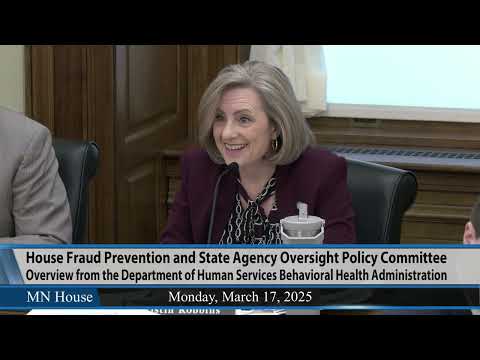
Several legislators asked DHS about particular providers that have appeared in public reporting and in federal indictments tied to a separate investigation called Feeding Our Future. Chair Robbins asked whether the department had stopped payments to two programs that were the subject of federal search warrants; Gandhi said DHS has reviewed payments and taken actions depending on the program. "We have taken actions to disqualify people from our programs, to revoke licenses, and to stop payments," Gandhi said. The department also said it is conducting audits of EIDBI sites in person.
DHS and BCA officials repeatedly stressed limits on public disclosure. Gandhi told the committee that payment-withhold information is confidential, and Alyce Bailey and other DHS officials said fiscal detail often lives in separate finance systems, not the contracts integration system.
BCA role and enterprise coordination
Evans said that, with the consolidation, the BCA unit can accept referrals from multiple state agencies and pursue cases that cross jurisdictions. The new unit will also work to provide feedback to state agencies and to Minnesota Management and Budget’s internal-controls team so that investigative findings can inform statewide process improvements.
Lawmakers asked about recurring schemes: overbilling of service hours, misclassification of workers as independent contractors, and operators who dissolve one entity and reconstitute under another name. Evans said the agency is pursuing a holistic approach that includes forensic accounting support, prosecution assistance in Greater Minnesota and improved information-sharing across agencies to identify repeat offenders and emerging fraud patterns.
Ending: Both DHS and the BCA told the committee they will continue audits and criminal referrals. Lawmakers asked for additional follow-up from DHS on which providers had been disqualified or had payments stopped, and for the BCA to coordinate evidence-sharing so law enforcement and administrative agencies can act in concert.