Get Full Government Meeting Transcripts, Videos, & Alerts Forever!
Get email alerts on the Grants And Procurement topic
No spam. Unsubscribe anytime.
DHS behavioral health office says it has closed most audit recommendations, flags staffing and system limits
Summary
Department of Human Services officials told a legislative committee they have implemented processes to improve grant and contract oversight in the new Behavioral Health Administration but acknowledged remaining gaps in staffing, data systems and mandatory training.
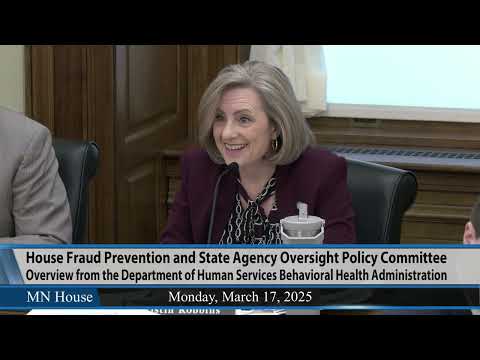
The Minnesota Department of Human Services told the Legislature’s Fraud Prevention and State Agency Oversight Committee on March 17 that its newly formed Behavioral Health Administration has implemented many of the Office of the Legislative Auditor’s recommendations and is continuing to strengthen grant and contract controls.
Assistant Commissioner Teresa Steinmetz and Temporary Commissioner Shereen Gandhi said the administration has reorganized leadership, hired a contracts and compliance unit manager, launched staff training and implemented quality-control steps in the department’s contract integration system.
Those process changes followed audits the department cited to the committee. Steinmetz said 26 of 32 recommendations from OLA reports dating to 2019 and 2021 had been closed as of February 2025, and the six remaining items from a March 2021 audit were in the final stages of remediation. "We've put some kind of safeguards in place to make sure that things get uploaded," Steinmetz said, describing new upload requirements and standardized templates for requests for proposals and other grant documents.
Why it matters: DHS officials told lawmakers the state has rapidly increased behavioral health grant funding in recent years while staffing levels remained comparatively flat, creating risk that documents or oversight tasks can be missed. Strengthened processes aim to reduce errors, improve compliance monitoring and increase the visibility of grant performance across the administration.
Key details provided to the committee include: the Behavioral Health Administration (BHA) has about 210 staff, roughly 50 of whom perform grant-manager duties; BHA oversees about 90 grant programs supported by about 1,000 contracts; and grants activity has grown by roughly 333% over the past decade per a chart Steinmetz presented. DHS also reported that it has adopted 25 training modules for grant staff and that a spot check of 20 RFPs published since April 2023 showed 100% compliance in uploading conflict-of-interest forms.
Committee members pressed DHS on several operational limits. Lawmakers asked whether progress and financial reports are consistently uploaded and reviewed; Steinmetz said deficiencies had occurred in the past but that new processes and a compliance unit manager are intended to close those gaps. Alyce Bailey, DHS budget director, told the committee that transfers of appropriated funds depend on the legal authority behind each appropriation: "Some grants have specific riders… In that instance, if all the funds haven't been spent, that cannot be transferred," she said.
Lawmakers also raised the separation between DHS document tracking and fiscal systems. Steinmetz and Gandhi said the contract integration system (a document repository) is separate from the department’s fiscal databases; financial reconciliation and decisions about transferring unspent funds are handled in the agency’s finance systems. Gandhi told the panel the division of systems makes it harder to automatically detect billing anomalies and that an end-to-end grants-and-payments solution would improve fraud prevention.
On mandatory training and conflicts of interest, DHS said training is broadly required of staff who perform grant work and attendance is tracked, but that training is not yet a mandated item in position descriptions. Steinmetz said supervisors encourage participation and that recorded modules and one-on-one follow-ups are available. The department said conflicts identified in the sampled RFPs were mitigated by reassigning reviewers when appropriate.
What remains open: Committee members asked DHS to provide more detailed accounting about one-time federal COVID-related grants that expire in 2025, and for a state-to-state comparison of treatment engagement metrics. Vice Chair Anderson and Representative Greenman asked DHS to show evidence that expanded programs produce measurable improvements, not just enrollment. Steinmetz said the department can provide comparative metrics but cautioned that causation in behavioral health outcomes is difficult to prove.
Ending: DHS officials asked for continued legislative partnership on enterprise solutions and cautioned that as program rules and funding streams grow more complex, the agency’s ability to ensure payment accuracy requires both process improvements and clearer, consolidated systems.