Get Full Government Meeting Transcripts, Videos, & Alerts Forever!
Solvang workshop presses for clearer objective design standards, suggests limited A-frame and temporary sign changes
Summary
The Planning Commission and Design Review Committee held a special joint workshop on Thursday, March 13, 2025, in Solvang to discuss rewriting the city's objective design standards and revising the sign code, including rules about A-frame signs, temporary banners and a citywide design handbook.
The Planning Commission and Design Review Committee held a special joint workshop on Thursday, March 13, 2025, in Solvang to discuss rewriting the city's objective design standards and revising the sign code, including rules about A-frame signs, temporary banners and a citywide design handbook.
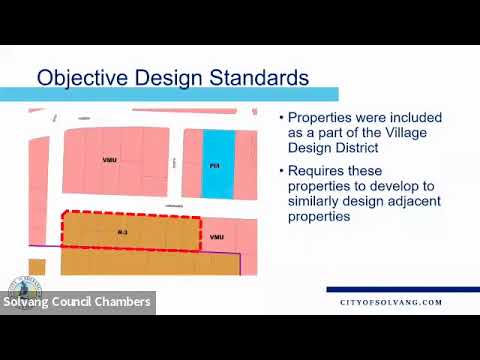
The session focused on several interrelated questions: whether to keep R-3 (multifamily) lots inside the Village Design District and, if so, how to apply objective design standards for residential projects now constrained by state law; what to include in a visual design handbook (including a starting color palette and examples); and whether to lift the citywide ban on A-frame signs and expand allowances for temporary signage under time, place and manner rules.
City staff said the push for change came from the 2024 zoning ordinance updates and state law. Rafael (staff) told the meeting that California's Housing Accountability Act and recent case law make it difficult for cities to deny or condition residential projects on subjective aesthetic findings and that objective, quantifiable standards are now the primary defensible tool for review. "We're trying to become objective," Rafael said, explaining that measurable requirements (for example, "minimum front setback between 6 and 10 feet") are the kinds of rules that survive legal scrutiny. He also summarized staff options for the R-3 lots in the Village Design District: remove them from the district, repeal the objective standards, or amend zoning (Table 11.7) to limit new structures to a maximum share of gross floor area devoted to residential uses.
Why it matters: planners said these changes affect what developers and property owners can build and how the city preserves the Village's historic, "old world" Danish character. Multiple speakers said clearer, objective rules would reduce inconsistent outcomes and speed permitting for businesses and property owners.
Key outcomes of the discussion and staff direction
- R-3 lots and a 49% carve-out for new construction: Staff and committee members generally favored keeping the R-3 parcels within the Village Design District but creating a carve-out for new construction that would limit new buildings to a maximum of 49% of gross…
Already have an account? Log in
Subscribe to keep reading
Unlock the rest of this article — and every article on Citizen Portal.
- Unlimited articles
- AI-powered breakdowns of topics, speakers, decisions, and budgets
- Instant alerts when your location has a new meeting
- Follow topics and more locations
- 1,000 AI Insights / month, plus AI Chat