Get AI Briefings, Transcripts & Alerts on Local & National Government Meetings — Forever.
House economic-development committee reviews bill to revive young-entrepreneurs program after bank disputes and returned funds
Loading...
Summary
The Puerto Rico House Commission on Economic Development reviewed House Bill 149 on March 17, 2025, a measure by Representative Ángel Morey Nobles that would amend Act 389 (2004) to relaunch a program to help young entrepreneurs access financing and expedited permitting.
The Puerto Rico House Commission on Economic Development reviewed House Bill 149 on March 17, 2025, a measure by Representative Ángel Morey Nobles that would amend Act 389 (2004) to relaunch a program to help young entrepreneurs access financing and expedited permitting.
The bill would revise articles 2, 3 and 4 of Act 389-2004 to charge the Banco de Desarrollo Económico para Puerto Rico (the bank) and the Department of Economic Development (DDEC) with coordinating a youth entrepreneurship program that combines capital access and a referral system to speed permits and certifications for participating entrepreneurs.
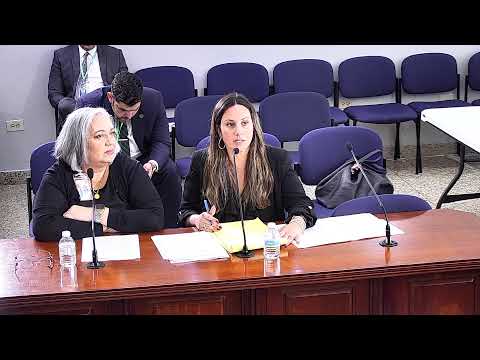
Licenciada Bianca Rivera of the Department of Economic Development, who identified herself as the staff member handling legislative affairs for the department, and Charlene Newman, director of the Youth Development Program, testified to the commission. Rivera said the department has tried multiple initiatives over the years to support young entrepreneurs and described the bill’s two main proposals: that the DDEC collaborate with the Banco de Desarrollo Económico on the program and that an online link be created to speed permit review for participating businesses. "A través de los años, el Departamento de Desarrollo Económico ha implementado diversas iniciativas para apoyar y facilitar el desarrollo empresarial de los jóvenes en Puerto Rico," Rivera told the committee.
Newman described the bank’s previous collaboration, saying the DDEC had assigned funds and prepared entrepreneurs for loan applications but that the bank later required different terms when applicants arrived. "Ellos nos devolvieron ocho millones de dólares," Newman said, summarizing the department’s account that funds originally set aside for the program were returned in 2024 after a partial, inconsistent rollout.
Committee members pressed the department for specifics: how much money had been disbursed, how many loans were approved, and under what legal authority the funds had been allocated. Officials told members the DDEC had initially set aside roughly eight million dollars for the program (they said an earlier total had been about twelve million) and that the bank ultimately approved financing for nine participants totaling about $81,587 in loans, with only a subset of approvals leading to full disbursement. Representative Ángel Morey Nobles and others said the commission will request detailed loan and agreement records from the bank and from the department.
Lawmakers and witnesses described the terms the youth program had originally offered as more flexible than standard commercial loans: committee members and DDEC witnesses recalled a fixed interest rate of about 3 percent, a six-month moratorium on payments, an initial small payment (cited as $25), and loan caps that had been discussed at $10,000 and later $25,000. Charlene Newman told the committee that, in practice, applicants reported the bank presented different terms than those they had been told by the department, and that some applicants failed to deliver required documentation when they went to the bank.
Members also discussed the program’s age definition and related tax and incentive rules. Committee members and witnesses noted that definitions differ across statutes: the Youth Development Program under the department has used ages up to 29, while Law 60 (Puerto Rico’s incentives code) and other incentive programs treat "young entrepreneur" eligibility as up to 35 years old. Several members recommended aligning statutory age definitions across incentive programs.
Permitting and regulatory hurdles were a recurrent theme. Rivera and Newman described steps taken under the current administration to speed permit review, including putting agency staff into the central office charged with permit reform and enforcing a statutory endorsement deadline. The department said enforcement of a 20-day response window (with some 30-day exceptions) has led to measurable increases in permit throughput; the DDEC cited an increase of roughly 4,163 unique permits approved in January–February compared with the same period last year. Committee members asked the department to provide permit timelines and multi-year metrics to show whether processing times are improving.
In argument and recommendation, lawmakers and witnesses urged several changes short of adopting any final language at the hearing: align youth ages across incentive statutes, consider raising the age cap (witnesses suggested up to age 39–40 for application eligibility), review and, if necessary, amend the loan-qualification and collateral rules so the program is accessible to entrepreneurs with limited credit history, and improve monitoring and post-approval coaching so loans do not become high-risk losses. Representative Rodríguez Aguiló noted the bank was absent from the hearing: "el banco se excusó con nosotros hoy," he said, and members requested that the bank appear at the next session.
Committee members instructed the DDEC to provide specified documents within five days: the executed collaborative agreement (MOU) with the bank, loan-disbursement reports showing how many loans were approved and how much was disbursed, and financial-accounting details showing the present status of the funds that had been set aside for the program. DDEC witnesses agreed to provide the requested records and to coordinate with the committee and the bank on a follow-up hearing.
Lawmakers also discussed other existing incentives that young entrepreneurs may use, including a capital-seed (capital semilla) PyMEX grant program and other export/commercial supports handled under different departmental umbrellas. Members asked the department to map which incentives remain active, which can stack with a "young entrepreneur" decree, and how future funding would be treated in the fiscal year budget process.
Next steps recorded in the hearing: the commission will seek the bank’s attendance at a future hearing; the DDEC will submit the MOU and loan and budget details within five days; and members signaled interest in drafting amendments to HB149 to standardize definitions, clarify eligibility and loan parameters, and add monitoring and technical assistance requirements if the loan program is reinstated.
The bank did not testify at the March 17 hearing; committee members said the bank’s presence is central to resolving the outstanding questions about why the earlier program did not proceed as planned and whether a jointly administered program is viable in future sessions.