Get Full Government Meeting Transcripts, Videos, & Alerts Forever!
Get email alerts on the Public Safety topic
No spam. Unsubscribe anytime.
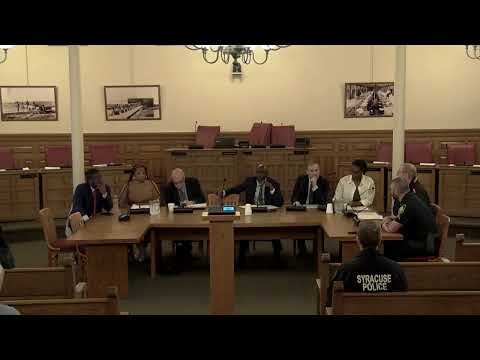
Syracuse committee reviews police drone-as-first-responder program, requests draft policy before purchase
Summary
Police briefed the Syracuse City Public Safety Committee on proposed drone-as-first-responder (DFR) software and operations, including vendor platforms, training, FAA limits, data publication and civil‑liberties safeguards; councilors asked for the surveillance-committee report and a draft policy before authorizing software purchase.
At a Syracuse City Public Safety Committee meeting, police leaders presented technical and operational details for a proposed drone-as-first-responder program and answered councilors’ questions about training, flight limits, data sharing and civil‑liberties safeguards.
The presentation outlined three vendor-supported components: a flight-logging and management platform (Axon Air powered by DroneSense), a remote-operation add‑on for rooftop or fixed deployments (AxonAir Remote) and a mobile streaming/tracking tool (MSAT) for SWAT interior drones. Sergeant Wells, identified in the presentation as the unit supervisor for the drone program, said the main platform “logs all the flights” and records pilot certifications, maintenance and mission metadata.
The committee pressed department leaders for policy details and independent review materials. A councilor noted that a surveillance-technology committee had evaluated the program; Chief (unnamed) said the committee’s report is not yet publicly released and that staff would follow up with Niko Diaz to determine its status. Several councilors said they were uncomfortable voting on software purchase without seeing the surveillance-committee report and a draft policy in advance.
Why it matters: Councilors said the DFR proposal raises both public‑safety and civil‑liberties questions — who decides when a drone is used, what data are collected and published, and whether footage could be shared with other agencies. Committee members sought written policies and a public‑facing schedule for data publication before authorizing purchase of the first‑responder software component.
Key program details presented
- Platforms and uses: Sergeant Wells described three program elements: a primary logging/management platform (Axon Air/DroneSense), a remote-operation module for stationary rooftop drones (AxonAir Remote) and MSAT for live streaming from SWAT interior drones. He said the SWAT drones are smaller, have protected propeller domes and are intended for interior, close‑quarters clearing.
- Flight logging and public site: The department demonstrated a dashboard that shows flights (date, duration, takeoff location, route thumbnail and a “view and replay” mode). Sergeant Wells said flight metadata such as time, location, duration and a route thumbnail would be migrated to a public website; he was unsure whether the textual call notes would be published.
- Camera-on timing and transparency: The surveillance-technology committee recommended cameras be turned on later in a flight; department staff said they pushed back and want cameras on for the entire flight to allow transparent review of what pilots were looking at while en route. Sergeant Wells said the view-and-replay mode includes a camera‑crosshair overlay so reviewers can see where the camera was pointed.
- Training and certification: The department said pilots must hold the FAA Part 107 remote-pilot certificate and that the department will require additional, department-specific training for DFR pilots. Sergeant Wells said new pilots will complete Part 107 and then an internal training regimen before being cleared to fly.
- Technical limits and capabilities: City staff said FAA rules limit drone altitude to 400 feet and that the DFR stationary units would be limited by their certificate of authorization to roughly a two‑mile radius from a fixed launch point. Typical flight time was described as about 30 minutes. The department reported currently owning one DFR unit and said the long‑term goal is 4–5 fixed deployments to broaden coverage.
Councillors’ civil‑liberties and operational concerns
Councilors raised a range of concerns about timeliness, mission creep and data sharing. One councilor asked about an incident weeks earlier in which a drone was used and whether a delay in drone deployment could have endangered people; department leaders replied that tactics are situation dependent and that entry is used when negotiators and other options have been exhausted. Lieutenant Williams of Syracuse Police said, “The drone always goes in before the officer,” explaining that the primary goal is officer and public safety.
A councilor asked whether video or flight data would be available to federal immigration authorities; Chief (unnamed) stated, “We won't be using the drone program for immigration enforcement at all.” The department also said one recommendation from the surveillance-technology committee was to restrict data sharing with other agencies and that staff had generally accepted most committee safeguards while pushing back on limits that would bar DFR from low‑level calls where the department believes the program has value.
Costs and equipment resilience
The department said interior SWAT drones have protective domes; if a drone is damaged inside a structure, the department has spare units. Staff estimated a full replacement including extras at about $1,600 and a total-loss replacement for a single drone at roughly $500–$800.
Next steps and direction from the committee
Committee members requested the surveillance‑technology-committee report and a draft DFR policy before the council voting session. The department agreed to provide a draft policy in advance and to schedule an additional meeting focused on policy and safeguards (staff indicated a meeting would be arranged soon). No formal vote or purchase authorization took place at the committee meeting.
The department said it will continue public outreach and a public‑education period before program launch; staff pointed to Chula Vista, California, as an example of an agency that has deployed a DFR program with a public facing site and regular reporting.