
Tennessee Finance Department seeks recurring funds for technology, continues VCIF growth request
Get AI-powered insights, summaries, and transcripts
Sign Up Free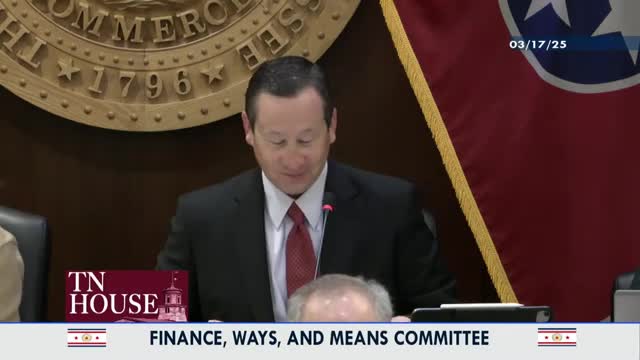
Summary
At a March 17 Finance, Ways and Means Committee hearing, Commissioner Jim Bryson outlined a Department of Finance and Administration budget that prioritizes technology modernization, grant-management systems and continued funding for the Violent Crime Intervention Fund while identifying $4.8 million in reductions.
The Tennessee Department of Finance and Administration told the Finance, Ways and Means Committee Monday that its 2026 budget request emphasizes technology modernization and continued support for law-enforcement grant programs while identifying $4.8 million in reductions.
"Most but not all of our requests that you'll see in front of you reflect the increasing importance of technology to the efficient delivery of government services," Commissioner Jim Bryson told the committee as he opened the department's presentation. Bryson identified cloud migration, expanded artificial-intelligence tools and an enterprise resource planning replacement among the top priorities.
The department said the agency's package includes cost increases totaling "almost $81,000,000," of which roughly $31.5 million is from state appropriations and about $30,000,000 of that is nonrecurring. The presentation highlighted several specific requests:
- A $5,000,000 request for ADA compliance remediation tied to newly updated federal accessibility requirements for customer-facing websites, mobile apps and forms.
- Investments to continue migration from on-premises data centers to cloud storage and a proposed $40,000,000 estimate tied largely to relocating the North Data Center and establishing connections in Dallas and Virginia, with some capacity to remain in the state's South Data Center in Smyrna.
- A $4,800,000 line labeled for security enhancements; the department said these tools and technologies will continue protections started with ARPA-funded implementations.
- An enterprise grants-management system requested for the Office of Criminal Justice Programs (OCJP) to manage a large increase in administered grants; OCJP staff told the committee the number of grants overseen grew from 284 in 2018 to 952 in 2024.
- Continued funding for Vine (VINE) court-notification services that the presentation said is already live in 86 Tennessee counties and recorded 36,426 registrations and 189,100 notifications in calendar year 2024.
The department also described an ongoing role in administering law-enforcement grant programs. Jennifer Brinkman, director of OCJP, summarized results from the Violent Crime Intervention Fund (VCIF), saying: "For fiscal year 2026, the governor has proposed an additional 30,000,000 for the Violent Crime Intervention Fund to continue the support of our law enforcement partners." Brinkman said OCJP has obligated the entire $150,000,000 across more than 300 contracts, reaching about 250 law-enforcement agencies and supporting purchases including P25 radios, digital-forensic software and a regional digital-forensic center.
Committee members pressed staff on several operational details. Deputy Speaker Zachary asked whether a prior $6,700,000 appropriation for data-center equipment had achieved its goals; department staff said that appropriation was "appropriate" for that year but noted ongoing upgrade needs as migration continues. Zachary and others asked about the $40,000,000 North Data Center relocation estimate; deputy commissioner Eugene Neubert said it covers establishing two connections, equipment moves and consulting to vacate the facility.
On technology billing, the committee discussed the Statewide Technology Services (STS) internal service fund. Stephanie Dedmon, Tennessee's chief information officer, described STS as "an internal service fund" that recovers costs through agency rates and said the unit must bill federally funded agencies at the same rates as others. Dedmon said STS has simplified its rate structure in recent years and adjusts rates to recover costs when new or higher-priced contracts arrive.
On cybersecurity, Dedmon said the state blocks more than a million attempts across email and network vectors and that training completion among state employees has reached about 95 percent in peak periods. "We have implemented a number of tools that help us much better detect and not allow those attacks or intrusion into our environment," she told the committee.
Bryson reiterated that the department identified $4.8 million in reductions tied to efficiencies and provider changes, and that the department is not requesting new headcount while relying on existing vacancies where new roles are needed.
The department closed by inviting committee questions and offering follow-up on specific green-sheet items and other line‑item clarifications.
The committee did not take a final vote on any item at the hearing; the department's requests will be considered as part of the broader appropriations process.
Ending: The Finance, Ways and Means Committee received briefings and asked for follow-up on several specifics — notably details on the proposed cloud and data‑center work, the structure of STS rates, and the deployment timeline for additional VCIF funding — and the department said it would provide written responses on requested items.