Towson University highlights rising applications, outlines steps to cover state funding cut
Loading...
Summary
Towson University told the subcommittee it expects modest enrollment gains next year and plans a hiring pause and other cost‑control measures to absorb an anticipated state funding reduction while preserving student services.
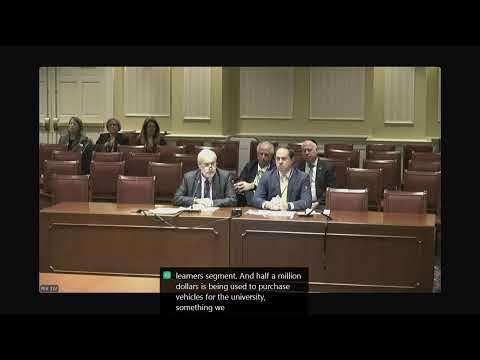
Sarah Baker, the committee’s analyst, presented an overview of Towson University’s budget and enrollment trends to the Education, Business and Administration Subcommittee, and President Mark Ginsburg described steps the university will take to respond to a projected state funding reduction.
Baker’s analysis noted fall 2024 enrollment declined 1.5 percent and that continuing student and transfer enrollments have fallen since 2019. State funds for Towson are projected to decrease about 7.1 percent (roughly $14.8 million) when excluding the impact of FY25 general salary increases not included in the FY26 working appropriation. The analysis shows state funding per full‑time equivalent student rose in recent years largely because enrollment fell while salary and restoration funding increased.
Mark Ginsburg, president of Towson University, told the committee the university has seen “momentum” in applications and expects to enroll about 200 additional first‑year students next year. He described recent national recognition for the university and emphasized its role in workforce development: “Of our nearly 20,000 students, 90 percent hail from Maryland,” he said.
To manage a projected budget shortfall, Ginsburg said Towson will combine expense controls with revenue efforts: the university plans a pause on hiring so vacant positions can be evaluated, will review expenses and will not seek furloughs or layoffs. He said the university expects modest increases in transfer students and will continue efforts to strengthen community college transfer pathways, including participation in a statewide transfer task force.
Why this matters: state appropriations are a significant revenue source for public institutions; declining enrollments and reductions in state funding force institutions to balance program priorities, staffing and student support while protecting retention and student success initiatives.
Committee questions focused on dual enrollment and transfer credit articulation. Ginsburg said the system‑level transfer task force is addressing lost credits and time for transfer students and that Towson is working to expand seamless transfer agreements with community colleges.
What was decided or directed: there were no committee votes; Towson outlined its internal fiscal and enrollment strategies, including a hiring pause and targeted recruitment to increase first‑year and transfer student enrollment.
Ending: Towson asked the committee to continue its support for higher education funding and said modest enrollment gains and cost controls will help the university manage near‑term fiscal pressure without program disruption.