Get Full Government Meeting Transcripts, Videos, & Alerts Forever!
Get email alerts on the State Legislation topic
No spam. Unsubscribe anytime.
Senate debates township land-use bill, approves measures on dams, fees, health workforce and teacher stipends
Summary
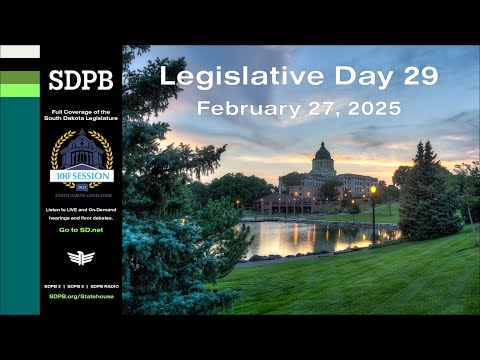
PIERRE, S.D. — The South Dakota Senate on Feb. 27 debated a high-profile land-use bill that opponents said would strip townships of decision-making over public right-of-way matters before rejecting it, and approved a package of other measures that included funding for a dam repair, an upgrade to the Secretary of State’s business-filings platform, and changes to health-care and education programs.
PIERRE, S.D. — The South Dakota Senate on Feb. 27 debated a high-profile land-use bill that opponents said would strip townships of decision-making over public right-of-way matters before rejecting it, and approved a package of other bills that included funding for a dam repair, an upgrade to the Secretary of State’s business-filings platform, and changes to health-care and education programs.
Senators spent most of the day on House Bill 12-61, a measure the sponsor described as a permissive framework to ensure townships, counties and municipalities are notified and included in conditional-use permitting that could affect public rights of way. "This bill is created to protect family farms and their ability to operate efficiently and transparently," Senator Davis said on the floor, arguing the measure would provide “clarity in the permitting process” and require two separate notices to townships.
Opponents, led by Senator Nelson, said the bill would remove townships’ authority and effectively allow counties to grant private uses in rights of way. "This bill removes the township's role as the decision maker when dealing with what goes in the public right of way and gives it to the county," Nelson said. She warned the change could permit private infrastructure in ditches and urged the Senate to send the issue back for further local negotiation.
After more than an hour of debate, the Senate voted 14 yeas to 21 nays and the president declared House Bill 12-61 lost.
The Senate also took final action on several other bills. Lawmakers approved a $13.0 million appropriation for replacement and repair of the Richmond Lake dam and spillway (House Bill 10-26), a measure described on the floor as urgent because the structure is a state-owned, "high-hazard" dam with reported cracks whose failure could endanger roughly 1,800 downstream residents and cause extensive property damage in Aberdeen and Brown County.
On business filings, Senators passed House Bill 10-24, which raises certain Secretary of State fees to help fund a new business-filing and retrieval platform. Sponsor Senator Miskimmons told the chamber the platform has an initial estimated cost of $2,250,000 and an annual maintenance cost of $435,000; fee increases would be used to finance the platform, ongoing upgrades and one requested full-time equivalent position.
The Senate also approved measures that change health-care and training rules. House Bill 10-71, which adjusts the supervision and practice pathway for physician assistants, passed after extensive debate about scope, training and long-term implications for medical education. Senator Grove, the bill sponsor, said the bill is intended to let physician assistants practice to the full extent of their education once they meet a 6,000-hour threshold and maintain certification. Critics, including Senator Howard, warned it could undercut incentives for physicians to pursue medical training and said the bill's language leaves some terms — for example, "routine clinical office surgical procedure" — undefined.
Other final actions included a one-time student-teacher stipend pilot (House Bill 10-92) that authorizes $5,000 grants for districts to attract and retain student teachers, a bill to allow out-of-state physicians to train here for up to 90 days with hands-on experience under a teaching physician (House Bill 10-97), and a change to county drainage permit statute that raises the statutory maximum fee from $100 to $500 to better reflect permit-processing costs (House Bill 11-57).
Votes at a glance: House Bill 12-61 (intra-county land use/conditional-use permits) — Final: failed, 14 yeas, 21 nays. House Bill 10-26 (Richmond Lake dam repair appropriation) — Final: passed by two-thirds; tally announced as 32 yays, 2 nays, 1 excused. House Bill 10-24 (Secretary of State business filing fees; IT platform) — Final: passed (two-thirds required); tally announced as 32 yays, 2 nays, 1 excused. House Bill 10-71 (physician assistant practice/supervision changes) — Final: passed; tally announced as 32 yays, 3 nays. House Bill 10-92 (student-teacher stipend pilot) — Final: passed (two-thirds required); tally announced as 25 yays, 10 nays. House Bill 10-97 (temporary training for nonresident physicians, up to 90 days) — Final: passed (two-thirds required); tally announced as 31 yays, 3 nays. House Bill 11-57 (county drainage permit fee maximum) — Final: passed; tally announced as 28 yays, 6 nays. House Bill 10-51 (interim rulemaking oversight updates) — Final: passed; tally announced as 24 yays, 10 nays, 1 excused. House Bill 10-67 (definition of "must") — Final: passed; tally announced as 22 yays, 11 nays, 2 excused.
What happened next: Several committee and floor scheduling motions were made and agreed to, the president signed a group of bills in open session, and the Senate adjourned. Committees announced meetings for the coming week, including Local Government and Appropriations.
Why it matters: The failed land-use bill caps a day in which lawmakers weighed local control, property rights and regulatory certainty for agriculture, while the passage of the dam appropriation and business-IT funding addresses infrastructure and state technology needs. The health-care and education items reflect continued legislative attention to workforce and recruitment — both for medical providers and for teachers.
Quotes in context: The article uses direct quotations that appear in the Senate transcript and attributes them to named senators who spoke on the floor. The article separates debate (discussion and argument) from formal action (roll-call results) and does not infer legal effects beyond what senators stated on the record.
Ending: The Senate will resume work on Monday, March 3, with several committee meetings and deferred calendar items on the agenda.