Get Full Government Meeting Transcripts, Videos, & Alerts Forever!
Get email alerts on the State Grant Parameters topic
No spam. Unsubscribe anytime.
Committee debates state grant parameter changes, tuition cap and AFR adjustments; colleges warn of disproportionate impacts
Summary
Conferees discussed proposed changes to state grant parameters — including a 1% tuition cap, a change to the living and miscellaneous expense allowance, and shifts to assigned family responsibility (AFR) calculations — and private colleges and conferees warned those changes could disproportionately affect dependent students and two-year colleges.
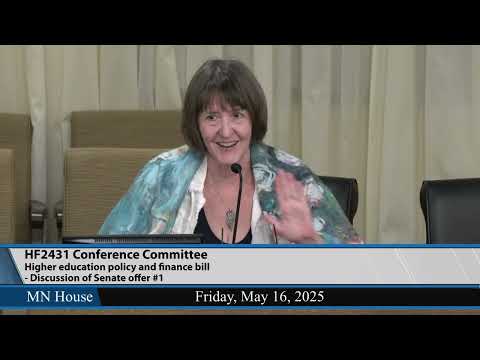
The conference committee on May 16 examined proposed changes to state grant parameters included in the Senate’s offer, and several conferees and institutional representatives warned the changes could reduce awards for particular student populations.
Allison Grubner, government relations director at the Private College Council, said the council is concerned with a Senate provision that would cap tuition increases at 1% for the University of Minnesota Twin Cities and argued this would distort grant calculations and disproportionately affect nonprofit private colleges. "By imposing the 1% cap for the University of Minnesota Twin Cities, that obviously impacts the state grants at nonprofit colleges because our tuition cap is capped at the U of M Twin Cities," she said. Grubner also warned that moving the AFR for dependent students to a higher percentage would affect the roughly two-thirds of state grant recipients who are dependents.
Senator Duckworth and other conferees asked whether the proposed tuition-cap parameter would be temporary; staff said the change was proposed for the biennium and would not be ongoing. Several conferees — including Senator Duckworth and Representative Robbins — urged caution about balancing the state grant budget by adjusting parameters that cut student awards rather than identifying other budget savings.
Conferees also discussed the Senate language that would change how the Office of Higher Education rationed awards if appropriations were insufficient and debated whether the statute should grant the commissioner automatic authority or retain commissioner discretion. Commissioner Dennis Olson said the proposed language would be helpful in clarifying procedures, but the agency favored retaining some flexibility.
No final statutory language was adopted during the session; conferees flagged potential disproportionate impacts on student parents, dependent students and MinnState two-year colleges and asked staff to consider those impacts in drafting compromise language.