Get Full Government Meeting Transcripts, Videos, & Alerts Forever!
Get email alerts on the Higher Education Budget topic
No spam. Unsubscribe anytime.
Lawmakers review Lewis‑Clark State College budget as enrollment, pay gap and LAUNCH support shape funding requests
Summary
Lawmakers at the Joint Finance‑Appropriations Committee reviewed Lewis‑Clark State College’s FY2025 budget and heard college leaders describe how the Enrollment Workload Adjustment, salary gaps with K‑12, LAUNCH student aid and a new prison education program affect operations and future requests.
Lewis‑Clark State College told the Joint Finance‑Appropriations Committee on Jan. 27 that its FY2025 base appropriation and enrollment trends, along with new student aid and prison‑education programs, are shaping its budget requests.
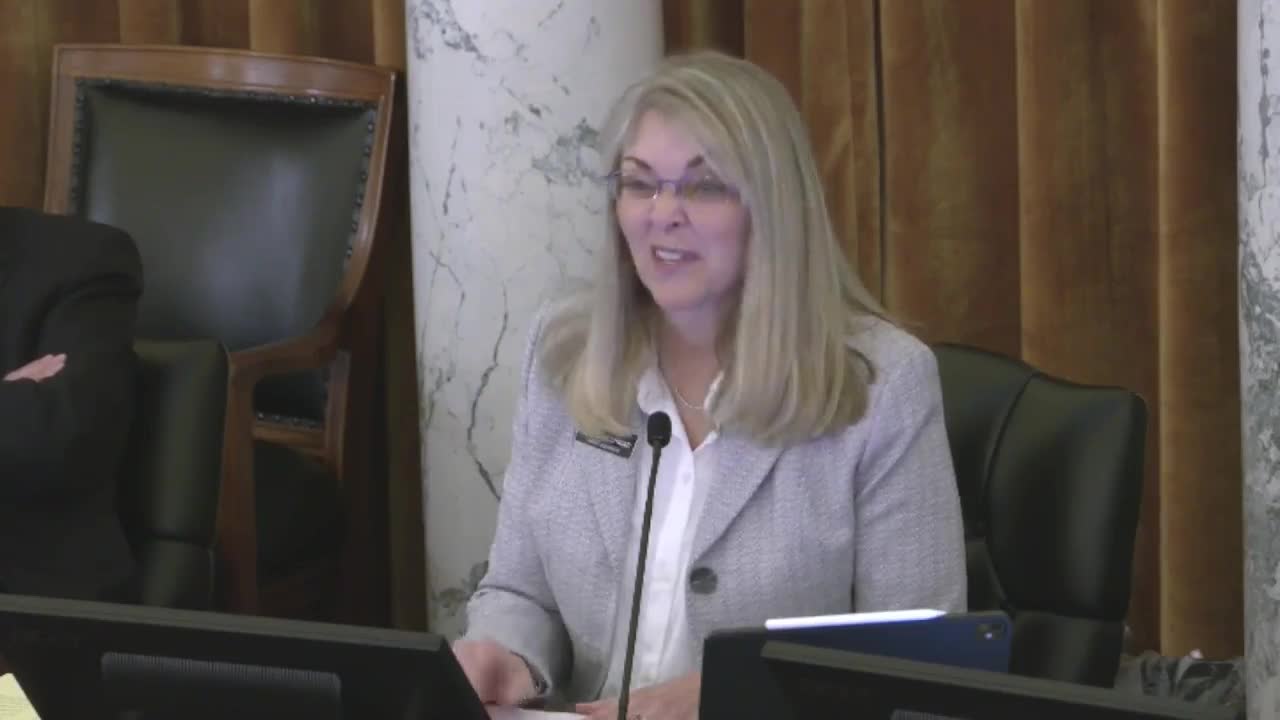
The college’s president, Dr. Cynthia Pemberton, and Legislative Services Office analyst Kevin Campbell presented budget details to JFAC members and answered lawmakers’ questions about a three‑decade‑old enrollment formula, employee compensation and the impacts of the state’s LAUNCH program.
Campbell opened the college presentation by noting Lewis‑Clark’s reported enrollment of 3,881 students and by explaining how tuition and fee receipts are treated in the state budget process. He said the college’s FY2024 total appropriation was $40,517,100 and that Lewis‑Clark reported about $23,700,000 in tuition and fees that were reappropriated into FY2025. He also highlighted the Normal School Income (endowment) fund, which the presentation said is governed by distributions determined by the Endowment Fund Investment Board and is governed by Idaho code. Campbell said the college’s reported FY2025 base budget was $41,700,000.
Pemberton told the committee the college is requesting additional operational capacity enhancement (OCE) funds and noted the effect of the Enrollment Workload Adjustment (EWA) formula on the institution’s budget. She described EWA as “a weighted credit hour formula” that uses a three‑year rolling average; the college will see a $102,500 reduction from EWA in FY2026, Campbell said. Pemberton also described the college’s request for $287,000 in OCE for CEC (competitive employee compensation) and said Lewis‑Clark had received $440,200 in OCE for FY2025.
On compensation, Pemberton and committee members discussed the gap between Lewis‑Clark salaries and K‑12 pay. Pemberton said recent data show an LC State instructor makes about $9,000 less per year, and an assistant professor about $3,777 less per year, than K‑12 averages. She and Campbell said the college is seeking incremental funding to close that gap; Pemberton said she estimates about $1.2 million would be needed to meaningfully narrow the disparity.
Committee members asked about enrollment trends and retention. Pemberton said the college served primarily Pell‑eligible, first‑generation students and that the pandemic produced a substantial enrollment decline; since then, she said, the college has begun to stabilize. She told lawmakers fall enrollment rose 2.4% and spring enrollment was up about 9% from the previous year, and that career‑technical enrollment was up 19% in the fall and another 10% in spring. Pemberton credited targeted marketing, advising and student supports for the rebound.
Pemberton described the LAUNCH program’s effect: she said about 240 individual students received LAUNCH funds in the fall, with a disproportionate share in career‑technical programs. She also said 36 of 54 students in a fourth‑year electrical apprenticeship completed their program with LAUNCH support. The college reported 10 of 11 industrial programs currently include LAUNCH recipients, she said.
The president also highlighted the college’s transition from an experimental prison‑education pilot to a full prison‑education program. She said Lewis‑Clark is the first institution in Idaho to complete all four aspects of transition approval, and that the college is serving nearly 200 incarcerated students at sites in Orofino, Pocatello and Boise.
Pemberton and staff detailed how recent enhancements were spent: finishing occupancy and custodial funding for the Schweitzer Career Technical Engineering Building, investing in marketing and promotion, and strengthening IT and cybersecurity. She said the college intends to use requested enhancement funds to make incremental progress on employee compensation.
Committee members asked for salary comparables compiled across institutions; Campbell said he is preparing a document that compiles salary data for all eight institutions for the committee’s review.
The committee did not take formal action on the college’s requests during the hearing; presenters and legislators agreed to exchange additional data.
The Lewis‑Clark presentation and Q&A occupy the committee record’s college budget segment; committee members indicated they would review submitted comparables and the college’s follow‑up materials as they consider FY2026 budget decisions.