Get Full Government Meeting Transcripts, Videos, & Alerts Forever!
Get email alerts on the Higher Education Budget topic
No spam. Unsubscribe anytime.
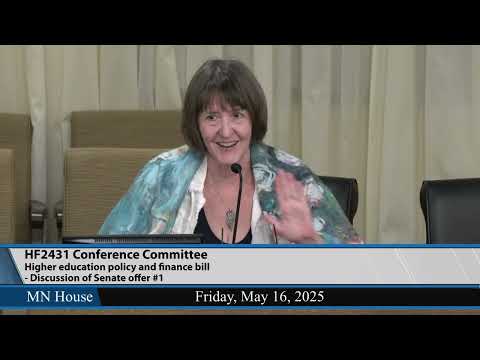
Conference committee reviews Senate 'offer No. 1' for higher education budget and policies
Summary
A Minnesota conference committee met May 16 to review the Senate’s offer No. 1 on higher education, which lists funding adjustments and policy changes across state grant programs, colleges and universities, and several targeted grants and riders.
The conference committee on House File 2431 reviewed the Senate’s “offer No. 1” for higher education on May 16, hearing staff summaries of proposed funding changes and a rundown of policy provisions affecting state grants, campus programs and institution riders.
Megan Bursch, a nonpartisan fiscal analyst supporting the Senate Higher Education Committee, told conferees the spreadsheet labeled “senate offer number 1” showed a set of budget and policy changes the Senate is proposing for higher education. Bursch summarized line-item changes that the Senate either accepted from the House or retained as its own position, including adjustments to the state grant program, student support programs and several program-specific riders.
The spreadsheet review covered a wide set of items. Bursch reported the offer “nets to the global target amounts for higher education” and listed line-item proposals such as increases for the state grant program, proposed reductions and match requirements for physician residency grants, restoration or consolidation of multiple riders into operating or administration lines, and proposed transfers and cancellations for a handful of research and training grant accounts. Conferees also discussed policy changes recorded in article 2 of the offer, including direct-admissions language, program reporting changes, and definitions tied to campus misconduct policy.
Nonpartisan staff later walked conferees through the policy provisions page by page. Senate staff said the Senate accepted some House positions (for example on tuition caps and emergency assistance for postsecondary students) while preserving original Senate positions on other matters (for example, certain AFR and application-deadline calculations in the state grant program). Staff described an amendment (A15) that would add the word “annual” to several grants to specify awards are made annually. Staff also described language that would make the loss of federal student-aid eligibility automatic grounds to remove state aid eligibility, and said conferees were considering restoring discretion to the Office of Higher Education’s commissioner.
Committee members asked questions about individual lines of the spreadsheet and requested additional witnesses later in the session, including representatives of teaching hospitals and the Office of Higher Education. No formal motions or votes were taken during the review; staff said the committee would recess and reconvene after posting the next offer publicly.
The discussion signaled substantive areas conferees are seeking to reconcile: state grant parameter changes (tuition caps, living-expense calculations and AFRs), consolidation or changes to riders for University of Minnesota and Minnesota State, and targeted changes to research, residency and campus-support programs. Members asked for additional data and invited testimony from impacted institutions and OHE staff before agreeing to finalize decisions.