Get Full Government Meeting Transcripts, Videos, & Alerts Forever!
Get email alerts on the Committee Votes topic
No spam. Unsubscribe anytime.
Environment and Transportation Committee advances wide slate of bills on housing, transit safety, water and waste
Summary
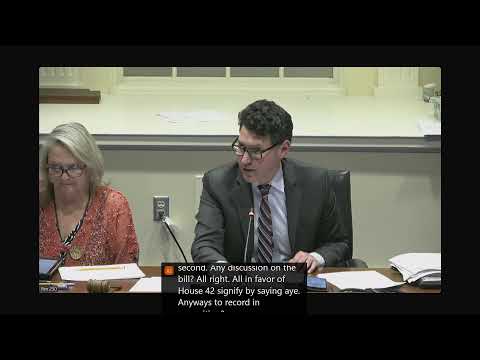
Annapolis — The Maryland House Environment and Transportation Committee on Friday, March 14, approved a lengthy voting list that included bills on accessory dwelling units, transit safety, water management and waste reduction.
Annapolis — The Maryland House Environment and Transportation Committee on Friday, March 14, approved a lengthy voting list that included bills on housing, transit safety, water management and waste reduction.
The committee took up dozens of measures (voting list #9), moving most with subcommittee amendments and recorded votes. The session covered measures ranging from an accessory dwelling unit (ADU) policy that preserves broad local regulatory authority to a transit safety bill requiring a ban-and-appeals framework and a managed aquifer recharge pilot to test use of treated reclaimed water.
Why it matters: the batch affects local zoning conversations, homeowner protections and public infrastructure. Several bills set statewide policy or authorize local governments and state agencies to implement programs that could change permitting, grantmaking, enforcement and transportation safety practices across Maryland.
Key outcomes and highlights
Accessory dwelling units (House Bill 14-66): The committee approved HB 14-66 as amended. The amended bill establishes a state policy encouraging creation of ADUs on land zoned for single-family detached residential use while preserving broad local authority to regulate specifics. The committee amendments require ADUs to be subordinate in use and cap an ADU at 75% of the size of the primary dwelling; they removed specified restrictions on local jurisdictions and preserved local control over parking, setbacks, health and safety and building permits. The sponsor and members discussed that the bill originally preempted local zoning but was narrowed through multiple amendments. The bill passed as amended; no recorded roll-call of yea votes was provided in the transcript.
Transit operator safety (House Bill 11-44): The committee voted to pass HB 11-44 with amendments. As amended, the bill directs the Maryland Transit Administration (MTA) to develop a code of conduct and an internal safety program, and authorizes a transit operator to prohibit a person alleged to have assaulted a public transit operator from using state transit services under guidelines established by MTA. The committee added an appeals process and an amendment clarifying that the definition of "public transit operator" covers contractors; the bill also includes a backstop provision that would take effect if MTA fails to produce an acceptable policy by the statutory deadline. The bill passed; multiple members were added as cosponsors on the floor.
Managed aquifer recharge pilot (House Bill 12-96): The committee approved legislation establishing a managed aquifer recharge pilot program administered by MDE to authorize and regulate the use of treated reclaimed water for groundwater augmentation. Subcommittee amendments clarified definitions and strengthened MDE's permitting and regulatory authority. Members discussed that the pilot relates to work in Anne Arundel County but the bill is statewide in scope. The bill passed as amended.
On-farm organics and food-waste grants (House Bill 42): The committee approved a package establishing grant programs for on-farm organics diversion, wasted-food reduction and county block grants to support infrastructure and education. Committee amendments removed a proposed solid-waste disposal surcharge and left funding to the discretion of budget writers; the bill no longer includes the explicit transfer from the Strategic Energy Investment Fund but includes a funding placeholder for consideration by budget writers.
Other notable items
- House Bill 14-34: Directs Maryland's Food System Resiliency Council to assess strategies to attract and retain grocery stores in healthy food priority areas. Passed as amended.
- House Bill 3-03 (common ownership community board): Approved as amended to create a state board of common ownership community managers and delay implementation by one year. The committee recorded several members in opposition (Delegate Jacobs, Delegate Otto, Delegate Naraki, Delegate Morgan and Delegate Baker) but the bill passed.
- House Bill 12-57 (tenant fee disclosures): Passed as amended; the committee removed advertising-related prohibitions and limited the bill to notice requirements in lease/rental agreements.
- House Bill 15-41 (condominium insurance): Approved as amended; the bill requires unit owners to maintain specified insurance and allows councils of unit owners to obtain coverage and assess owners when they fail to maintain required insurance.
- House Bill 7-69 (“zombie mortgage”): Passed as amended; the bill restricts certain foreclosure actions and sets a 10-year restriction after default before an order to docket or complaint may be commenced in designated circumstances.
- Multiple local speed-camera and traffic bills (for Prince George's County, Baltimore City, Montgomery County, Queen Anne's County and the Intercounty Connector): Several local bills authorizing or increasing speed monitoring cameras were approved on a straight favorable or local-favorable basis.
- Environmental and wildlife connectivity (House Bill 7-31): Passed as amended to establish the Maryland Connectivity Coalition to improve wildlife habitat connectivity and reduce wildlife-vehicle collisions; committee amendments removed a proposed fund and members discussed a fiscal estimate in the range of $50,000–$100,000 for initial staffing, and that departments already perform several functions related to the work.
- House Bill 5-06 (LEAF and fisheries / water quality): The administration bill (with amendments) passed; the committee retained a fiscal note of about $900,000 as presented during discussion and the bill carries programmatic changes across multiple natural-resources and fisheries topics.
- House Bill 8-58 (mattress stewardship): The committee passed the bill as amended; it would establish a stewardship program with producer plans and assessments to fund mattress take-back and recycling. The committee removed reuse provisions and adjusted assessment parameters; some members expressed concern about program cost impacts for institutions and shelters.
Votes at a glance (selected bills and recorded opposition where the transcript names members):
- HB 14-34 — assessment for grocery stores in healthy food priority areas — passed as amended; no recorded opposition listed in transcript. - HB 14-66 — state policy encouraging ADUs; ADU capped at 75% of primary unit; preserves local regulatory authority — passed as amended; no recorded opposition listed. - HB 3-03 — state board for common ownership community managers; implementation delayed one year — passed; recorded opposition: Delegate Jacobs, Delegate Otto, Delegate Naraki, Delegate Morgan, Delegate Baker. - HB 12-57 — landlord disclosure of fees; advertising prohibitions removed — passed as amended; no recorded opposition listed. - HB 15-41 — condominium unit-owner insurance requirements — passed; recorded opposition: Delegate Naraki, Delegate Baker. - HB 7-69 — foreclosure timing restrictions (“zombie mortgage” bill) — passed as amended; no recorded opposition listed in transcript. - HB 3-35 — nuisance/local code provisions for Baltimore County — passed as amended; no recorded opposition listed. - HB 163 — MVA out-of-state motor home show permit for Worcester County — passed as straight favorable; no recorded opposition listed. - HB 3-71 — speed cameras on MD-5 (Prince George’s County) — passed as straight favorable; no recorded opposition listed. - HB 9-13 — increase speed cameras on I-83 in Baltimore City (2 to 4) and make authorization permanent — passed; recorded opposition: Delegate Jacobs, Delegate Otto, Delegate Laverde, Delegate Naraki, Delegate Baker. - HB 11-44 — transit operator ban-and-appeals policy and internal safety program (MTA) — passed as amended; no recorded roll-call opposition noted; many members later added as cosponsors. - HB 7-31 — Maryland Connectivity Coalition (wildlife connectivity) — passed as amended; recorded opposition: Delegate Jacobs, Delegate Otto, Delegate Naraki, Delegate Morgan, Delegate Baker. - HB 5-06 — LEAF program, fisheries and water-quality provisions — passed as amended; recorded opposition: Delegate Otto, Delegate Naraki. - HB 8-58 — mattress stewardship program — passed as amended; recorded opposition: Delegate Jacobs, Delegate Otto, Delegate Boyce, Delegate Layman. - HB 12-96 — managed aquifer recharge pilot (MDE) — passed as amended; no recorded opposition listed. - HB 42 — on-farm organics diversion and wasted-food grant programs — passed as amended; recorded opposition: Delegate Naraki, Delegate Baker.
The transcript records dozens of additional bills on the list (local speed-camera authorizations, shore erosion and special taxing district clarifications, MDTA toll-payment plans, off-highway vehicle rules for Charles County, and multiple other local authorizations). Most were approved on straight favorable or favorable-with-amendment recommendations from subcommittees. The committee recorded specific names where members asked to be recorded in opposition; otherwise votes were taken by voice (ayes/ayes) and the clerk recorded passage.
Discussion vs. decisions
Committee discussion covered: how ADU language affects local control and building-permit authority (members emphasized the bill preserves local discretion on setbacks, parking and health/safety), placement of appeals processes in the transit bill, fiscal estimates and staffing questions for the wildlife connectivity coalition, and removal of certain fee or surcharge proposals from waste and composting bills to leave funding decisions to the budget process. Formal actions were votes to approve bills (many as amended) and to adopt subcommittee amendments; where members asked to be recorded in opposition the transcript lists those names.
Next steps and implementation
Most bills proceed to the House floor with the committee’s recommendation and any adopted committee amendments. Several measures (for example, the on‑farm organics grants and water/fishery changes) include funding questions that will be decided during the budget process or require follow-up by implementing agencies (MDE, MDA, MTA, MDTA, DNR, SHA). The committee noted some items carry sunset dates or delayed implementation (for example, the board for common ownership community managers was delayed one year).
Ending
The committee concluded the voting list and adjourned; members were reminded of the floor schedule and that additional voting sessions could be scheduled if needed. The transcript shows broad bipartisan engagement across issues affecting housing, transportation safety and environmental programs, with several members registering formal opposition on individual bills.