Get Full Government Meeting Transcripts, Videos, & Alerts Forever!
Get email alerts on the Housing topic
No spam. Unsubscribe anytime.
Placer County to adopt TRPA Phase 2 housing amendments to encourage deed‑restricted workforce housing
Summary
Placer County and Tahoe Regional Planning Agency officials described plans to incorporate TRPA’s Phase 2 housing amendments into the Tahoe Basin Area Plan to encourage deed‑restricted workforce housing within existing development caps.
At a virtual town hall, Placer County and Tahoe Regional Planning Agency officials described plans to incorporate TRPA’s Phase 2 housing amendments into the Tahoe Basin Area Plan to encourage deed‑restricted workforce housing within existing development caps.
Placer County Supervisor Cindy Gustafson opened the meeting by summarizing the multiyear effort and the local need, saying TRPA had "started the working group on housing amendments" to identify ways "to encourage housing that would be affordable to our local workforce." Alyssa Bettinger, senior planner with the Tahoe Regional Planning Agency, said she was "the project manager for the phase 2 housing amendments." Emily Setzer and Crystal Hooley, planners with Placer County’s Community Development Resource Agency, outlined the county’s process and timeline.
Why the amendments. The Phase 2 package focuses on development standards — height, density, coverage and parking — that TRPA and consultants identified as drivers of high construction cost and larger, less affordable homes. Bettinger said the package is limited to units that are deed‑restricted: "all of the changes ... only apply to deed restricted housing only." The stated goal is to make smaller units cheaper to build and occupy so more locally employed households can afford them.
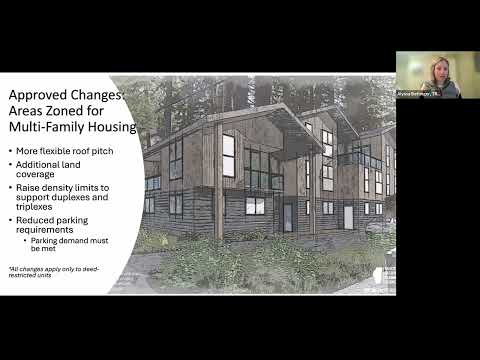
Key changes and limits. TRPA’s governing board approved two main sets of changes: (1) expanded building envelopes in town centers, including an additional story of height for deed‑restricted housing, higher allowable coverage if the project connects to a stormwater treatment system, higher density limits and reduced parking requirements; and (2) scaled changes in existing multifamily zones (for example, the Kings Beach grid and parts of Tahoe City and Homewood) allowing more flexible roof pitch, modestly higher coverage tied to stormwater connections, raised density limits and reduced parking. Bettinger said the coverage increase is conditional on tying into stormwater treatment and that "not many of these stormwater systems exist right now," which limits immediate use of that incentive.
Parking and parking studies. The package reduces default parking requirements for deed‑restricted units but requires developers to justify lower parking counts with a site‑specific parking analysis or rely on an anticipated basin‑wide parking study. Bettinger described a common local baseline today as about two spaces per unit and the new standard as permitting lower ratios where studies show demand is lower or where shared commercial parking is available.
Area plans, CEQA and growth caps. TRPA’s code changes do not become effective until each local jurisdiction amends its area plan. Emily Setzer said Placer County must serve as CEQA lead agency for the area plan amendment and perform environmental review before the county’s Planning Commission and Board of Supervisors would vote on adoption. She said the county expects to begin the environmental review in spring 2025 and "bring it back to our Planning Commission and Board of Supervisors by the end of 2025," subject to the level of analysis required. Bettinger and county staff reiterated that the Phase 2 changes do not increase basin‑wide growth caps or the total pool of residential bonus units; they instead aim to enable development that better matches the allowable density in existing zoned areas.
Local process and short timeline items. Placer County staff told the meeting they will seek a funding agreement with TRPA to cover environmental analysis costs at a Board hearing on April 1. Bettinger said TRPA’s governing board was scheduled to consider adopting the Tahoe Basin Area Plan amendments on March 26. County staff said jurisdictions could either adopt the TRPA changes as written, propose alternatives that provide equal or greater benefit, or face TRPA adopting the area plan for them if they do not act within TRPA’s required timeline.
How deed restrictions and affordability are enforced. County staff described deed restrictions and monitoring. Emily Setzer said Placer County’s deed restrictions for county programs last 55 years and are renewed at resale; Bettinger said TRPA’s deed restrictions are effectively perpetual. County staff said occupancy will be monitored annually to ensure occupants meet deed‑restriction requirements (income limits or local‑worker status). The officials noted a TRPA pool of residential bonus units is divided to reserve a portion for lower‑income affordable units, with remaining units for moderate/achievable or local‑worker categories.
Public comments and local projects. Multiple residents raised concerns about parking spillover, increased density, and short‑term rentals. Kristen, a resident, urged limits on short‑term rentals, citing "over 3,000 short term rentals in Eastern Placer County." Brad Altman, principal engineer at Evolve Design Works, described a local redevelopment in Lake Forest that could yield nine deed‑restricted workforce units and said the project could obtain TRPA approval but not a Placer County permit until the county amends its area plan. Altman said the redevelopment would reuse existing verified coverage and include nine parking spaces and an ADA unit.
Staff responses and next steps. County and TRPA staff repeatedly stressed that the Phase 2 changes are targeted to town centers and zoned multifamily areas, not single‑family neighborhoods; that the overall basin growth caps remain in place; and that where parking reductions are approved the developer must provide a parking study and ongoing local enforcement would apply. Staff also said they are assessing which existing stormwater systems might accept additional coverage and that a future Phase 3 of TRPA’s housing work will examine longer‑term systems and fee structures.
What remains unresolved. Participants asked for clearer local mapping of where the amendments would apply, for stronger short‑term rental policies, and for mechanisms to allow modest additional coverage where stormwater hookups are not feasible. Staff said those topics remain part of ongoing discussions (including a county Launchpad financial incentive program under development) and that public hearings remain scheduled at TRPA and later at Placer County, with public comment opportunities.
Ending note. County staff urged attendees to submit comments and attend upcoming hearings; staff listed March 26 (TRPA) and an April 1 county funding‑agreement item as early milestones and said Placer County expects to complete CEQA and bring area‑plan amendments to its Planning Commission and Board of Supervisors by the end of 2025.