Get Full Government Meeting Transcripts, Videos, & Alerts Forever!
Get email alerts on the Education Safety Information Sharing topic
No spam. Unsubscribe anytime.
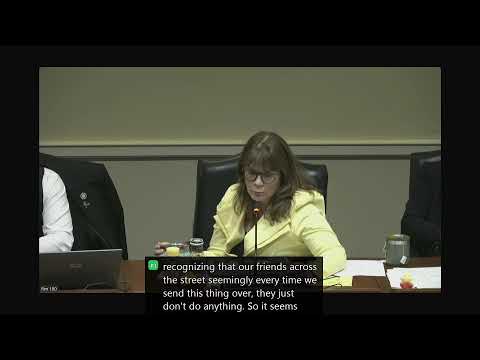
Judiciary committee hears Ways and Means counsel on HB 1265 changes to mandatory-offense list and school information sharing
Summary
The House Judiciary Committee questioned Ways and Means counsel about amendments to House Bill 1265 that narrow the statutory list of mandatory-offense crimes, add certain surveillance and mass-violence offenses, and require transfer of reportable-offense information between school systems and from the Department of Juvenile Services.
The House Judiciary Committee on the evening session reviewed amendments to House Bill 1265, with counsel from the Ways and Means Committee explaining that the bill, as amended, removes several drug-related mandatory-offense crimes, adds offenses tied to video surveillance with premeditated intent and threats of mass violence, and requires expanded information sharing between school systems and the Department of Juvenile Services (DJS).
Alastair, counsel to the Ways and Means Committee, said, “as amended the bill removes several of the current mandatory offense crimes from law. Some of those related to drugs such as possessing controlled dangerous substance like materials and things of that nature.” He added the bill “adds 2 things that were in a bill that was jointly assigned between the 2 committees to the list of mandatory offenses,” specifically video surveillance with premeditated intent and threats of mass violence, and codifies existing inter-county sharing practices in statute.
Under the amended language explained by Alastair, when a student with a reportable offense transfers from one school system to another the student’s reportable-offense information must transfer with the student. The bill also requires that when a youth is in the custody of the Department of Juvenile Services and either has been adjudicated/determined delinquent or the criminal matter remains pending, the Department must transfer the reportable-offense information and any educational or special-service information to the receiving school system.
Alastair also described changes to officers’ and prosecutors’ reporting duties: "when a reportable offense case is finished, when it's either dismissed by the state's attorney or there's been an adjudication of delinquency or, criminal finding...the state's attorney has to report that to either the principal or the superintendent of the school system. Under this bill as amended, he would have to report it or she would have to report it to the principal, the superintendent, and if the school has 1, a school security officer." The amended bill likewise requires arresting officers who make initial reports to follow the same reporting channels.
Committee members asked detailed statutory and operational questions. Delegate Eric Hand asked the counsel to identify specific code citations that were removed or retained; Alastair listed several criminal-code sections discussed by Ways and Means, including sections referenced in the transcript as 38A03 D4 and several criminal statutes related to controlled dangerous substances and false testimony (transcript citations mentioned numbers such as 5602, 602, 603, 604, 606, 617, 618 and criminal-law article sections 9302, 9303, 9305). When Delegate Taylor asked whether the bill’s references to a "confidential file" required a paper or electronic format, counsel said the statute uses the term but does not define it and that such records could be electronic; Delegate Pasteur said confidential files have been electronic in the past.
Ways and Means counsel also explained why the Ways and Means Committee did not adopt certain JSEP-proposed amendments: the committee concluded the State Department of Education (SDE) should be responsible for creating the broader information-sharing protocol rather than making Juvenile Services Education Program (JSEP) the lead, because not all youth in DJS custody are enrolled in JSEP and reportable-offense issues do not always involve DJS custody.
No final Judiciary Committee vote on HB 1265 was recorded during this session; members continued to ask technical questions and the committee planned to reconvene. Counsel told the committee the Ways and Means Committee had reported the bill in favor and that the Ways and Means vote was unanimous for the bill as amended.
The committee returned other administrative items and scheduled further consideration the next day.