Get Full Government Meeting Transcripts, Videos, & Alerts Forever!
Get email alerts on the Consumer Protection Wire Transfers topic
No spam. Unsubscribe anytime.
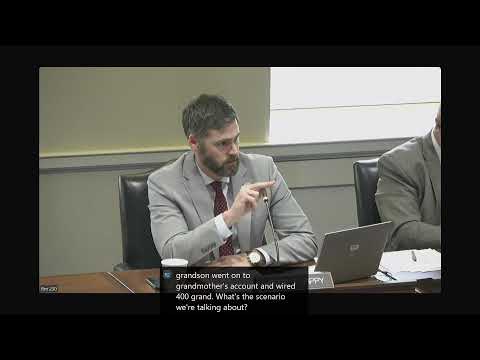
Committee debates domestic-wire protections to shield seniors from fraud; bill held for further work
Summary
The Economic Matters Committee extensively debated a bill to apply Electronic Funds Transfer Act-like protections to certain domestic bank-to-bank wire transfers, with members split over legal exposure to banks, competitive impacts on community banks and remedy mechanisms; the bill was held for further clarification.
House Bill 332 (as numbered in committee packet), a proposal to apply consumer protections comparable to the federal Electronic Funds Transfer Act (EFTA) to certain domestic wire transfers, drew extended debate in the Economic Matters Committee and was held for further work after members raised questions about scope, remedies and interstate litigation.
The bill’s amended language would subject consumer wire transfers that are ancillary to bank-to-bank transfers to protections similar to those in the EFTA. Sponsors said the intent is to give Maryland consumers — particularly seniors and other vulnerable people — the same protections now afforded for international wires and to address recent case law (including a Citibank matter referenced in committee discussion) that has shifted liability in some fraud cases.
Why it matters: Committee members framed the bill as an effort to protect residents from wire-transfer fraud that can wipe out life savings, while others warned the bill could place competitive burdens on state-chartered community banks, raise compliance costs and invite federal litigation over state-level regulation of banks.
Key discussion points
- Remedy and liability: Members pressed for clarity on who would be responsible for refunding defrauded customers, with proponents saying the intent is to place verification duties on the initiating bank and to provide mechanisms similar to the federal framework; opponents warned the bill might not create a practical route for recovery in all cases.
- Competitive impact: Several members expressed concern that a state-level requirement could impose greater costs on community and state-chartered banks compared with federally chartered banks, and asked whether other states have adopted similar measures (members suggested "zero" states had comparable statutes and cited New York case law as relevant precedent).
- Litigation and preemption risk: Members noted pending federal litigation and the potential for preemption challenges; sponsors said the bill includes a self-executing provision that would suspend applicability if a court enjoins or strikes down the law to prevent unequal treatment.
Outcome and next steps
Committee members agreed to hold the bill to obtain more detailed legal analysis of remedies, the interplay with federal law and any competitive impacts on local banks. The committee asked sponsors and staff to provide clearer drafting and to identify whether cross-file or related federal actions exist.
Ending: Committee postponed final action to allow attorneys and sponsors to provide clarifications on consumer remedies, bank obligations and the bill’s interaction with existing federal law and case law precedents.