Get Full Government Meeting Transcripts, Videos, & Alerts Forever!
Get email alerts on the Transmission Permitting topic
No spam. Unsubscribe anytime.
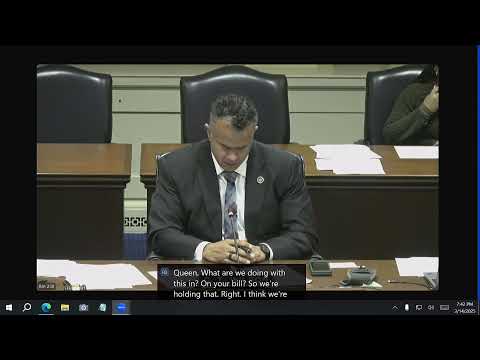
Committee advances transmission‑line permitting bill after debate over routes, local impacts and federal preemption
Summary
The Economic Matters Committee voted to move House Bill 829 as amended; members debated whether the bill requires meaningful consideration of alternative routes, impacts to historic and agricultural lands, and the limits of state authority where FERC and PJM have jurisdiction.
The Economic Matters Committee voted to move House Bill 829, as amended, after an extended debate over how the state should require applicants for certificates of public convenience and necessity (CPCN) to disclose alternatives, advanced technologies and potential impacts of proposed overhead transmission lines.
Supporters said the amended bill will force greater transparency in applicants’ planning by requiring evidence that alternatives were considered and by expanding items applicants must disclose, including advanced transmission technologies and whether technologies could delay or avoid future transmission or generation upgrades. “This forces transparency for the applicant to have to disclose the PJM process that led to the approval and all of the alternatives that were considered at PJM,” a committee member said during the hearing.
The debate centered on how prescriptive the statute should be and whether listing particular land‑use categories—historic resources, agricultural easements or planned growth areas—would be appropriate. “The goal of the transmission bill and the alternatives and the way that I have written it, is to consider alternatives in any number of, types of locations,” Delegate Duane Sarkodian, the bill sponsor, said. Sarkodian argued the bill was written with input from the Attorney General and the Public Service Commission (PSC) to avoid federal preemption by the Federal Energy Regulatory Commission (FERC).
Delegate Pippe proposed an amendment to require explicit consideration of impacts on historical, environmental and agricultural preservation areas and on proximity to planned growth and residential zones. “In Frederick County, the proposed NPRP project runs through 27 historical resources and Maryland Environmental Trust easement and several agricultural land preservation areas,” Pippe said, arguing the PSC and transmission owners should explicitly consider those impacts.
Sarkodian resisted adding a list of protected categories, saying doing so could be “dangerous” because it might pick winners and exclude other legitimate concerns such as environmental‑justice communities. He also said some language in Pippe’s amendment could raise questions about state jurisdiction where FERC has primacy. Legal staff and PSC representatives repeatedly emphasized the need to write the bill to preserve state authority where it exists while avoiding provisions that could be preempted in court.
As amended, the bill removes a requirement that an applicant provide a formal “analysis of alternatives,” and instead requires the application to include evidence that the applicant considered alternatives as part of its internal planning process, including local, state and federal planning processes and the PJM Interconnection planning processes. The amendment also changed a reporting cadence from every two years to every four years and authorized the PSC to modify the schedule.
Committee members raised practical questions about what qualifies as “evidence” and whether an applicant could satisfy the requirement by internal notes. Legal staff replied that the PSC would determine whether submitted materials met the statutory threshold and that the amended language is intended to require applicants to disclose the PJM planning process and the alternatives considered there.
The committee adopted a verbal amendment to add Delegate Pippe as a cosponsor, and members voted to move the bill as amended to the next stage of the legislative process.
Why it matters: The bill sets state‑level transparency requirements for transmission projects that proponents say are needed as the grid is expanded for new generation and large loads such as data centers. Opponents warned that overly prescriptive language or a list of protected site types could inadvertently undermine the PSC’s discretion or trigger preemption issues with FERC.
Next steps: The bill was moved as amended and will proceed from committee to the next floor or cross‑chamber stage as determined by committee leadership.