Get Full Government Meeting Transcripts, Videos, & Alerts Forever!
Get email alerts on the Planning Procedures Training topic
No spam. Unsubscribe anytime.
Deputy city attorney trains Stockton Planning Commission on Brown Act, conflicts and findings; staff reviews code basics
Summary
Deputy City Attorney Zoe Merle provided training on Brown Act rules, conflicts of interest, ex parte contacts and the difference between quasi-judicial and legislative actions; Planning staff summarized the general plan, zoning, Title 16 and permit review authority.
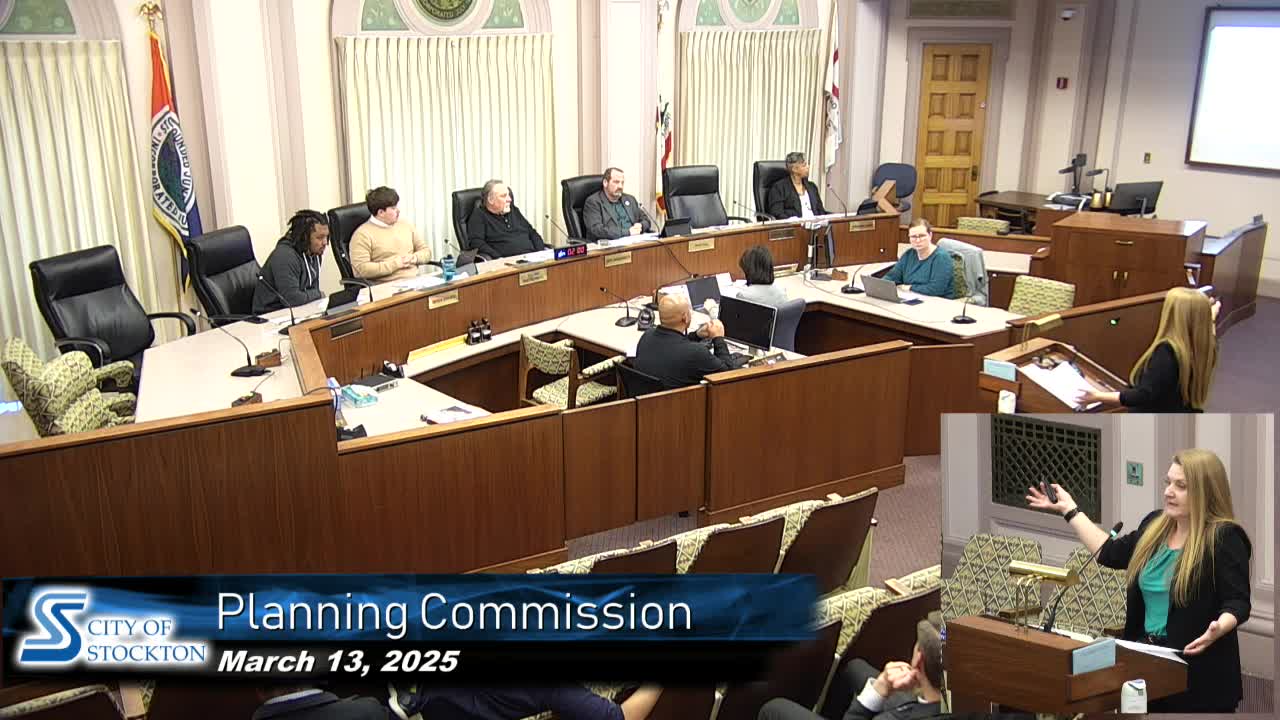
Deputy City Attorney Zoe Merle led a training session for the Planning Commission of the City of Stockton on March 13, 2025, covering key legal and procedural topics including the Brown Act, conflicts of interest, ex parte contacts, site-visit disclosure, social media and the distinction between quasi-judicial and legislative proceedings.
Why it matters: Commissioners make decisions that limit or regulate property rights; the training emphasized legal guardrails (due process, disclosures and required findings) that govern how the commission must conduct quasi-judicial hearings and how the publiccomment is handled.
Key points from the legal training
Zoe Merle told commissioners that "property rights are sacrosanct," and explained that local land-use regulation is a balancing act between private property rights and the public welfare. She summarized these practical rules:
- Brown Act meetings: Four or more commissioners deliberating on a matter within the body's jurisdiction constitute a meeting that must be noticed and open to the public; serial "hub-and-spoke" or daisy-chain contacts among commissioners can create an unpermitted meeting.
- Ex parte contacts and site visits: Commissioners must disclose conversations or site-visit observations that other commissioners do not have; if a site visit or private discussion prejudges an issue, the commissioner should recuse.
- Conflicts of interest: Financial interests or immediate-family interests that are reasonably foreseeable require recusal; staff and the city attorney are available to help commissioners evaluate situations.
- Quasi-judicial vs. legislative roles: When acting in a quasi-judicial role (e.g., conditional use permits, subdivisions), commissioners must make findings based on evidence received at the hearing and avoid basing decisions on outside information. Legislative actions (code changes, policy) have different standards, but still must not be arbitrary or capricious.
- Public comment and decorum: The chair may set reasonable time limits and remove disruptive attendees after warnings; speaker cards are useful but not required, and anonymity is allowed.
- Electronic communication and records: Commissioners were warned against using personal email or social-media accounts for commission business without understanding CPRA (public records) implications; reply-all email threads and inter-commissioner social-media interactions about commission matters can trigger Brown Act issues.
Deputy city attorney Merle urged commissioners to consult the city attorneyoffice when uncertain about recusal or disclosure.
Staff presentations on policy and implementation
Planning Manager Scott Spirit and Senior Planner Arturo Carrasco briefed the commission on the relationship among the general plan, zoning and the development code (Title 16 of the Stockton Municipal Code), and on how applications are reviewed and routed through ministerial and discretionary pathways.
- General plan and zoning: Scott noted the city's General Plan (adopted 2018) is the overarching policy; zoning districts and Title 16 implement the plan by assigning permitted uses and development standards.
- Land use table and permits: Staff explained the land-use table letters (for example, P = permitted/ministerial; L = land development permit; A = administrative use permit; C = commission use permit) and said the table indicates where a use is allowed and what level of review is required.
- Ministerial vs. discretionary: Ministerial approvals follow objective checklists (building permits, some site plans) and do not require findings; discretionary permits (use permits, subdivisions) require findings supported by evidence and often include conditions of approval.
- Review authority and appeals: Director-level decisions can be appealed to the Planning Commission; Commission decisions can be appealed to City Council. Some director-level matters may be elevated to the commission when appropriate.
- Code modernization context: Staff said the proposed development code update was initiated in 2021, that the last comprehensive overhaul was in February 2008, and that the draft is substantial (staff described it as about "two and a half inches" of material). They said the housing portion must be before City Council by June to satisfy grant-related timelines; the full package will proceed through public hearings and ordinance amendment steps.
Commissioner questions and staff responses
Commissioners asked practical questions about conflicted ownership, use of city-issued email and devices, the consequences of changing state law after an application is submitted, and the difference between advisory recommendations and final decisions taken by City Council. Staff and the city attorney clarified that applications deemed complete before a law change are generally processed under the law in effect at the time of completeness, and that staff will flag potential conflicts or nearby ownership issues in staff reports so commissioners can consult counsel.
What to expect next
Merle, Spirit and Carrasco encouraged commissioners to contact the city attorney or staff with questions about conflicts, disclosure, site visits or Brown Act concerns. Staff said they will present the development code revisions through the ad hoc review process and then to the full commission and City Council for the ordinance amendment process.