Get Full Government Meeting Transcripts, Videos, & Alerts Forever!
Get email alerts on the Education Charter Schools topic
No spam. Unsubscribe anytime.
Steering and Rules Committee places 2023–24 charter school review on file after presentation on academics, facilities and lead testing
Summary
The Milwaukee Steering and Rules Committee received the Charter School Review Committee's 2023'24 annual reports on March 14, 2025, heard academic and facilities data from charter school leaders and staff, discussed annual lead and water testing and facility maintenance, and placed the reports on file by unanimous consent.
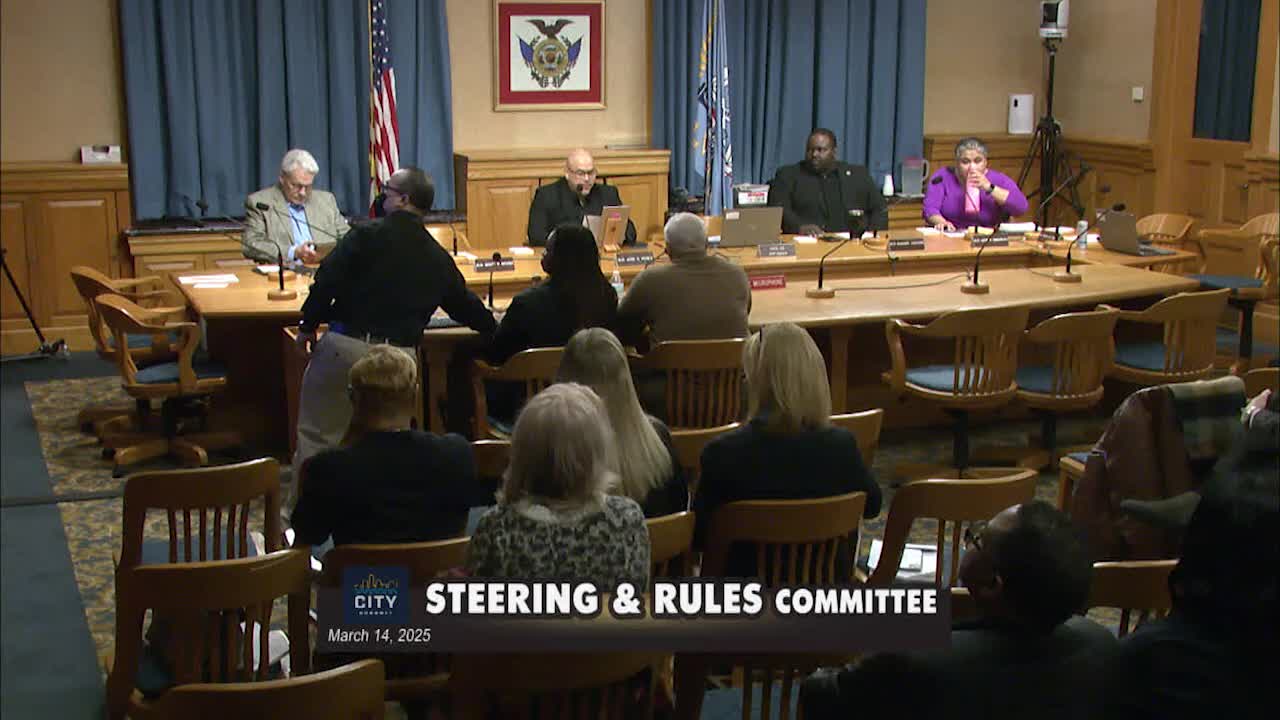
The Steering and Rules Committee on March 14, 2025 heard the Charter School Review Committee's annual report for the 2023'24 school year and voted to place file 241014 on file after a presentation of academic performance, school climate survey results and facility-maintenance practices.
The report, presented by Kevin Ingram, chair of the Charter School Review Committee, and Doctor Baylor, the committee's research and charter school monitor, summarized Forward Exam and growth data, pre-ACT and ACT results, four-year cohort graduation rates, and a school scorecard the committee uses to measure performance. Committee staff and school leaders also answered questions about annual lead and water testing and other maintenance activities.
The committee's scorecard requires schools to score 60 or higher to remain in good standing; all seven monitored city charter schools met that threshold in 2023'24, the presenters said. The presentation reported that charter schools generally outperformed nearby Milwaukee Public Schools (MPS) comparators in the same ZIP codes on Forward Exam math and English Language Arts measures, and that growth measures from fall to spring showed student progress. The presenters reported a range of growth on some measures and that pre-ACT fall-to-spring growth figures ranged from about 34% to 67.6% across schools. The presenters also said charter high-school graduation rates were higher than those of neighborhood schools in their ZIP codes and higher than the statewide rate for socioeconomically disadvantaged students, with one exception: Central City Cyber School's cohort data were affected by a high-school expansion year tied to COVID-era enrollment changes. Presenters reported that graduating seniors from the charter high schools accumulated more than $5,000,000 in scholarships.
Committee members asked for more detailed breakdowns (for example, reading-specific results and counts of students with Individualized Education Programs) in future presentations to help compare school populations and outcomes. Alderman Scott Speicher asked whether differences could reflect student population mix rather than instructional differences; presenters said the ZIP-code comparator schools were chosen because they serve similarly low-income populations, but agreed to consider adding additional demographic and IEP breakdowns next year.
School climate surveys reported strong community and staff sentiment overall; recurring concerns cited in the presentation included facility maintenance, student behavior, school lunch quality and transportation. Presenters and school leaders described steps taken for 2024'25: HVAC and other facility upgrades at some schools, entryway and reception-area improvements, new or improved lunch vendors (including one high school that has implemented a culinary program that supports school lunches), expanded social-emotional-learning programming and targeted communication protocols for parents. Leaders said the survey results were used to guide summer planning, staffing and professional development.
Committee members pressed school leaders and staff about lead and water testing and other facility maintenance. Gail Peek, the charter program policy analyst, said the city health department conducts annual lead and water testing at the charter schools, a practice that staff said was established following a council request and subsequent policy change several years ago. School leaders described annual summer maintenance routines, renovation-related abatement or encapsulation when buildings are renovated, and routine asbestos inspections. Multiple school leaders said they would share maintenance logs with families; the Milwaukee Academy of Science CEO said his school would publish its maintenance checklist if requested.
Committee members asked the charter school review committee to follow up with the health department for clarity on what inspections and testing have been done and to consider making maintenance logs part of the annual monitoring process. The committee's staff said they will follow up and collect uniform responses from each school on protocols and inspection timing.
Alderman Deandre Jackson used his time to announce April 3 as an apprenticeship day at City Hall for students interested in trades, and invited charter-school participation.
Alderman Jose Perez, chair of the Steering and Rules Committee, said Alderman Scott Speicher moved to place file 241014 (the Charter School Review Committee's 2023'24 reports and recommendations) on file. There were no objections and the motion carried by unanimous consent. The committee adjourned after the vote.
The charter schools identified in the presentation and monitored in the 2023'24 review were Milwaukee Math and Science Academy, Durham and Hines Academy, Escuela Verde, Downtown Montessori, Central City Charter School (including Central City Cyber), Milwaukee Academy of Science and Howard Fuller Collegiate Academy. Individual school scorecard breakdowns and appendices were referenced in the packet and are available in the report appendices, the presenters said.