Get Full Government Meeting Transcripts, Videos, & Alerts Forever!
Get email alerts on the Enforcement Process topic
No spam. Unsubscribe anytime.
Ethics Commission plans SARP revisions and outlines probable cause/hearing process
Summary
Director of Enforcement Bessie Matthews and enforcement staff briefed commissioners on quarterly enforcement caseload, a planned revision of the Streamlined Administrative Resolution Program (SARP), and the commission—s probable cause and administrative hearing procedures, including timelines for responses and rulings.
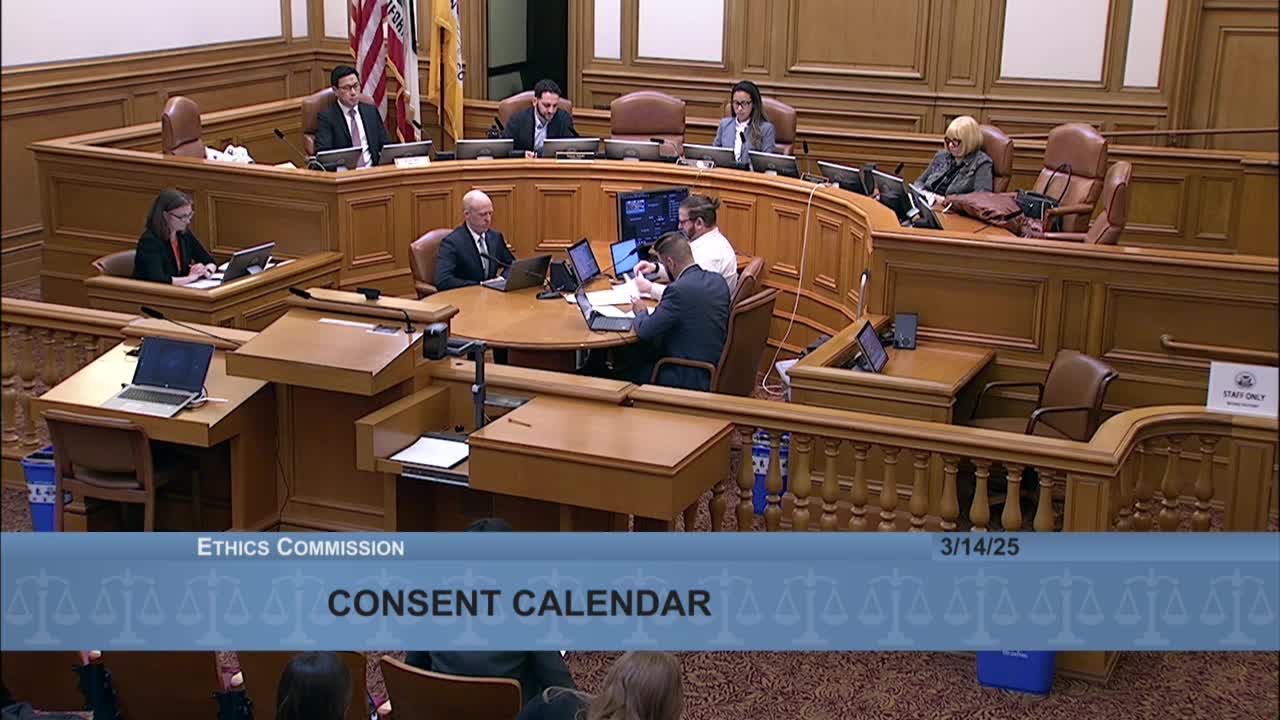
On March 14, 2025 the San Francisco Ethics Commission received a quarterly enforcement report from Director of Enforcement Bessie Matthews and staff, who described ongoing work to revise the Streamlined Administrative Resolution Program (SARP) and provided a detailed overview of the probable cause and administrative hearing process.
Matthews said the enforcement division has two major projects this fiscal year: revising enforcement regulations and refining SARP, the program adopted in February 2021 that allows streamlined resolutions for a subset of violations. "This informational session is really timely," Matthews said, noting the division has an active caseload and recent probable cause determinations.
Senior Investigator Eric Willett, who administers SARP, told commissioners the program currently covers 41 provisions and focuses on violations that generally require little additional investigation to resolve. Willett said staff have already consulted with other jurisdictions, plan two interested‑persons meetings in April, and expect to present proposed amendments to commissioners for review in June with a possible July adoption. "We plan to conduct 2 interested persons meetings in the month of April, followed by commissioner engagement, with a review of the proposed amendments," he said.
Senior legal and investigative analyst Bertha Chang provided a step‑by‑step overview of the probable cause (PC) and hearing process and the timelines that govern each phase. Among the details she highlighted: - A probable cause report is issued by the director of enforcement; respondents may file a written response within 21 calendar days and any rebuttal within 14 days. - A confidential PC conference may be requested within 21 days of the PC report; the executive director must issue a written probable cause determination within 60 calendar days of that conference. - Once a PC determination is issued, any commissioner may request review within 5 calendar days; if review is requested the matter must be ratified by at least three commissioners at a regularly scheduled meeting and the review is conducted in closed session. - For hearings on the merits, the executive director must deliver hearing notice and a hearing brief at least 30 calendar days before the hearing; respondents may file a brief 15 days before the hearing and any replies are due 7 days prior. - The commission must make written findings no later than 45 calendar days after the hearing concludes; findings require at least three commissioners and must be based exclusively on the hearing record.
Commissioners asked procedural questions about closed sessions for prehearing matters, discovery mechanisms, and the process for preparing findings while complying with the Brown Act. Staff said prehearing matters are typically handled in closed session (or by an assigned commissioner or hearing officer when delegated) and that discovery and subpoenas are available in the administrative process. Matthews and staff agreed to bring procedural recommendations to improve the mechanics of preparing findings and rulings in future cases.
Matthews and Willett said the SARP review is collaborative and will include public input; Willett said staff will present draft amendments to the commission in June and seek adoption as early as July. Chang—s presentation served as an informational primer so commissioners understand timelines, parties' rights, and the commission—s role as the ultimate decision maker in administrative hearings.
No enforcement decisions were made at the March 14 meeting; staff offered to return with proposed regulatory revisions and procedural recommendations for handling prehearing matters, assigned‑commissioner determinations, and the drafting process for written findings.