Get Full Government Meeting Transcripts, Videos, & Alerts Forever!
Get email alerts on the Revenue Sources topic
No spam. Unsubscribe anytime.
Oro Valley participants weigh revenue options: bonds, grants, annexation, sales tax and property tax concerns
Summary
Town staff and residents discussed using bonds, franchise fees, grants, annexation and sales-tax growth, while some participants urged removing or downplaying property-tax language from the plan unless preceded by broad public input.
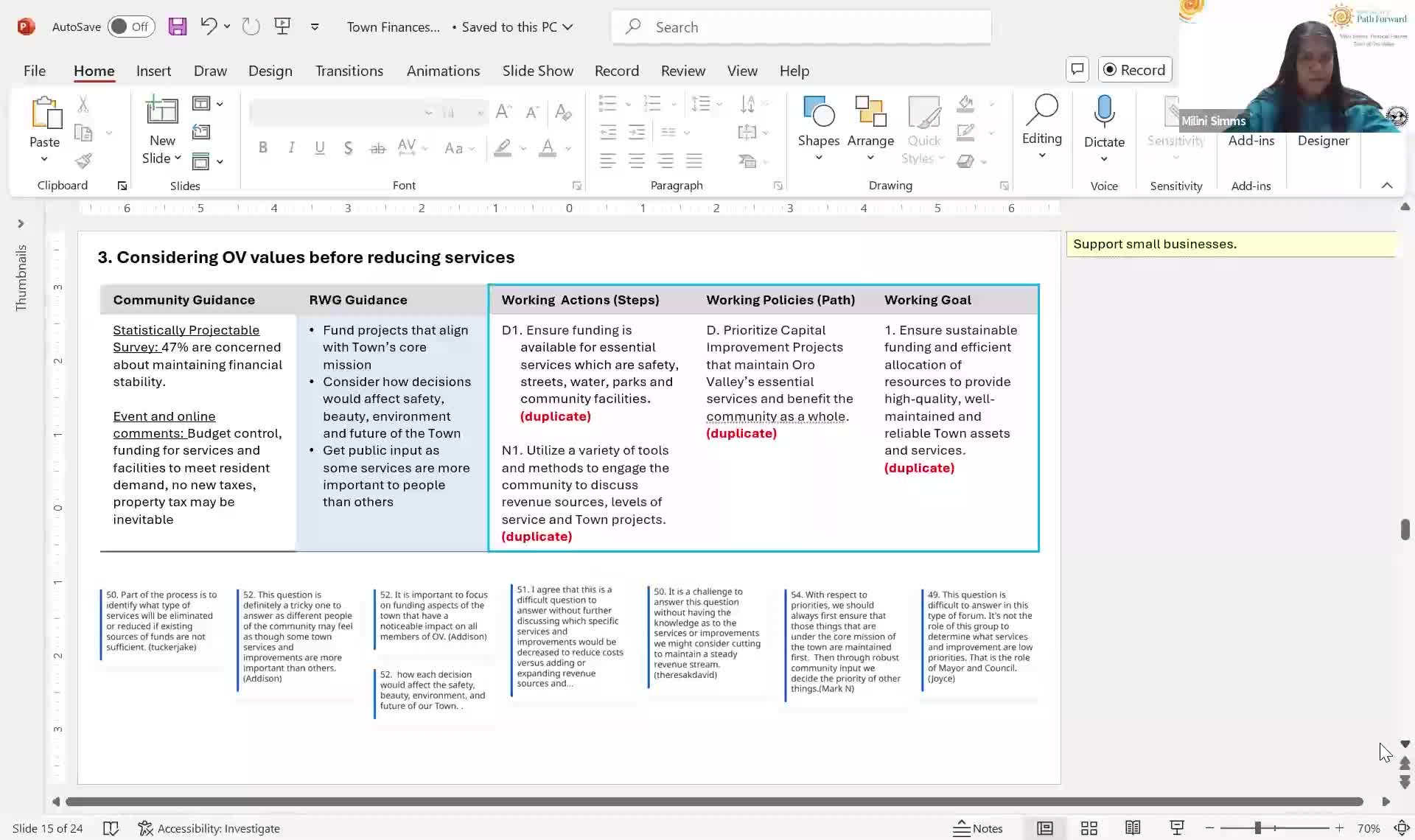
During a Feb. 25 working session to refine a draft 10-year plan, Oro Valley staff and participants discussed a range of revenue options including bond issuance, franchise or utility fees, state-shared revenue, grants, annexation, sales tax growth through tourism and business attraction, and property tax as a last resort.
Staff framed bonds as a capital-financing tool, not a revenue stream. "Bonds are really kind of a source of capital," one participant cautioned, noting they must be repaid and carry a cost. Participants agreed any use of bonds should include robust repayment planning and should be targeted to qualifying CIP projects.
Grants and partnerships were widely supported as a way to reduce local costs. Several participants recommended investing in regular grant-writing capacity to increase grant success. "Maybe the town needs to invest in a grant writer or more resources to pursue grants on a regular basis," a participant said, noting recent grant application results described in the town manager's reports.
Property taxes drew clear disagreement. Some participants said mentioning property tax in the plan would be politically charged and could undermine public acceptance of the document. "If you have the word property tax in the document, this will be a problem," one participant said. Others argued the plan should not preclude any legal revenue option but must require strong community input before council acts.
Annexation and sales-tax growth were discussed as potential revenue strategies. Several participants urged pursuing annexation opportunities and business attraction to grow the sales-tax base; participants noted that a portion of sales tax is paid by nonresidents and visitors and that annexation can expand the town's retail footprint. Staff cautioned the plan should retain flexibility and avoid committing to a specific property or parcel in the document.
Regional funding partnerships, including the Regional Transportation Authority, were discussed as critical for major street projects. Several participants suggested the plan refer broadly to intergovernmental cooperation rather than specifying a single agency.
Staff said the draft would be revised to broaden revenue-source language, remove unnecessary specificity, and add procedures for public engagement before significant revenue changes are pursued.