Get Full Government Meeting Transcripts, Videos, & Alerts Forever!
Get email alerts on the Campaign Finance topic
No spam. Unsubscribe anytime.
Ethics Commission report: public financing paid out $8.8 million in 2024; staff flags individual expenditure ceiling for revision
Summary
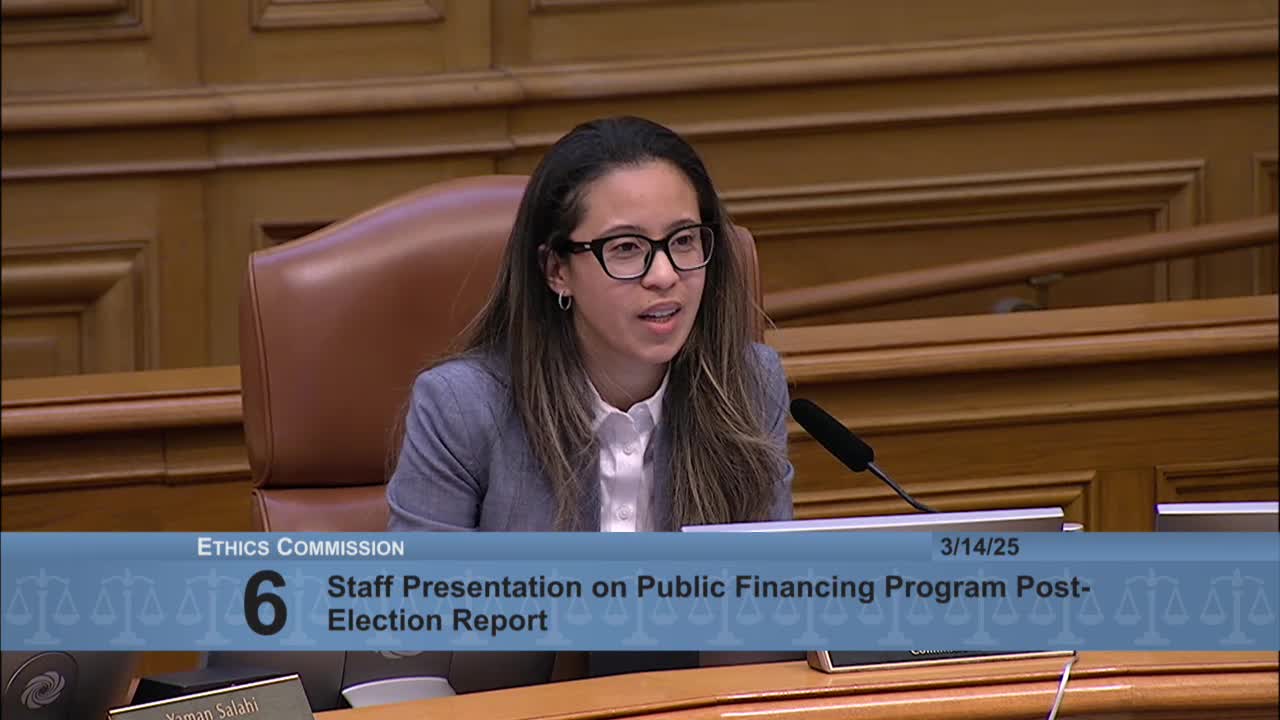
Audit manager Eamon Wilson told the San Francisco Ethics Commission on March 14 that 2024 was a record year for candidate spending and for public financing, with roughly $8.8 million in public matches disbursed and staff recommending legislative changes to the individual expenditure ceiling (IEC) mechanism.
On March 14, 2025, the San Francisco Ethics Commission received a post‑election report on the city—s public financing program showing record public funding and higher-than-ever third‑party spending.
The report, delivered by Audit Manager Eamon Wilson, found that the commission dispersed roughly $8.8 million in public matching funds for the 2024 mayoral and supervisorial elections and that total candidate spending approached $27 million. Wilson said staff will ask the commission to consider possible legislative changes to the individual expenditure ceiling (IEC) formula because it imposes heavy administrative burdens while rarely constraining candidate spending.
Wilson said the program—s reported numbers were pulled from the commission—s disclosure dashboards and candidate filings. "All the data in the report and in this presentation was pulled from the data dashboards that the commission makes available on its website," he said. He told commissioners the 2019 amendments that raised the match ratio to 6:1 and increased contribution caps helped drive a larger share of candidate spending coming from public funds.
Why it matters: public financing now represents a substantial share of candidate spending in supervisorial contests, and the administration of the program consumed large portions of the audits division—s time. Wilson said the work required to qualify contributions and process matching requests is time‑intensive and often manual, and that staff want to streamline elements of the program.
Key figures and findings from the presentation: - Public matches disbursed in 2024: about $8,800,000 (split roughly evenly between mayoral and supervisorial candidates, Wilson said). - Total candidate spending in 2024: nearly $27,000,000. - Third‑party independent expenditures in 2024: about $19,000,000, producing a combined total election spending of about $45,000,000. Wilson described both totals as records for the city. - Publicly financed candidates approved in 2024: 27 qualifying approvals; 96 matching requests processed; staff reviewed roughly 13,000 individual contributions for eligibility. - IEC administrative activity in 2024: staff calculated about 295 IEC adjustments on 65 distinct days of analysis, but only 12 of those adjustments affected a candidate—s ability to spend (i.e., funds were actually blocked because the candidate exceeded the IEC). - Typical initial IEC amounts cited by staff: $350,000 for supervisorial candidates and $1,700,000 for mayoral candidates; IEC increases are made in $50,000 increments for supervisors and $250,000 increments for mayoral races per current code provisions.
Wilson described the mechanics: qualifying requests require verification that contributions came from San Francisco residents, did not exceed limits, and were properly documented — a process he said remains largely manual. He illustrated how the IEC is recalculated as new opposition or independent spending is reported, and how frequent recalculations consumed staff time while rarely constraining spending in practice.
Commissioner questions focused on origins and intent of the IEC and whether the policy originally sought to prevent a publicly financed candidate from outspending opponents. Wilson said the policy team will study historical justifications and community impacts and return with proposed changes. "I think what actually we do have a, if we can go back to the chart, thank you...I think the idea is that if a candidate has received public funds, this is intended to offset spending, and not just to be an additional boost to spending and contributions they're making anyway," he said.
Chair Flores Fang and other commissioners asked staff to bring forward policy options in the coming months; Wilson said the policy team would prepare a proposal and that it might take additional study. The presentation closed with staff noting the workload implications: the audits division currently spends much of its time on public financing administration and hopes code changes and automation could free capacity for audits and other work.
Public comment on the item included a call from David Pilpel of the Sunshine Ordinance Task Force, who described the staff report as "very helpful" and urged the commission to consider procedural questions raised elsewhere on the agenda.
Next steps: staff said they will explore legislative revisions to the IEC and other program elements and plan to present possible amendments through the commission—s policy process in the coming months. The commission did not take formal action on the report at the March 14 meeting.