Get Full Government Meeting Transcripts, Videos, & Alerts Forever!
Get email alerts on the Infrastructure Prioritization topic
No spam. Unsubscribe anytime.
Oro Valley participants press for clearer infrastructure priorities and geographic equity in parks funding
Summary
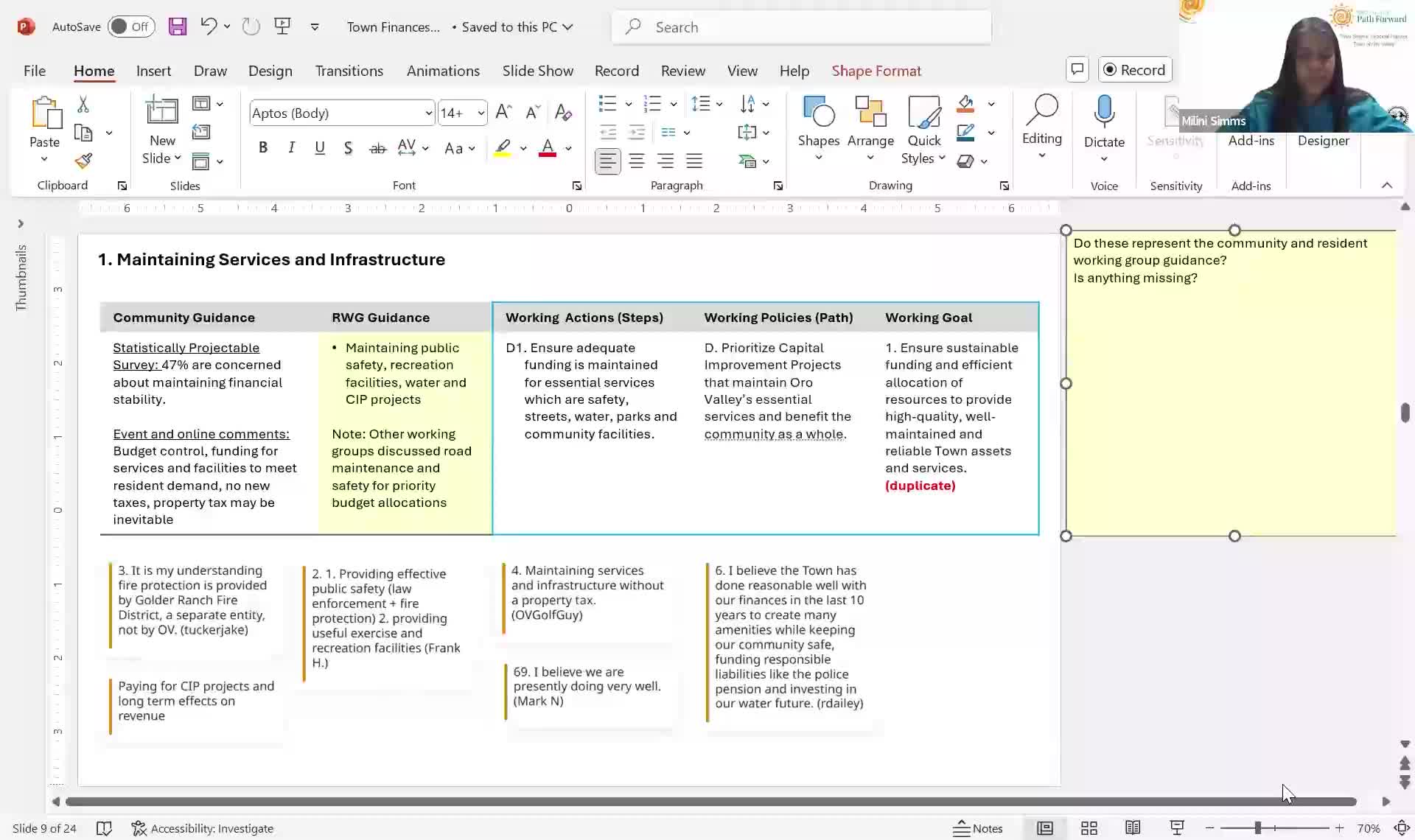
Residents and staff discussed prioritizing essential services such as safety, streets and water, and urged the town to add geographic-equity and level-of-service considerations when allocating park and recreation funding.
At a Feb. 25 meeting on the town's draft 10-year plan, Oro Valley participants emphasized maintaining core services and asked staff to add clearer prioritization criteria for capital projects, as well as geographic-equity and level-of-service considerations for parks and recreation.
Facilitator Molini Sims and participants noted that the community repeatedly ranked road preservation highly in prior surveys. Several residents and commission members said essential services should take precedence in decisions about limited town resources; repeated examples of essential services included police, water, and road maintenance.
Rosa, a resident who described attending many council meetings, urged geographic equity for parks and recreation spending, saying some neighborhoods have little investment while others receive concentrated spending. "You can't spend all your parks and recs dollars within 2 miles of the town offices," she said, urging a level-of-service standard and a distributed investment approach. Richard, another participant, asked for clearer long-term parameters to classify projects as "essential" versus "nice to have," including the future maintenance burden of new facilities.
Participants also discussed regional funding partnerships. One speaker urged the group to consider support for the Regional Transportation Authority funding mechanisms for major street work but others suggested the plan use broader language about intergovernmental partnerships rather than naming a single regional agency.
Staff said actions in the draft would be updated to clarify which types of infrastructure are considered essential, to add parameters for project prioritization (including safety impact, benefit to the majority of residents, geographic equity, and long-term financial sustainability) and to incorporate coordination opportunities with private utilities and developers for economies of scale.
The town will continue to refine these draft actions as the plan proceeds.